
Kocher Clamp: Identification, Uses and Variants
The common pattern has a ring-handled locking form with serrated jaws and terminal teeth; exact specifications require model-level verification.
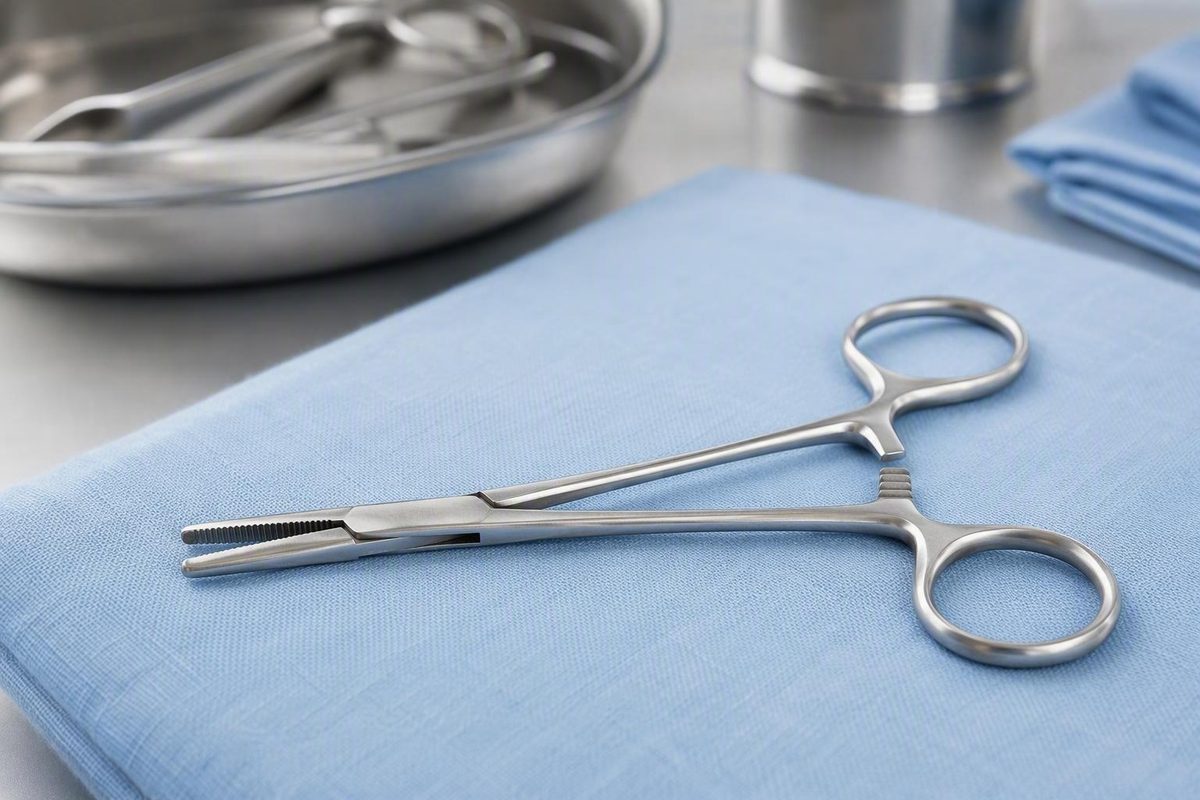
What is a Kocher clamp?
A Kocher clamp is commonly described as a ring-handled, locking clamp designed to maintain a firm grasp. In conventional listings reviewed for this guide, the recurring pattern includes finger rings, a ratchet lock, serrated jaws, and interlocking teeth at the distal tip. Those physical details are more useful for identification than a package label, marketplace title, or family photograph.
“Kocher forceps,” “Ochsner clamp,” and “Ochsner-Kocher clamp” are commonly used as overlapping names. Meister Surgical, for example, calls Kocher clamps Ochsner clamps and describes the pattern as having serrated jaws, a toothed tip, a ratchet, and straight or curved configurations. This naming overlap does not prove that every instrument carrying one of these names has identical dimensions, serrations, teeth, or intended use. See Meister Surgical’s description of the Kocher or Ochsner pattern.
Terminology at a glance
- Kocher clamp: A common name for the locking, serrated, toothed instrument pattern.
- Kocher forceps: Usually refers to the same general pattern; commercial and educational material often interchanges “clamp” and “forceps.”
- Ochsner clamp or Ochsner-Kocher clamp: Common overlapping names for the Kocher-style family.
- Rochester-Kocher, mosquito Kocher, and intestinal Kocher: Commercial labels that may indicate a related size or specialized configuration. The reviewed evidence does not establish them as standardized synonyms for one exact design.
The distinction between a general pattern and an exact catalog model is essential. One supplier may offer straight and curved Kocher forceps with 1×2 teeth, while another may use the Kocher name for a long intestinal instrument whose page documents longitudinal serrations but not terminal teeth or a ratchet. No individual listing supplies universal specifications for the entire category.
A provisional Kocher-style identification should therefore rest on several agreeing details:
- Ring-handled, hinged construction
- A locking ratchet near the rings
- Serrations on the gripping faces
- Terminal teeth that interlock when the jaws close
- A straight or curved profile consistent with the relevant catalog model
- Dimensions and markings that match model-specific documentation
Terminal teeth are a strong recurring cue in conventional Kocher listings, but they are not proven to be universal across every product sold under the name. When a listing omits the tooth pattern, lock, jaw length, processing status, or regulatory classification, the correct conclusion is unresolved pending model-level verification. An omitted specification does not prove that a physical feature is absent, but it does not justify assuming that the feature is present.
This article is limited to educational identification and pre-procurement verification. Medical Forceps describes itself as an instrument-room reference, states that it does not sell instruments or accept manufacturer-paid placement, and says its material does not replace professional training. Read more about Medical Forceps. Its terms also identify the content as informational rather than medical advice or a substitute for clinical training. Review the educational-use notice.
The available evidence is dominated by manufacturer pages, seller listings, commercial articles, a marketplace search, and a user-generated study guide. It is adequate for comparing seller-listed features and illustrating naming variability, but it is not a substitute for authoritative clinical guidance, regulatory documentation, model-specific instructions for use, or a facility’s validated procedures.
Anatomy and identifying features
A Kocher-style clamp shares the broad architecture of many ring-handled hemostatic forceps. Identification therefore requires inspection of both ends of the instrument: the handles and lock establish the general construction, while the jaw faces and distal tip provide the more discriminating cues.
Finger rings
The two finger rings form the proximal handles. Their presence places the instrument within a broad ring-handled family, but rings alone do not identify a Kocher pattern.
Inspect the rings and adjacent shanks for:
- Manufacturer engravings
- Catalog or article numbers
- Model names
- Ownership or facility marks
- Market or regulatory markings
- Marks that appear incomplete, altered, or inconsistent with the accompanying documentation
A legible catalog number is generally more useful than an informal tray label because it can be compared with model-specific documentation. Even then, markings should be considered together with the instrument’s dimensions, curvature, jaw layout, and tip.
Ratchet
As the handles close, the ratchet can hold them at an engagement point. Mechanically, this allows the jaws to remain closed without continuous hand pressure.
The presence of a ratchet confirms a locking form, but it does not identify a Kocher clamp by itself. It also does not determine an appropriate closing force, engagement position, or application duration. Those are clinical and model-specific matters outside the scope of visual identification.
Shanks
The shanks extend from the rings and ratchet toward the hinge. Their length, thickness, and proportions influence the instrument’s silhouette, but they are not independently diagnostic.
Long-shank products may be sold under intestinal or other specialized labels. Short products may be advertised as mosquito or compact Kocher patterns. Because those terms are not shown here to represent a standardized taxonomy, record the actual overall and working lengths rather than inferring identity or purpose from a short or long silhouette.
Box lock
A box lock is common across many hemostatic forceps, so it confirms the general hinged-clamp construction rather than the Kocher pattern. For non-procedural identification, note whether the hinge configuration and movement appear consistent with the documented model. Any condition assessment must remain subject to the exact manufacturer instructions and facility policy.
Jaws
The jaws extend from the box lock to the distal tip. Relevant observations include:
- Straight or curved profile
- Jaw length
- Jaw width and taper
- Serration direction
- Whether serrations cover all or part of the jaw
- Presence and arrangement of terminal teeth
- Whether the two sides appear geometrically matched
Length and curvature can help reconcile a physical instrument with a catalog entry.
Serrations
Serrations are grooves or ridges on the inner jaw faces. Depending on the seller and model, they may be described as transverse, horizontal, longitudinal, full-length, or simply “serrated.”
Serrations and terminal teeth are separate features:
- Terminal teeth engage at the distal tip.
A listing may document one feature without documenting the other. A longitudinally serrated instrument, for example, cannot be identified conclusively as a Kocher or Carmalt pattern from that detail alone.
Distal teeth
Terminal interlocking teeth are the strongest recurring Kocher cue in the conventional listings and educational descriptions reviewed here. Other descriptions refer more generally to a single tooth and opposing groove or to interlocking toothed tips.
The reviewed evidence does not establish one universal tooth arrangement. If the listing does not document the teeth—or if wear, damage, or a poor photograph prevents inspection—do not make a confident assignment from the product name alone.
Record the observable arrangement precisely. “One tooth opposing two” is more useful for verification than “toothed,” particularly when comparing closely related catalog entries.
A practical visual identification sequence
Use a close, feature-by-feature check:
- Confirm the general form. Look for two finger rings, a hinged box lock, and a ratchet.
- Record the profile. Determine whether the working end is straight or curved.
- Trace the serrations. Note their direction, extent, and distribution across both jaw faces.
- Inspect the distal tip. Look for interlocking teeth and record the visible arrangement.
- Measure the instrument. Record overall length and, where relevant, jaw or working-part length.
- Read the markings. Capture the manufacturer, catalog number, model number, and any market or regulatory information.
- Compare the combined findings with the exact catalog entry. Resolve discrepancies before assigning a final identity or procurement status.
Do not identify a Kocher clamp from a distant silhouette or product-family image alone. A photograph may show a representative member of a family rather than the exact catalog item. The selected item’s written specifications, markings, and current documentation should control.
When the identity remains uncertain, describe the instrument before naming it. For example:
Ring-handled locking clamp; curved profile; transversely serrated jaws; apparent 1×2 terminal teeth; approximately ___ cm overall; markings read ___.
That neutral record can then be reconciled with a manufacturer catalog or other approved documentation without forcing a premature pattern assignment.
Why the grip is strong—and why the pattern is not atraumatic
The Kocher pattern’s firm purchase and its trauma implications arise from the same physical features. Serrations increase contact along the jaw faces, while terminal teeth engage at the tip. Mechanically, those features can resist movement at the contact surfaces.
A conventional toothed Kocher pattern should therefore not be characterized as atraumatic. One manufacturer article explicitly distinguishes toothed clamps from patterns intended to limit tissue damage and describes the Kocher as a heavy-duty clamp whose interlocking teeth can heavily compress or crush tissue. That article is commercial rather than an independent clinical guideline, but its trauma warning is consistent with the mechanical implications of toothed jaws. Review the discussion of toothed clamps and tissue compression.
Promotional statements that a Kocher design inherently minimizes trauma, improves outcomes, or provides superior safety are not established by independent comparative evidence in the supplied material. Likewise, seller descriptions of reduced slippage, superior grip, precision, or ergonomic performance should be treated as marketing claims unless supported by appropriate comparative testing.
Commercial and educational sources commonly describe the pattern as firm, aggressive, or heavy-duty. That wording should be understood as a characterization of the gripping design—not as a recommendation to apply the instrument to a particular structure.
| Design element | Mechanical implication | Identification or selection implication |
|---|---|---|
| Jaw serrations | Increase contact along the jaw faces | Verify their direction, extent, and condition |
| Terminal teeth | Engage at the distal tip | Strong recurring Kocher cue; verify the exact arrangement |
| Ratchet | Maintains closure after the handles are released | Confirms a locking form but does not establish suitable force |
| Firm closure | Can resist movement at the contact surfaces | Also creates compression, crushing, and puncture concerns |
| Straight or curved jaws | Changes geometry and alignment | Does not independently determine suitability |
Dense, heavy, resistant, or fibrous tissue is the broad context repeatedly associated with Kocher clamps in vendor material. Meister Surgical specifically reports fascia, uterine tissue, tendons, and other fibrous tissue as applications. These are source-reported examples, not clinical instructions or independently established indications. See the vendor-reported tissue examples.
Clinical boundary
This reference does not determine which tissue may be clamped, how much force to apply, which ratchet position to use, or how long an instrument may remain applied. Those decisions require professional training and judgment, the procedure’s requirements, the exact model’s manufacturer documentation, and applicable institutional guidance.
A toothed clamp also cannot be accepted or rejected solely through a general web comparison. Tissue characteristics, jaw design, instrument condition, closing force, application circumstances, and model-specific instructions all matter. Selection between a Kocher-style instrument and a less-traumatic pattern must remain a trained clinical decision.
Reported uses and the limits of the evidence
Commercial sources generally associate Kocher-style clamps with two broad functions:
- Hemostatic clamping, including seller claims about clamping vessels or helping control bleeding.
- Firm grasping or manipulation, particularly involving resistant, dense, heavy, or fibrous tissue.
These descriptions explain how the pattern is marketed and taught. They do not establish safe anatomical limits, procedure-specific indications, contraindications, acceptable closing pressure, or application duration.
Source-specific examples include:
- Meister Surgical reports fascia, uterine tissue, tendons, and other fibrous tissue.
- gSource reports hemostatic use and grasping tissue, including thick skin or muscle in its explanatory material.
- Other commercial descriptions refer more generally to dense or fibrous tissue.
These are vendor-reported applications rather than clinical recommendations. The supplied sources do not establish that every Kocher-labeled model is suitable for every named tissue.
Several sellers also associate Kocher forceps with blood-vessel clamping or bleeding control. Those claims must not be extended into a conclusion that any Kocher clamp is safe or recommended for major vessels. The reviewed material does not establish vessel-size limits, contraindications, acceptable pressure, duration, or other clinical boundaries.
A separate commercial article mentions grasping bone. Because the supplied evidence does not authoritatively support that claim, it is not accepted here as an established application.
Catalog categories are also poor substitutes for an intended-use statement. Kocher-labeled products appear in general-instrument, orthopedic, ENT, podiatry, veterinary, laboratory, and intestinal groupings. Those placements may reflect market organization, sales targeting, or a specialized configuration. They do not establish a common clinical authorization.
Claim-strength guide
| Recurring design fact | Vendor-reported application | Unsupported or unresolved claim |
|---|---|---|
| Ring-handled locking form | Hemostatic clamping | Safe use on major vessels |
| Serrated jaw faces | Grasping resistant or fibrous tissue | Appropriate force or ratchet position |
| Terminal interlocking teeth in conventional listings | Handling fascia, tendon, muscle, thick skin, uterine tissue, or similar structures | Suitability for every named tissue |
| Straight and curved versions are sold | Different profiles may change alignment or visibility | Universal superiority of either profile |
| Multiple lengths and jaw patterns exist | Sellers place models in different specialties | Function determined by length alone |
| Toothed construction has trauma implications | Firm or aggressive clamping | Atraumatic performance or reduced injury |
| Sterility and reusability vary by model | Products are sold into human, veterinary, or laboratory markets | Transferability between those markets |
| Several models list 1×2 teeth | General, orthopedic, veterinary, and other catalog placement | A standardized tooth pattern for every Kocher |
The evidence is strongest when it reports a physical specification attached to a catalog number. It is weaker when a commercial page describes broad clinical applications, and weakest when a seller makes outcome, safety, or superiority claims without comparative support.
The practical rule is straightforward: determine clinical suitability from professional training, the exact model’s current manufacturer documentation, applicable regulatory information, and institutional protocol—not from a seller category, general article, product image, or marketplace title.
Straight, curved, long, and specialized variants
“Kocher” describes a variable commercial family rather than one universally dimensioned instrument. Reviewed listings show straight and curved profiles, multiple overall lengths, different jaw lengths, several serration descriptions, and labels such as mosquito, Rochester-Kocher, Ochsner-Kocher, and intestinal Kocher.
Straight-versus-curved performance claims require caution. A straight jaw may offer direct alignment, while a curved jaw may preserve a line of sight around another structure. Vendors sometimes convert those geometric observations into claims about grip, access, visibility, or maneuverability, but the supplied evidence does not independently establish universal selection rules.
gSource provides a controlled commercial example. Models gS 17.5060 and gS 17.5080 are both listed as 5½-inch Kocher forceps with serrated jaws, 1×2 teeth, and German surgical stainless-steel construction; one is straight and the other curved. The pair demonstrates curvature variation while several other seller-listed specifications remain the same. It does not prove that either profile performs better. Review the gSource Kocher models.
Carl ROTH lists straight and curved Kocher (Ochsner) clamps in 140 mm and 160 mm lengths. The selected TE04.1 product is curved and 160 mm. This range shows that both length and curvature must be selected at the model level rather than inferred from the family name. See the Carl ROTH range and TE04.1 specifications.
Novo G6133-37 differs substantially from those shorter examples. It is seller-listed as a straight intestinal Kocher forceps measuring 26.0 cm overall, with a 12.7 cm longitudinally serrated jaw. The page does not document terminal teeth or a ratchet and warns that website images may represent a product family rather than the selected item. The listing therefore supports the stated dimensions and serrations, but not an assumption that the model has every conventional Kocher feature. Review the Novo model and image warning.
Marketplace results add another layer of naming variability. Visible listings use Kocher terminology for products advertised from 5 to 11 inches and combine it with labels such as mosquito, Rochester, hemostatic, locking, and intestinal. That demonstrates commercial naming breadth, not a standardized taxonomy, verified sterility, manufacturing quality, or suitability for surgery. View the marketplace range of Kocher-labeled products.
Variant examples
In this table, not documented means that the feature was absent from the cited page as reviewed. It does not prove that the physical instrument lacks the feature.
| Label or model | Profile | Overall length | Jaw length | Serration description | Tooth description | Intended market or category | Unresolved details |
|---|---|---|---|---|---|---|---|
| gSource gS 17.5060 | Straight | 5½ in | Not listed | Serrated | 1×2 | Multiple commercial categories | Sterile status and model-specific instructions |
| gSource gS 17.5080 | Curved | 5½ in | Not listed | Serrated | 1×2 | Multiple commercial categories | Sterile status and model-specific instructions |
| Carl ROTH TE04.1 | Curved | 160 mm | Not listed | Complete layout not specified | 1:2 | Laboratory/special-instrument supply | Ratchet and full serration layout |
| Novo G6133-37 intestinal Kocher | Straight | 26.0 cm | 12.7 cm | Longitudinal | Not documented | Intestinal/general ring-handled instrument listing | Terminal teeth and ratchet not documented |
| Mosquito Kocher label | Listing-dependent | Advertised examples begin around 5 in | Listing-dependent | Listing-dependent | Often claimed; must be verified | Marketplace | Whether the label denotes a standardized pattern |
| Rochester-Kocher label | Straight or curved by listing | Listing-dependent | Listing-dependent | Listing-dependent | Often advertised as 1×2 | Marketplace | Relationship to a standardized Rochester pattern |
| Intestinal Kocher label | Often long; listing-dependent | Advertised examples extend to 11 in | Listing-dependent | May be longitudinal | May be undocumented | Marketplace or intestinal category | Whether it matches conventional toothed Kocher anatomy |
Length and curvature alone cannot establish identity or function. The jaw shape, serration layout, terminal tip, lock, dimensions, catalog number, intended market, and manufacturer documentation must be considered together.
Kocher vs Rochester-Pean and Rochester-Carmalt
Identification should therefore begin at the distal working end rather than the rings.
Terminal interlocking teeth are repeatedly associated with conventional Kocher forceps. Rochester patterns are more commonly screened by their serration layouts. A user-created study guide describes Rochester-Pean jaws as transversely serrated and Rochester-Carmalt jaws as longitudinally serrated with transverse serrations at the tip. Because that source is user-generated rather than an authoritative standard, these distinctions should be treated as provisional screening cues and verified against the exact manufacturer catalog. Compare the reported patterns in the study guide.
| Pattern | Terminal tip | Reported serration pattern | Locking form | Identification caution |
|---|---|---|---|---|
| Kocher | Interlocking teeth are a recurring conventional cue | Serrated; direction and extent vary by model | Commonly ring-handled with ratchet and box lock | Confirm the tooth arrangement and exact catalog entry |
| Rochester-Pean | Screened without relying on the Kocher-style tooth cue | Reported as transverse | Ring-handled locking form | Size and curvature can overlap with other patterns |
| Rochester-Carmalt | Tip must be considered with the jaw faces | Reported as longitudinal with transverse serrations at the tip | Ring-handled locking form | Longitudinal serrations alone do not complete the identification |
Tip design and serration layout must be examined together. Longitudinal serrations may suggest a Carmalt-style layout, but the Novo intestinal product is also sold under the Kocher name with longitudinal serrations. Product name, distal anatomy, markings, and catalog documentation must agree before a final identity is assigned.
A missing or poorly documented tooth configuration should trigger verification rather than improvisation. If the tip cannot be seen or the teeth appear altered, record the instrument as unresolved and compare its measurements and markings with the exact catalog entry.
A useful instrument-room memory aid is:
Tip first, serrations second, overall pattern and markings third.
This is an identification sequence, not a procedure-selection rule. The supplied comparison evidence does not establish superior grip, better hemostatic effectiveness, reduced trauma, or universal procedure preference for any of these patterns.
Model specifications: what is universal and what is not
A generic list of “Kocher specifications” is misleading because many important properties belong only to an individual model. The model or catalog number—not the family name—is the proper unit for technical comparison.
In the table below, statements such as not established or not documented mean that the cited page did not supply the information as reviewed.
| Model | Profile and dimensions | Jaws and teeth | Seller-listed material | Supply or reuse status | Market or regulatory note |
|---|---|---|---|---|---|
| Novo G6133-37 | Straight; 26.0 cm overall; 12.7 cm jaw | Longitudinal serrations; terminal teeth not documented | Stainless steel | Reusable; non-sterile | Listed in an intestinal specialty within general ring-handled instruments |
| gSource gS 17.5060 and gS 17.5080 | Straight or curved; both 5½ in overall | Serrated; 1×2 teeth | German surgical stainless steel | Not established by the cited category page | Displayed across several commercial categories |
| HomeLab 8012/1 | Straight; 20 cm overall; working-part length missing | Small teeth; exact arrangement and serration layout not specified | “Medical steel” | Seller mentions preparation using sterilization methods but supplies no validated parameters | Marketed for veterinary surgical practice |
| Carl ROTH TE04.1 | Curved; 160 mm overall | 1:2 teeth; complete serration description not supplied | Stainless steel | Autoclavable | Explicitly labeled “Not a medical device / Not an IVD product” |
Material descriptions require restraint. “Stainless steel,” “medical steel,” “premium grade,” and “German surgical stainless steel” are seller-supplied terms. On their own, they do not establish corrosion resistance under every process, regulatory compliance, validated sterilization compatibility, manufacturing consistency, or suitability for a particular facility.
Country of manufacture is similarly a provenance statement, not proof of clinical performance. A warranty may address manufacturing defects under stated conditions, but it does not replace incoming verification, regulatory review, processing instructions, or suitability assessment.
Prices, discounts, inventory, shipping promises, and customer ratings should be excluded from the primary technical comparison. They change over time and do not demonstrate sterility, steel quality, regulatory status, manufacturing quality, or clinical suitability.
Even models that look nearly identical may differ in:
- Exact tooth arrangement
- Serration direction or coverage
- Jaw and shank lengths
- Straight or curved profile
- Sterile supply condition
- Reusable or single-use designation
- Autoclaving claims and limitations
- Human, veterinary, laboratory, or teaching market
- Medical-device status
- Availability of current instructions for use
The practical implication is simple: procurement decisions must be tied to an exact catalog item, not merely to the word “Kocher.”
Procurement, reprocessing, and inspection checklist
Purchasing or placing a Kocher-style clamp into service requires more than matching a photograph. Begin with the intended market and product status, then verify the physical, documentary, and processing information for the exact model.
Procurement checklist
Verify and document:
- [ ] Manufacturer and, where applicable, legal manufacturer
- [ ] Current catalog, article, or SKU number
- [ ] Product name and any obsolete or superseded number
- [ ] Documented intended use
- [ ] Human, veterinary, laboratory, teaching, or other market
- [ ] Applicable medical-device status
- [ ] Overall length
- [ ] Jaw or working-part length
- [ ] Straight or curved profile
- [ ] Serration direction and extent
- [ ] Terminal tooth configuration
- [ ] Ratchet and lock type
- [ ] Manufacturer-stated material
- [ ] Sterile or non-sterile supply condition
- [ ] Single-use or reusable designation
- [ ] Manufacturer-stated processing compatibility
- [ ] Current instructions for use
- [ ] Warranty scope and exclusions
- [ ] Required regulatory and purchasing documentation
- [ ] Availability of replacement instruments and current documentation
Three terms commonly conflated in listings must be kept separate:
Novo G6133-37, for example, is seller-listed as reusable and non-sterile. That documented combination demonstrates why “reusable” must not be read as “supplied sterile.”
Carl ROTH TE04.1 illustrates a different distinction. The page describes the product as autoclavable while explicitly stating that it is not a medical device or IVD product. Autoclavability therefore does not establish sterile supply, a validated facility cycle, medical-device status, or suitability for human clinical use.
No generic autoclave cycle, detergent, lubricant, exposure time, temperature, or pressure can be derived from the supplied product pages. Reprocessing must follow the exact model’s current manufacturer instructions and the facility’s validated procedures. If the required instructions are absent, incomplete, incompatible with local processes, or attached to a different catalog item, that mismatch must be resolved before the instrument is considered for service.
Non-procedural inspection checklist
The following is a general facility-condition prompt, not a validated Kocher-specific inspection standard. Apply it only within the exact manufacturer instructions and institutional policy.
Consider whether:
- [ ] Terminal teeth are present in the documented arrangement
- [ ] Opposing teeth align as documented
- [ ] Serrations are intact and free of obvious damage
- [ ] Jaw faces meet as intended
- [ ] Tips show no obvious bending, chipping, spreading, or distortion
- [ ] The box lock moves in the expected manner
- [ ] The ratchet engages and releases as intended
- [ ] The instrument opens and closes without an obvious irregularity
- [ ] Surfaces meet the facility’s cleanliness and dryness requirements
- [ ] No visible condition conflicts with the facility’s acceptance criteria
- [ ] Manufacturer and catalog markings remain legible
- [ ] The physical instrument matches its documentation and tray record
A manufacturer article recommends inspecting the teeth and ratchet and storing the instrument clean and dry. Those points may serve as prompts, but the article is not a validated reprocessing or inspection standard and cannot replace the model’s instructions for use or institutional procedures.
Veterinary, laboratory, marketplace, and explicitly non-medical-device products must not be assumed suitable for human clinical use. Familiar geometry, a stainless-steel description, a tooth pattern, or an autoclavable label does not bridge differences in intended market, regulatory status, documentation, or quality controls.
A defensible documentation workflow is:
- Match the physical instrument to its manufacturer and exact catalog number.
- Compare its dimensions, curvature, serrations, teeth, lock, and markings with the current catalog description.
- Retrieve the current instructions for use for that exact model.
- Verify intended market, product status, sterile supply condition, and purchasing requirements.
- Confirm that the facility has an applicable validated processing and inspection pathway.
- Resolve any documentary or physical mismatch under facility policy before the instrument is placed into service.
Frequently asked questions
Are a Kocher clamp and an Ochsner clamp the same instrument?
The terms are commonly used as overlapping names for the same general pattern. Commercial sources use “Kocher,” “Ochsner,” and “Kocher (Ochsner)” in this way.
That naming overlap does not mean that every Kocher-, Ochsner-, or Ochsner-Kocher-labeled product has identical dimensions, serrations, tooth arrangement, intended market, or regulatory status. Treat the name as a starting point and verify the exact model.
Do all Kocher clamps have 1×2 teeth?
The reviewed evidence does not establish a universal 1×2 configuration. Several commercial models explicitly list 1×2 or 1:2 teeth, while another vendor describes a single tooth and opposing groove. Some Kocher-labeled pages do not document terminal teeth at all.
A 1×2 arrangement is therefore common in the reviewed listings, not universal. Inspect the actual tip and confirm the configuration against the exact catalog number.
Is a Kocher clamp atraumatic?
No. A conventional Kocher pattern uses serrations and terminal teeth to create firm mechanical purchase. Those features can concentrate pressure and create compression, crushing, or puncture concerns; commercial educational material accordingly describes the pattern as heavy-duty or aggressive rather than atraumatic. See the reported trauma distinction.
Selecting a toothed Kocher or a less-traumatic pattern requires professional judgment, training, model-specific documentation, and institutional guidance. This reference does not determine appropriate tissue, force, ratchet position, or application duration.
Does autoclavable mean a Kocher clamp is supplied sterile?
No. “Autoclavable” describes claimed compatibility with specified autoclaving conditions, while “sterile” describes supply condition. “Reusable” is a third, separate designation.
Confirm the product’s supply status and follow only the exact manufacturer instructions and applicable facility procedures.
Can a veterinary or laboratory Kocher clamp be assumed suitable for human surgery?
No. A veterinary or laboratory product’s shape, material description, teeth, or autoclavability does not establish suitability for human clinical use. HomeLab’s 20 cm Ochsner-Kocher model, for example, is marketed for veterinary practice. Review the veterinary product listing.
Suitability for a human clinical setting requires verification of the exact product’s intended use, medical-device status, manufacturer documentation, applicable regulatory requirements, and institutional purchasing policy.
Conclusion
A Kocher-style clamp is commonly recognized by a ring-handled, locking form with serrated jaws and terminal teeth. That description is an identification pattern, not a complete specification or proof that every product carrying the name has identical anatomy.
For reliable identification and procurement, verify the distal tip, serration layout, curvature, dimensions, lock, catalog number, intended market, sterile status, medical-device status, and current manufacturer instructions. Treat missing specifications as unresolved rather than filling the gaps from a family name or photograph.
The toothed pattern also has meaningful compression, crushing, and puncture implications. This educational reference cannot determine clinical suitability and does not replace professional training, model-specific manufacturer instructions, regulatory review, or institutional protocols.