
Autoclave Sterilization of Surgical Instruments
Understand steam sterilization of surgical instruments, common exposure times, forceps preparation, and why indicator tape alone cannot prove sterility.
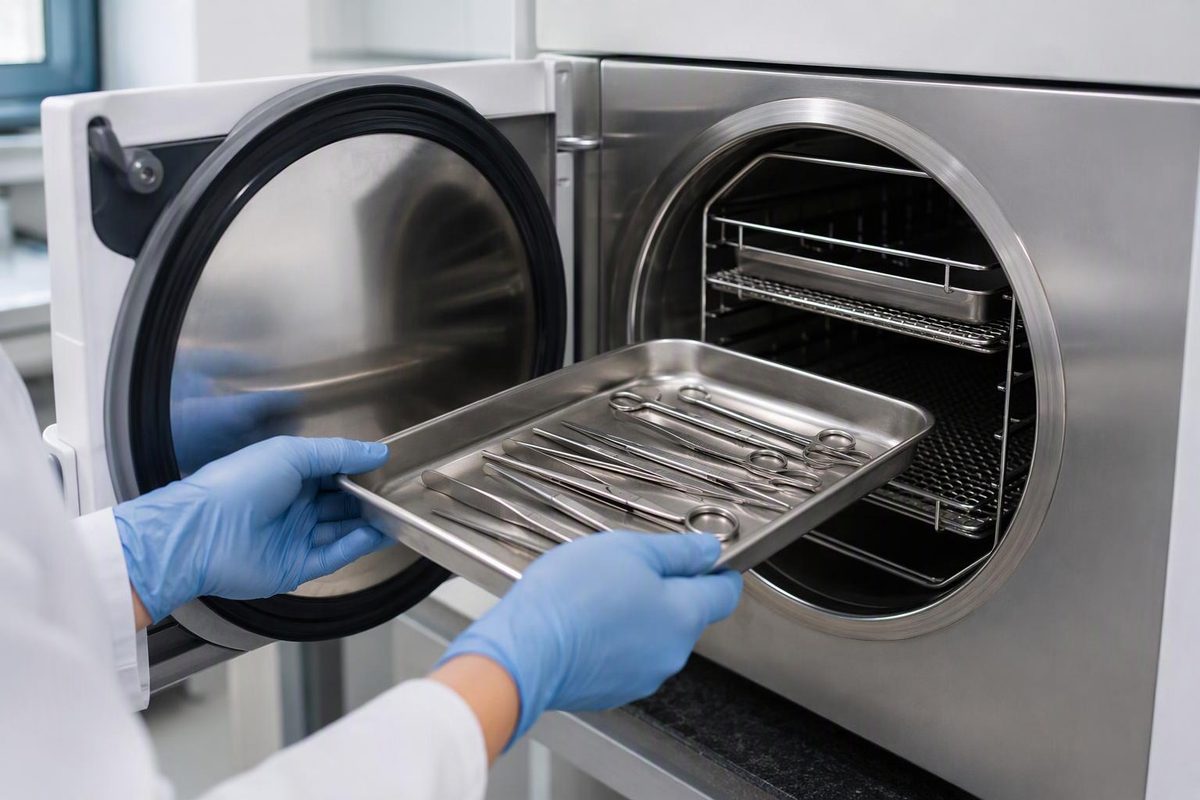
Autoclave sterilization uses saturated steam under pressure to destroy microorganisms, including bacterial spores. Each surface must receive direct steam contact under the required conditions. CDC steam-sterilization guidance
Steam is the preferred method for critical surgical instruments that tolerate heat, steam, pressure and moisture—but compatibility and cycle settings must come from the instrument, sterilizer and packaging manufacturers’ instructions, not from the instrument’s name or appearance. Critical instruments are those that enter normally sterile tissue or the vascular system. CDC recommendations
This is an educational reference for reading instrument-care documentation, not a substitute for sterile-processing training or a facility’s approved procedures.
What makes steam sterilization work?
Each surface must contact steam at the required temperature for the specified exposure time. Pressure enables the high temperature; it is not, by itself, the sterilizing agent. Moist heat damages microbial enzymes and structural proteins. Air trapped in the chamber or load can prevent steam contact, which is why air removal matters.
Two common sterilizer designs handle air differently:
- Gravity displacement: incoming steam displaces air through the chamber drain.
- Prevacuum: a vacuum system removes air before steam enters, improving penetration into porous loads.
Their exposure times are not interchangeable. CDC steam-sterilization guidance
Common temperatures and exposure times
The following are reference examples for wrapped instruments, from Table 7 of CDC’s 2008 guideline—not a cycle prescription for every tray, pouch or device.
| Sterilizer type | Exposure temperature | Minimum exposure time in CDC’s table |
|---|---|---|
| Gravity displacement | 121°C (250°F) | 30 minutes |
| Gravity displacement | 132°C (270°F) | 15 minutes |
| Dynamic-air-removal, such as prevacuum | 132°C (270°F) | 4 minutes |
Source: CDC minimum steam-cycle times.
Exposure time is not total turnaround time. The cycle also includes stages such as air removal, heating and drying; items must cool before handling or use. Device design, lumens, packaging and sterilizer type affect the required conditions. CDC steam-sterilization guidance
Follow compatible manufacturer instructions, and resolve conflicting instructions with the manufacturers rather than selecting a compromise setting. CDC recommendations
Which instruments are compatible?
Steam is suitable for heat- and moisture-resistant critical instruments. Heat- or moisture-sensitive devices require an appropriate alternative specified for that device. A metal appearance does not establish compatibility for the complete instrument, particularly where other materials or components are present. CDC sterilization guidance
The useful lookup is the exact manufacturer and model’s instructions for use (IFU). Confirm reuse status, permitted sterilization method, preparation requirements and cycle parameters. Do not treat an IFU for a conventional forceps as authority for a different instrument carrying the same pattern name.
Forceps preparation: the features that matter
Sterilization follows cleaning; it does not replace it. CDC recommends removal of organic residue and inorganic salts before sterilization and inspection for damage that would impair processing or function. Dried soil can make subsequent processing less effective or ineffective. CDC cleaning recommendations
For forceps and clamps, the jaws, teeth, serrations, box lock and ratchet deserve particular attention when reviewing preparation instructions. For example, Ambler Surgical’s non-powered instrument IFU specifies:
- Cleaning soil from jaws, ratchets, tips and hinge or box-lock areas.
- Drying and inspecting the instrument after cleaning.
- Packaging ratcheted instruments unlatched, with all surfaces accessible to steam.
- Leaving lumen ports open and using steam-permeable tip protectors according to their IFU.
These are manufacturer-specific examples, not permission to use the same preparation for every device. The document applies to Ambler’s non-powered surgical instruments unless their packaging states otherwise. Ambler Surgical IFU, updated July 20, 2023
What monitoring can—and cannot—show
An indicator-tape color change alone does not establish sterility. Chemical indicators show exposure to process conditions, not proof that sterilization has been achieved. CDC sterilizing-practices guidance
CDC calls for complementary monitoring:
| Evidence | What it assesses |
|---|---|
| Mechanical or physical record | Recorded cycle conditions, such as time, temperature and pressure |
| Chemical indicators | Exposure to specified process conditions |
| Biological indicators | Process effectiveness using resistant bacterial spores |
CDC recommends mechanical and chemical monitoring of each load, including internal and external chemical indicators; an external indicator is unnecessary if the internal indicator is visible. It recommends biological monitoring at least weekly and a biological indicator for every load containing implants, with quarantine whenever possible until a negative result. Items must not be used when mechanical or chemical results indicate inadequate processing. These are US CDC recommendations, not a replacement for applicable standards or facility policy. CDC monitoring recommendations
For prevacuum sterilizers, CDC also specifies an air-removal test each day the sterilizer is used, before the first processed load. This checks for air leaks and inadequate air removal; it does not replace the other monitors. CDC steam-sterilization guidance
Package condition matters too: CDC recommends repacking and reprocessing packages whose integrity is compromised, including wet, torn or punctured packs. CDC storage recommendations For the moisture-specific problem, see wet packs after steam sterilization.