
Wet Packs After Steam Sterilization: What to Do
Withhold and trace the pack, follow approved complete reprocessing, review load evidence, and escalate recurring or load-wide moisture.
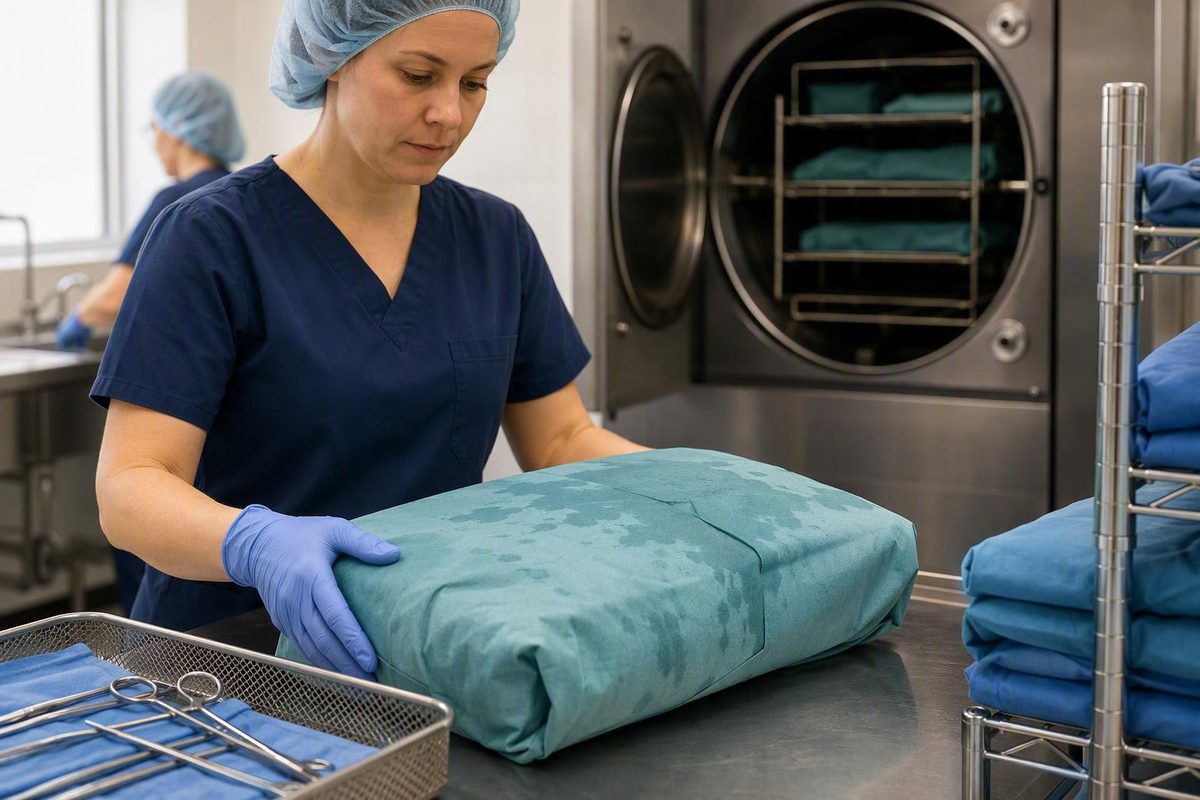
Do not use or release a sterilized instrument package that is damp, visibly wet, water-stained, or wet internally after the prescribed cooling period. Review the load and monitoring records, then investigate preparation, loading, drying, cooling, equipment, and steam conditions.
This is an educational reference, not a substitute for professional training. Exact reprocessing, documentation, notification, recall, and equipment-release actions must follow current facility policy and the applicable manufacturers’ instructions for use (IFU).
Immediate answer: do not use or release the wet pack
Use this immediate workflow:
- Identify the affected package.
- Withhold it from use or distribution.
- Preserve its traceability, including the load and cycle identity.
- Notify the responsible sterile-processing personnel.
- Route it through the approved complete-reprocessing procedure.
- Review the load evidence and investigate the cause.
CDC guidance says not to use a sterilized package if it is wet, torn, or punctured. It treats a sterile item that becomes wet as contaminated because moisture can carry microorganisms from surrounding air or surfaces through the packaging. The CDC also emphasizes that successful processing depends on cleaning, disassembly, packaging, loading, monitoring, sterilant quality, and correct cycle selection—not exposure alone (CDC sterilizing practices guidance).
An acceptable chemical indicator does not restore the integrity of wet packaging. It provides information about specified process conditions, but it does not make a damp, stained, or internally wet microbial barrier suitable for release.
Do not towel-dry the wrapper, wait for it to air-dry, or otherwise try to make the package acceptable without reprocessing. Manufacturer guidance specifically calls for affected wet packs to be identified and completely reprocessed; drying later does not establish that the package remained protected while wet (Tuttnauer wet-pack guidance).
“Complete reprocessing” does not mean inventing a universal sequence.
That distinction matters for forceps and other reusable surgical instruments. The FDA identifies surgical forceps as reusable medical devices and explains that inadequate cleaning can leave blood, tissue, or other biological debris that may allow microorganisms to survive subsequent disinfection or sterilization. Sterilization cannot compensate for inadequate cleaning (FDA guidance on reprocessing reusable medical devices).
How to recognize a wet pack
A wet pack has residual moisture on or within the package after steam sterilization and proper cooling. The finding may be obvious during unloading or hidden until the set is opened.
Signs include:
- A wrapper that feels damp
- Visible water staining on the wrapper
- Water staining on indicator tape
- Droplets or mist inside a package or tray
- Pooled water
- Moist instruments, towels, dressings, or other contents
External moisture may be found during unloading, cooling, inspection, or preparation for storage. Internal moisture can remain undetected until personnel open the package at the point of use. A set is not acceptable merely because its exterior appeared dry.
A single-center observational study used tactile dampness, visible moisture or staining, droplets, mist, pooled water, and moist contents as wet-pack criteria. It found associations with packaging compliance, pack contents, shelf position, weather, and cooling time. These findings came from one medical center and should not be generalized into universal packaging rules, environmental causes, or cooling limits (2024 wet-pack observational study).
Do not confuse a damp or water-stained wrapper with a dry deposit on an instrument. That separate investigation must not be used to dismiss moisture in or on the package.
Retained moisture may also contribute to instrument corrosion. The immediate reason to withhold the pack, however, is the unacceptable package condition and concern about maintenance of the microbial barrier.
Does one wet pack affect the whole load?
One wet pack does not establish a universal rule that every package in the load must be recalled. It does require immediate control of the affected package and a review broad enough to determine whether the finding is isolated or part of a load, process, monitoring, or equipment problem.
| Finding | Immediate disposition | Wider assessment |
|---|---|---|
| One externally wet pack after cooling | Withhold and completely reprocess that package | Review its load identity, chamber position, moisture pattern, cycle record, nearby packages, policy, and applicable IFU |
| Internal moisture found when opening | Do not use the set; notify sterile processing and reprocess it | Assess other traceable packs under local policy; a second internally wet pack increases concern about the wider load |
| Several wet packs from one load | Stop routine release and segregate affected material | Escalate as a wet-load event and evaluate the load, process, sterilizer, and utilities |
| Unacceptable monitoring or curtailed drying | Do not treat this as an isolated package defect | Follow the facility’s sterilization-failure process and determine recall, investigation, and return-to-service actions |
This decision framework reflects manufacturer guidance that identifies multiple wet packs as a wet load and distinguishes an isolated wet package from a load with unacceptable records, indicators, or an interrupted drying phase. The exact recall scope and authority to release unaffected packages remain facility-policy decisions.
For one externally wet package, preserve its load and cycle identity before removing it from the release pathway. Note where the package was positioned and whether the moisture was localized beneath a dense tray, found near the drain, or visible across several packages. Do not settle on a cause before checking the rest of the load and its records.
If internal moisture is discovered only after opening, do not use the set. Responsible personnel should assess other traceable packages under local policy. A second internally wet pack strengthens concern that the problem extends beyond one wrapper or handling location.
Several wet packs point more strongly to a wet load. Routine release should stop while authorized personnel determine the load’s disposition and investigate the process. If the cycle record or indicators show that required parameters were not met—or the drying phase was curtailed or aborted—follow the facility’s sterilization-failure procedure rather than treating the event as a packaging problem alone.
Troubleshooting matrix: pack, load, cycle, environment, and machine
Remove the affected package from use before troubleshooting. Then investigate the full process rather than assuming that every wet pack needs only a longer drying phase.
| Area | What to inspect | Questions to ask |
|---|---|---|
| Preparation | Cleaning, prepackaging dryness, inspection, disassembly | Were all surfaces dry? Were hinged or multipart devices opened or disassembled as instructed? |
| Instruments and trays | Metal mass, set density, drainage, nested or concave items | Could the configuration produce or retain condensate? |
| Packaging | Packaging type, wrapping or sealing, validated configuration | Was the system applied within its IFU? Were unsupported wrap or pouch combinations used? |
| Loading | Spacing, shelf position, pouch orientation, drain clearance | Could the load restrict air removal, steam circulation, or drainage? |
| Cycle and drying | Cycle selection, recorded phases, drying completion | Was the validated cycle selected? Was drying shortened, interrupted, or aborted? |
| Cooling and handling | Unloading, airflow, stacking, contact surfaces | Were hot packs stacked, exposed to a cold vent, or placed on a cool solid surface? |
| Equipment and utilities | Drains, strainers, valves, traps, vacuum, seals, condensate, steam supply | Does the pattern suggest a component, maintenance, or utility problem? |
Preparation starts before packaging. Instruments should be clean, dry, inspected, and disassembled where required. Hinges, channels, concave surfaces, nested items, dense sets, unsuitable trays, and unevenly distributed metal mass can retain condensate. Tray and containment-system configurations should support drainage.
Confirm that the packaging system is appropriate for the load and used within its validated instructions. Do not improvise extra layers, double wrapping, or double pouching. During loading, maintain the prescribed spacing and orientation, keep the chamber drain unobstructed, and position devices so condensate can drain rather than collect.
Equipment and utility checks may include drain strainers, valves, steam traps, vacuum performance, door seals, condensate, steam quality, and steam-line insulation. Skytron likewise recommends reviewing cycle printouts and examining loading practices, cycle selection, valves, seals, traps, vacuum components, drains, and steam quality. Its numerical steam-quality and door-opening suggestions are commercial technical recommendations, not universal regulatory settings (Skytron wet-pack troubleshooting guidance).
Cooling and handling also matter. Premature unloading, stacking hot packages, directing cold air onto a load, or placing a hot pack on a cool solid surface may promote condensation. Cooling requirements vary with the sterilizer, package, tray, load, and room conditions. Do not substitute a study interval or vendor recommendation for validated instructions.
Review the evidence from the cycle—and know when to escalate
Before making broader load decisions, personnel may use the following as an educational investigation prompt. Facility policy determines mandatory documentation fields, review authority, and release decisions:
- Load and cycle identity
- Cycle printout or electronic record
- Mechanical monitoring results
- Chemical indicators
- Biological monitoring, where applicable
- Selected cycle and completed phases
- Package position in the chamber
- External versus internal moisture
- Load configuration and density
- Drying, cooling, and handling conditions
- Whether other packages were affected
Steam sterilization depends on direct steam contact at the required pressure and temperature for the specified time. Effective air removal and a load configuration that permits steam circulation are also essential. Mechanical, chemical, and biological monitors provide different information about the process.
Moisture alone does not prove that the required exposure parameters were missed. It does establish that the affected package is unacceptable for use. Conversely, an acceptable cycle record or chemical indicator does not repair wet packaging.
Broaden the investigation when there are:
- Several wet packs
- Recurrent moisture
- An interrupted or aborted drying phase
- Unacceptable monitoring results
- Repeated patterns involving the same sets, shelves, cycles, or operating periods
- Suspected drain, vacuum, seal, trap, valve, condensate, or steam-supply faults
When equipment performance is suspected, involve sterile-processing leadership and qualified service personnel. Repeatedly adding drying time without identifying the cause can conceal equipment or utility problems and may move the process outside validated instructions.
Do not automatically apply a sterilizer-failure return-to-service sequence to every isolated wet pack. Formal verification becomes relevant when an actual sterilizer failure has been identified and facility policy requires it. Local policy must specify who may stop the sterilizer, define testing, release loads, or return the unit to routine service.
Prevent recurrence without changing a validated process
Prevention depends on a connected process: clean and dry instruments, suitable trays and packaging, unobstructed circulation and drainage, the correct validated cycle, complete drying, controlled cooling, and inspection before release.
For instrument sets:
- Position concave devices so they can drain.
- Open hinges and disassemble devices when their IFU requires it.
- Avoid nesting that traps condensate.
- Use trays or containment systems that support drainage.
- Distribute heavy metal mass according to the validated configuration.
- Give dense sets particular attention during assembly and loading.
Follow current instructions for every component: instruments, containment devices, packaging, sterilizers, cleaning products, accessories, and process monitors. If an IFU is incomplete, unclear, or appears incompatible with another component’s instructions, contact the relevant manufacturer rather than improvising.
Do not change packaging, add an unvalidated wrap or pouch layer, extend exposure or drying phases, add vacuum stages, or adopt a vendor’s generic setting without confirming that the change is validated and authorized. Producing a dry package does not make a correction acceptable if the altered process falls outside applicable instructions.
A concise prevention check for trained personnel is:
- Dry instruments before packaging.
- Open or disassemble devices as instructed.
- Position items to permit drainage.
- Avoid excessive density and uneven metal mass.
- Keep chamber drains and strainers clear as directed.
- Select the validated cycle.
- Allow the drying phase to finish.
- Cool the load as instructed without stacking or cold-surface contact.
- Inspect packages before release.
- Investigate recurrence instead of normalizing it.
Why wet-pack controls matter operationally
Wet-pack and wider reprocessing problems can interrupt surgical services even when no attributable infection has been identified. In 2026, CBC reported that processed instrument packs were found wet at Grande Prairie Regional Hospital, after which steam sterilization was moved to Edmonton and elective surgeries were postponed (CBC News report).
The official Alberta Health Services release confirmed a surgical-instrument reprocessing issue, postponed elective procedures, and the use of instruments reprocessed in Edmonton. It did not identify wet packs or explain the technical cause. Emergency and urgent procedures, including C-sections, cancer surgery, and trauma cases, remained available (Alberta Health Services statement).
Later reporting described a mobile medical-device reprocessing unit, replacement of steam sterilizers, and the rescheduling or completion of most postponed surgeries (EverythingGP report on operational recovery). Reports that no attributable infections were identified do not establish that wet packs are safe, and these facility reports do not provide a universal procedure for an individual package.
The operational rule remains simple: a wet sterilized package is not ready for use. Withhold and trace it, follow the approved complete-reprocessing procedure, review the load and monitoring evidence, and escalate recurring or load-wide moisture for process and equipment investigation. Do not improvise a drying fix or assume that one cause, one cooling time, or one whole-load rule applies to every sterilizer and instrument set.