
Identify Cushing Forceps by Profile and Jaws
Marina 060-360 is a straight, 17 cm dressing forceps without teeth, while 060-361 is a straight, 17 cm tissue forceps with 1 × 2 teeth.
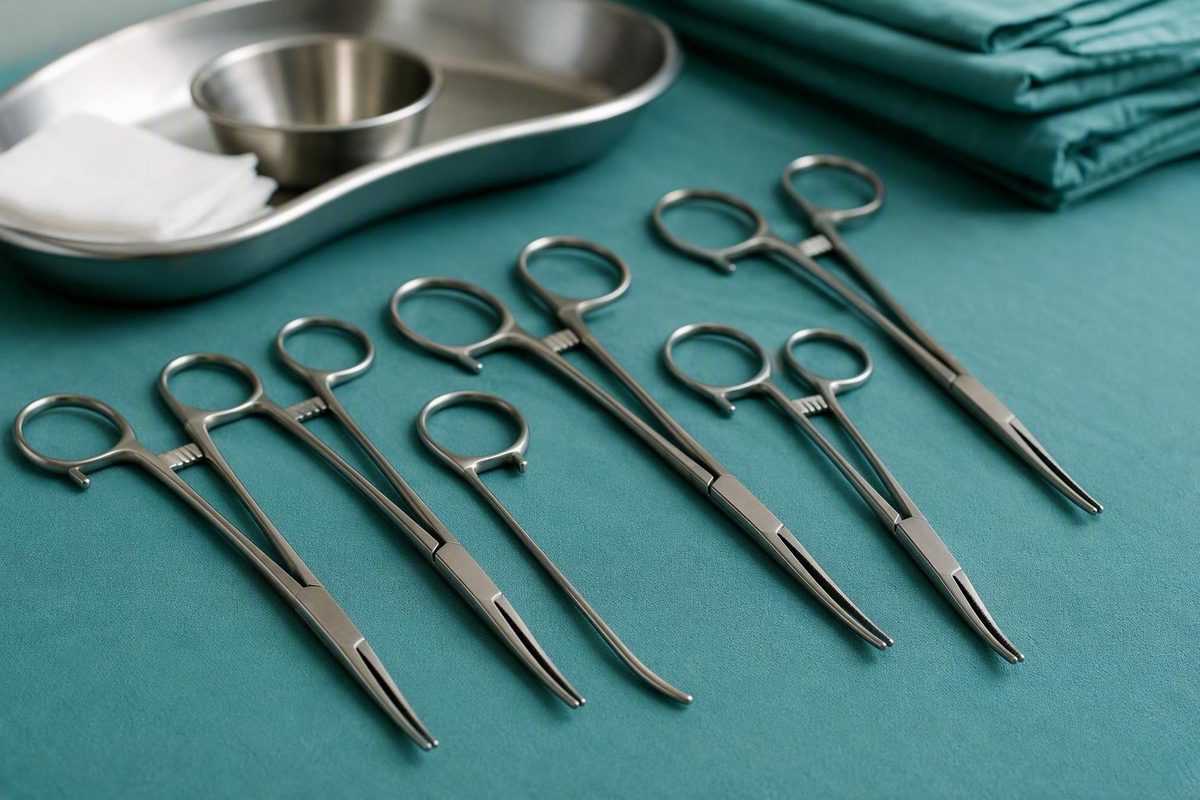
Cushing forceps are not one universally standardized instrument. They are a catalog family of thumb-style grasping forceps offered in multiple profiles, jaw patterns, lengths, materials, and specialized configurations. Accurate identification therefore depends on the exact part number and published specifications—not the Cushing name alone.
Catalog-review note: This guide compares manufacturer and supplier records for identification and procurement. It reflects Medical Forceps’ manufacturer-independent educational role, and it does not rank brands or recommend a configuration for a procedure.
What are Cushing forceps?
Catalogs describe Cushing forceps as thumb-style instruments used for grasping, manipulating, or dissecting tissue and for handling small objects. Suppliers commonly associate their long, slender, or narrow forms with delicate work and confined operative fields. Catalog examples appear under general surgery, ENT, orthopedic, podiatric, and veterinary categories, among others (gSource catalog).
These descriptions explain how suppliers classify and market their instruments. They are not procedural instructions and do not establish that a particular Cushing pattern improves control, visibility, tissue protection, safety, or clinical outcomes.
Neurological surgery is one documented specialty, but it is not a universal indication for every instrument carrying the Cushing name. Aspen part 36-6005, for example, is cataloged for neurological surgery and cranial anatomy; that classification applies to the specific reusable, 7-inch, 1.4 mm-tip model described on the Aspen product page.
Other catalogs place individual Cushing models elsewhere. Padgett P4204 is categorized under plastic and reconstructive surgery (Padgett product record), while Jarit models appear under general operating. A supplier of insulated variants also refers to breast and neck contexts for its monopolar models (Black & Black product listing). These are model-level catalog classifications, not comprehensive indications, contraindications, or recommendations for use.
The practical lesson is simple: “Cushing” is the start of identification, not the end. A complete description should answer:
- Who manufactured or branded the instrument?
- What is the exact part number?
- Is the profile straight, curved, angled, or bayonet?
- Are the jaws toothless, serrated, toothed, or combined?
- What are the overall length and published jaw or tip width?
- What is the base material, and are inserts identified?
- Is the instrument insulated?
- Is it reusable or single-use?
- Is it supplied sterile or non-sterile?
- What do the current manufacturer documentation and applicable instructions for use say?
This article is an educational identification and procurement reference. It is not medical advice, clinical instruction, or a substitute for professional training, as further explained in the site’s educational-use terms.
The identifying anatomy: profile, jaws, handle, and reach
Start with the permanent identity, then work from overall geometry to increasingly specific details.
1. Read the marking and part number
Begin with any manufacturer name, logo, catalog number, data-matrix code, or other permanent marking.
Do not assume that similar-looking instruments from different catalogs are interchangeable. Even when their lengths and jaw descriptions appear close, their materials, tolerances, documentation, processing requirements, electrical properties, warranties, and intended compatibility may differ.
If a marking is incomplete or illegible, record that limitation. Do not assign a precise SKU solely from resemblance to a catalog photograph.
2. Inspect the overall profile
Documented Cushing profiles include:
- Straight: The handle, shaft, and working end generally follow a direct longitudinal path.
- Curved: A visible curvature appears in the instrument or working portion.
- Angled: The catalog identifies a directional change as angled rather than curved.
- Bayonet: The handle and working end are offset instead of lying on one uninterrupted line.
A bayonet profile should be identified by its offset geometry, not by its jaws. Suppliers describe the offset as a way to move the user’s hand outside the direct line of sight in a narrow field. That is a stated design rationale, not comparative evidence that a bayonet model improves visibility, precision, safety, or outcomes.
“Curved” and “angled” are not necessarily interchangeable catalog terms. Before purchasing or reconciling an instrument, check a current manufacturer image or drawing to determine whether the word describes the full shaft, a localized bend, the working end, or another part of the geometry.
3. Examine the jaw pattern
Profile and jaw design are separate variables. A straight instrument can be toothless, serrated, or toothed. A bayonet instrument can likewise have serrated or toothed jaws.
Common catalog descriptions include:
- Toothless: No projecting teeth are listed.
- Serrated: The gripping surfaces have a textured or ridged pattern.
- 1 × 2 teeth: One tooth on one jaw opposes two teeth on the other.
- 1 × 2 teeth with serrations: Teeth and serrated surfaces are combined.
- 1 × 2 cross-serrated teeth: The catalog identifies a cross-serrated toothed pattern.
- Insert-equipped jaws: The listing identifies an inserted material, such as tungsten carbide, or uses a proprietary jaw term.
These labels describe mechanical geometry. They do not establish that one pattern is universally safer, less traumatic, more secure, or clinically preferable.
Avoid replacing the catalog’s terminology with a more familiar label unless the manufacturer supports that interpretation. In particular, a proprietary name should not be converted into a material claim merely because the wording sounds similar to another product designation.
4. Check handle and secondary-end notation
Some listings identify a Gutsch handle, while others mention a scraper end. These terms can help match a physical instrument to a catalog entry, but the available evidence does not adequately define their geometry, intended clinical function, or ergonomic benefit across manufacturers.
Treat “Gutsch handle” and “scraper end” as model-identification terms unless authoritative documentation for the exact SKU provides further detail. Do not infer that two products have identical handles simply because both use one of these labels.
5. Measure reach and jaw or tip width
Overall length helps distinguish similar patterns, but rounded catalog measurements can conceal differences. A product described as 7 inches may also be listed as 179 mm even though the exact mathematical conversion of 7 inches is 177.8 mm. Preserve the source measurement and label any conversion as approximate.
Jaw or tip width can also be important when published. Reviewed listings include values of 1.0, 1.4, 1.7, and 1.8 mm. Some catalogs describe these as jaw widths; others use “tip width.” Do not silently treat the two labels as interchangeable, and record an omitted dimension as “not stated” rather than estimating it from a photograph.
After documenting profile, jaws, length, and width, continue with:
- Handle or secondary-end notation.
- Base material and any inserts.
- Insulated or non-insulated status.
- Reusable or single-use classification.
- Sterile or non-sterile supply condition.
- Exact manufacturer record and current instructions.
Recommended identification diagrams
A useful training plate should separate profile from jaw pattern rather than combining every feature into one illustration. It should show:
- Straight, curved or angled, and bayonet profiles side by side.
- Toothless, serrated, 1 × 2-tooth, combined toothed-serrated, and cross-serrated jaws at the same scale.
- The locations used for overall-length and jaw- or tip-width measurements.
- Examples of manufacturer markings and part-number placement.
- A reminder that material, insulation, sterility, and reusability usually cannot be established from silhouette alone.
Such diagrams are teaching aids. The exact SKU and current manufacturer record should remain the final identification reference.
Cushing tissue forceps versus Cushing dressing forceps
The terms tissue forceps and dressing forceps can describe a meaningful model-level distinction, but they are not applied consistently enough to support a universal rule.
Marina Medical Instruments provides a clear paired example. SKU 060-360 is listed as a straight, 17 cm Cushing dressing forceps without teeth. SKU 060-361 is listed as a straight, 17 cm Cushing tissue forceps with 1 × 2 teeth (Marina product listing).
Model-level comparison
Feature Cushing dressing forceps Cushing tissue forceps Manufacturer Marina Medical Instruments Marina Medical Instruments SKU 060-360 060-361 Profile Straight Straight Source length 17 cm 17 cm Approximate conversion 6.69 in 6.69 in Jaw pattern Without teeth 1 × 2 teeth
This pair demonstrates why Cushing forceps should not automatically be described as toothed. It also shows why a tray list that says only “Cushing” may be inadequate for purchasing, assembly, or reconciliation.
The distinction is not universal across the market. A third-party instrument database calls a bayonet instrument “Cushing Bayonet Dressing Forceps” while giving “Cushing Bayonet Tissue Forceps” as an alternative name. The same entry allows serrated or toothed blunt tips, illustrating how the labels can overlap outside manufacturer-specific records (third-party naming example).
That entry is useful only as evidence of inconsistent third-party terminology. It does not establish a market-wide naming standard.
Accordingly, avoid a blanket rule that dressing always means toothless or tissue always means toothed. The more dependable identifiers are:
- Exact manufacturer and part number.
- Actual jaw geometry.
- Overall profile and dimensions.
- Current product documentation.
Straight, curved, angled, and bayonet configurations
A Cushing forceps profile describes the instrument’s visible path or offset. It does not, by itself, determine the jaws, specialty, material, insulation, or intended compatibility.
Straight configurations
A straight model has no cataloged bayonet offset, curve, or angle. gSource model gS 17.1690 is listed as straight, 6 3/4 inches long, and equipped with 1 × 2 teeth. The same catalog lists gS 17.1693 as a straight, 6 3/4-inch, 1 × 2-tooth version with tungsten carbide.
Straight does not mean toothed in every case. Marina 060-360 is straight and toothless, while Jarit 130-425 and 130425TI are straight models with serrated jaws.
Curved configurations
gSource gS 17.1692 is listed as a curved Cushing tissue forceps measuring 6 3/4 inches with 1 × 2 teeth. It provides a useful comparison with gS 17.1690: published length and jaw pattern remain the same, while the profile changes.
The same catalog lists gS 17.2860 as a 7 1/4-inch bayonet model with 1 × 2 teeth. Together, these entries establish straight, curved, and bayonet versions without implying that any profile is clinically superior (gSource model catalog).
A catalog’s use of curved should still be checked against its current image or drawing. The word alone may not establish where the curve begins or how pronounced it is.
Angled configurations
Jarit 130-417 is identified as an angled, 171 mm stainless-steel model with serrated jaws. Its listing also uses the proprietary term “Carb-Bite,” but the supplied catalog text does not explain the composition of that feature.
An angled model should not automatically be grouped with curved models. Retain the manufacturer’s terminology in inventory and comparison records, and do not relabel Carb-Bite as tungsten carbide without applicable manufacturer documentation.
Bayonet configurations
The defining feature of a bayonet forceps is the offset between the handle and working end. Jaw style remains an independent specification.
Jarit illustrates several combinations:
- 130-415: Bayonet, 181 mm, 1 × 2 teeth, 1.7 mm jaw width.
- 130-418: Bayonet, 191 mm, serrated jaws.
- 130-421: Bayonet, 200 mm, 1 × 2 teeth.
- 130-417: Angled rather than bayonet, 171 mm, serrated jaws.
The same catalog includes straight serrated and straight toothed configurations, reinforcing that profile and jaw geometry must be recorded separately (Jarit catalog).
When inspecting a bayonet-pattern forceps, do not infer:
- That it must be neurosurgical.
- That it must have teeth.
- That it must be serrated.
- That it is insulated.
- That its offset has a particular dimension.
- That it is interchangeable with another bayonet model.
Record the offset profile, then continue through the jaw, length, width, material, insulation, sterility, and part-number checks.
Jaw patterns, materials, and specialized variants
Cushing catalogs document a wider range of working ends than a simple choice between serrations and 1 × 2 teeth.
Toothless and serrated jaws
A toothless jaw lacks projecting teeth. Marina 060-360 is the clearest reviewed example: a straight, 17 cm dressing forceps listed without teeth.
Serrated jaws use surface texture rather than a projecting 1 × 2 tooth arrangement. Jarit 130-425 is a straight stainless-steel serrated model. Jarit 130425TI is a straight titanium model with delicate serrated jaws.
Serrations should not automatically be called “atraumatic.” That word would imply a tissue-effect claim not established by catalog geometry alone.
Toothed and combined patterns
A 1 × 2 arrangement consists mechanically of one tooth opposing two. Documented Jarit examples include:
- 130-430: Straight, 178.5 mm, 1 × 2 teeth.
- 130-435: Straight, 178.5 mm, serrated 1 × 2 teeth.
- 130-446: Straight, 200 mm, 1 × 2 cross-serrated teeth.
The latter two show why toothed and serrated are not always mutually exclusive categories. A catalog can describe both features on the same model.
Teeth and serrations create different engagement geometries, but the product specifications do not establish a universally safer or clinically superior option. Selection requires the exact manufacturer documentation, the facility’s approved requirements, and appropriately trained professional judgment.
Stainless steel and titanium
Stainless steel predominates in the reviewed manufacturer listings, but it is not universal. Jarit 130425TI is a documented exception: it is straight, reusable, 176 mm long, made from titanium, and fitted with delicate serrated jaws having a published width of 1 mm.
Material must therefore be checked at SKU level. A stainless-steel description for one Cushing model cannot be generalized to the entire family, and the titanium specification for 130425TI does not extend to other Jarit products.
Tungsten-carbide insert models
Selected Cushing models are cataloged with tungsten-carbide inserts. Aspen 36-6005 is a reusable, 7-inch model with a 1.4 mm tip. Its neurological-surgery, cranial-anatomy, and latex-free classifications apply only to that exact part number.
gSource also lists gS 17.1693 as a straight, 6 3/4-inch, 1 × 2-tooth model with tungsten carbide. These listings establish that insert-equipped variants exist; they do not establish superior grip, strength, durability, or clinical performance.
Proprietary terminology requires particular care. Jarit uses “Carb-Bite” for selected serrated models, but the reviewed catalog does not define its composition. It should not be treated as synonymous with tungsten carbide unless the applicable manufacturer documentation expressly confirms that interpretation.
Cushing forceps size and model comparison chart
The table below normalizes selected catalog entries so profile, jaws, measurements, and procurement fields can be compared without treating rounded inch and metric values as exact equivalents.
“Not stated” means the reviewed listing did not provide the information. It does not mean the feature is absent. Conversions are mathematical approximations of the source measurements and may reveal catalog rounding or discrepancies.
For row-level traceability, the Ambler specifications come from its 28-517 product record.
The grouped Jarit entries come from the manufacturer’s Cushing forceps catalog cited in the profile section above.
The Padgett P4204 entry comes from the manufacturer record cited in the opening section.
Aspen 36-6005 is documented on the manufacturer page cited above, and the Marina pair is documented on its cited product listing.
The 25 cm exception comes from the Accurate Surgical ASSI.AG27926 listing.
| Manufacturer or brand | Part number | Source measurement | Approx. converted measurement | Profile | Jaw pattern | Published jaw or tip width | Material or insert | Handle or scraper notation | Insulation | Reusable status | Supply sterility | Cataloged specialty |
|---|---|---|---|---|---|---|---|---|---|---|---|---|
| Ambler Value Line | 28-517 | 7 in | 177.8 mm | Straight | 1 × 2 teeth; semi-sharp dissecting end | Not stated | Stainless steel | Gutsch handle | Not stated | Yes | Non-sterile | Not stated |
| Jarit | 130-415 | 181 mm; cataloged as 7 1/8 in | 7.13 in | Bayonet | 1 × 2 teeth | 1.7 mm jaw width | Stainless steel | Scraper end | Not stated | Yes | Not stated | General operating |
| Jarit | 130-425 | 177 mm; cataloged as 6 7/8 in | 6.97 in from 177 mm; 174.6 mm from 6 7/8 in | Straight | Serrated | Not stated | Stainless steel | Gutsch handle; scraper end | Not stated | Yes | Not stated | General operating |
| Jarit | 130425TI | 176 mm | 6.93 in | Straight | Delicate serrated | 1.0 mm jaw width | Titanium | Not stated | Not stated | Yes | Not stated | General operating |
| Jarit | 130-430 | 178.5 mm | 7.03 in | Straight | 1 × 2 teeth | Not stated | Stainless steel | Not stated | Not stated | Yes | Not stated | General operating |
| Jarit | 130-446 | 200 mm | 7.87 in | Straight | 1 × 2 cross-serrated teeth | Not stated | Stainless steel | Not stated | Not stated | Yes | Not stated | General operating |
| Jarit | 130-421 | 200 mm | 7.87 in | Bayonet | 1 × 2 teeth | Not stated | Stainless steel; made in Germany | Not stated | Not stated | Yes | Not stated | General operating |
| Padgett | P4204 | 179 mm; cataloged as 7 in | 7.05 in from 179 mm; 177.8 mm from 7 in | Straight | 1 × 2 teeth | 1.8 mm jaw width | Stainless steel | Gutsch handle | Not stated | Yes | Not stated | Plastic and reconstructive surgery |
| Aspen | 36-6005 | 7 in | 177.8 mm | Not stated | Not stated | 1.4 mm tip width | Tungsten-carbide inserts; base material not stated | Not stated | Not stated | Yes | Not stated | Neurological surgery; cranial anatomy |
| Marina | 060-360 | 17 cm | 6.69 in | Straight | Toothless | Not stated | Not stated | Not stated | Not stated | Not stated | Not stated | Dressing-forceps classification |
| Marina | 060-361 | 17 cm | 6.69 in | Straight | 1 × 2 teeth | Not stated | Not stated | Not stated | Not stated | Not stated | Not stated | Tissue-forceps classification |
| Accurate Surgical | ASSI.AG27926 | 25 cm | 9.84 in | Straight | 1 × 2 teeth | Not stated | Not stated | Not stated | Not stated | Not stated | Not stated | Tissue-forceps classification |
Most of the reviewed manufacturer-catalog models cluster around 171 to 200 mm, approximately 6.7 to 7.9 inches. Accurate Surgical ASSI.AG27926, at 25 cm, is an important exception: it prevents “about 7 inches” from being treated as a family-wide specification.
The comparison also exposes several other limits on generalization:
- Not every Cushing forceps is toothed.
- Not every Cushing forceps is stainless steel.
- Not every model has a stated specialty.
- Not every reusable model has a stated supply-sterility condition.
- A nominal 7-inch label can coexist with a rounded metric measurement.
- Country of origin cannot be generalized from one SKU. “Made in Germany” is explicit for Jarit 130-421 but should not be inferred for the other listed Jarit models.
- Insert material does not, by itself, identify jaw geometry.
- “Not stated” is not evidence that a feature is absent.
Prices, inventory, shipping estimates, purchaser restrictions, and return rules are deliberately excluded from the core table. Those are time-sensitive seller conditions rather than stable physical specifications.
Standard versus insulated Cushing forceps
Ordinary mechanical Cushing forceps and insulated variants should be treated as distinct product categories. A familiar profile, length, or jaw pattern does not establish electrical suitability.
Black & Black Surgical lists long, stainless-steel insulated Cushing tissue forceps for monopolar coagulation in two styles:
- A 7-inch or 18 cm model with 1 × 2 teeth.
- An 8-inch or 20 cm model with serrated jaws.
The supplier also describes tungsten-carbide inserts. These are source-stated product specifications, not evidence of comparative performance.
Those facts do not mean that an ordinary Cushing forceps can be used as an electrosurgical instrument. Nor do they establish compatibility with a particular generator, cable, connector, voltage, accessory, or procedure.
The reviewed listing does not provide a complete set of:
- Voltage ratings.
- Generator compatibility.
- Cable or connector requirements.
- Insulation limits.
- Model-specific pre-use testing procedures.
- Contraindications.
- Inspection rejection criteria.
- Complete electrical specifications.
- Supply-sterility information.
Before an insulated model is selected or placed into service, verify the exact model number and obtain the current applicable instructions for use. Confirm compatible equipment, insulation-inspection requirements, reprocessing documentation, facility policy, and required accessories through authoritative manufacturer records.
This distinction should also be visible in inventory systems. “Cushing forceps, 7 inch, 1 × 2” is not an adequate substitute for a complete record identifying whether the product is standard or insulated.
Reusability, sterility, reprocessing, and purchasing checks
Reusable and supplied sterile answer different questions. Reusability means a manufacturer or seller classifies an instrument for repeated use under applicable instructions. It does not tell the receiving facility whether the unopened product arrives sterile.
Ambler 28-517 is a direct example: the listing identifies it as reusable and supplied non-sterile. That combination is not contradictory. It demonstrates why reusability cannot be used as a shortcut for determining initial sterility.
The product evidence reviewed here does not, however, establish model-specific cleaning cycles, sterilization temperatures, exposure times, packaging methods, lubrication requirements, inspection steps, or repair procedures for every instrument in the family.
Those parameters should not be inferred from:
- The instrument’s appearance.
- Stainless-steel or titanium composition.
- Instructions for a different brand or model.
- General knowledge about reusable instruments.
- A distributor’s abbreviated description.
- The Cushing family name.
Procurement and intake checklist
Use a checklist that separates stable instrument specifications from time-sensitive purchasing conditions.
Identity
- [ ] Exact manufacturer or brand.
- [ ] Exact part number or SKU.
- [ ] Permanent marking matches purchase and receiving records.
- [ ] Tissue-versus-dressing label recorded.
- [ ] Current catalog page, drawing, or technical record retained where required.
Geometry
- [ ] Straight, curved, angled, or bayonet profile.
- [ ] Toothless, serrated, 1 × 2-tooth, combined, or cross-serrated jaws.
- [ ] Source-unit overall length.
- [ ] Converted length clearly labeled as approximate.
- [ ] Published jaw or tip width, with the catalog’s terminology retained.
- [ ] Gutsch-handle notation, if stated.
- [ ] Scraper-end notation, if stated.
- [ ] Any discrepancy between catalog measurements documented.
Composition and specialized features
- [ ] Base material.
- [ ] Insert material, if present.
- [ ] Proprietary terms retained without unsupported reinterpretation.
- [ ] Insulated or non-insulated status.
- [ ] Latex status verified only when relevant and documented for the exact SKU.
- [ ] Country of origin recorded only when expressly stated for that model.
Supply and processing status
- [ ] Supplied sterile or non-sterile.
- [ ] Reusable or single-use classification.
- [ ] Current instructions for use obtained.
- [ ] Applicable reprocessing document identified.
- [ ] Facility processing capability and policy confirmed.
- [ ] Inspection and repair pathway established through approved documentation.
Commercial conditions
- [ ] Package quantity.
- [ ] Purchaser or account restrictions.
- [ ] Current price and availability.
- [ ] Shipping terms.
- [ ] Return policy.
- [ ] Effect of opening, marking, processing, or sterilization on return eligibility.
- [ ] Warranty and repair support.
Return conditions deserve attention before processing. The Ambler seller states that its non-sterile instrument cannot be returned after sterilization. This is a seller-specific commercial condition, not a universal rule, but it illustrates why return eligibility should be checked before an instrument enters the processing workflow.
Catalog cross-references also require caution. gSource asserts that gS 17.2860 is equivalent to Jarit 130-415 and that gS 17.1690 is equivalent to Jarit 130-430. These are seller-asserted cross-references, not independent confirmation of interchangeability.
Similar dimensions and jaws do not by themselves establish identical materials, tolerances, documentation, warranty, processing requirements, or approved use. If a proposed substitute must meet a purchasing specification, verify every required field rather than relying on the word equivalent.
Price, stock, shipping time, clinical-purchaser restrictions, and returnability can change without any alteration to the instrument itself. Keep those details in a dated procurement record rather than embedding them in a permanent identification standard.
Frequently asked questions
What are Cushing forceps used for?
Catalogs describe Cushing forceps as thumb-style instruments for grasping, manipulating, or dissecting tissue and handling small objects. Long, narrow, and bayonet models are often associated by suppliers with delicate or confined fields.
These descriptions should not be converted into procedural recommendations. Correct use of an exact model depends on its manufacturer documentation, facility requirements, and professional training.
What is the difference between Cushing tissue forceps and Cushing dressing forceps?
The difference must be established at model level. Marina 060-360 is a straight, 17 cm dressing forceps without teeth, while 060-361 is a straight, 17 cm tissue forceps with 1 × 2 teeth.
That is a clear distinction for those two SKUs, but it is not a universal naming rule. Other catalogs and third-party databases use dressing and tissue as overlapping names. Confirm the part number and actual jaw geometry rather than relying on the family label.
Are all Cushing forceps 7 inches long and made from stainless steel?
No. Many reviewed models are near 7 inches and many are stainless steel, but neither characteristic is universal.
Documented exceptions include a 25 cm straight model and a 176 mm titanium model. Selected products also incorporate tungsten-carbide inserts. Always verify the exact SKU’s source-unit length, base material, and insert description.
Why do some Cushing forceps have a bayonet shape?
A bayonet pattern offsets the handle from the working end. Suppliers describe this geometry as a way to move the user’s hand outside the direct line of sight in a narrow field.
That is a stated design rationale, not proof of improved visibility or better outcomes. Bayonet shape also does not determine the jaws: documented bayonet Cushing models include both 1 × 2-tooth and serrated configurations.
Are reusable Cushing forceps supplied sterile?
Not necessarily. Reusable status means an instrument is classified for repeated use under applicable instructions; it does not establish its condition when supplied.
Ambler 28-517, for example, is listed as reusable and non-sterile. For every Cushing forceps, verify the exact SKU’s supply condition, current instructions for use, and facility-approved processing requirements before it is placed into service.
Conclusion
The Cushing name is only a starting point. A toothless 17 cm dressing model, a straight 1 × 2-tooth instrument, a titanium serrated model, a 25 cm version, a bayonet pattern, and an insulated monopolar variant can all appear under the same family name.
Identify the exact SKU by its profile, jaw geometry, source-unit dimensions, material, inserts, insulation, sterile or non-sterile supply condition, and reusable status. Then confirm the current manufacturer instructions, facility policy, and professional requirements before purchase, processing, or use.