
Bishop-Harmon Forceps: Identification, Teeth and Sizes
Identify Bishop-Harmon forceps by their straight profile, perforated handle and fine jaws. Compare toothed, dressing and suturing variants.
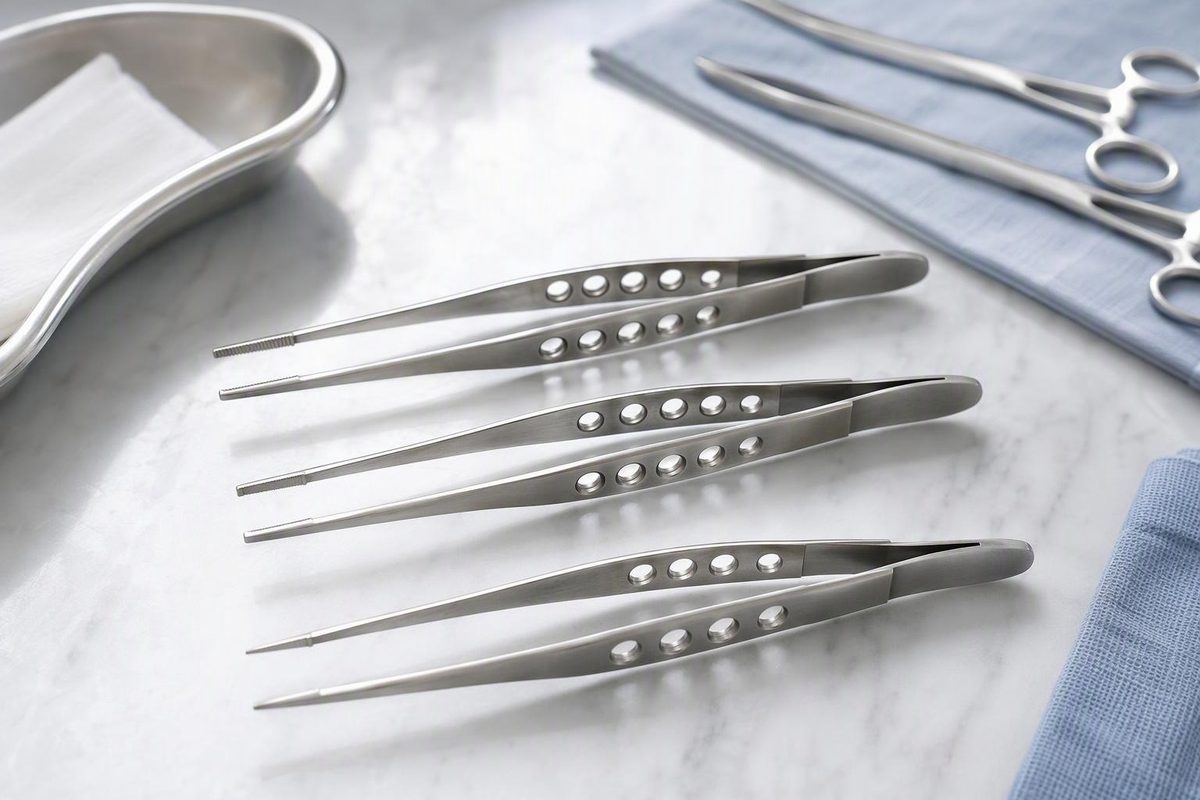
A typical Bishop-Harmon tissue forceps has straight shafts, fine 1 × 2 teeth and a flat handle with holes. It is a small instrument: Bausch + Lomb’s Storz E1500 measures 86 mm, while Ambler’s 2622E is listed at 3½ inches (about 89 mm) and has a three-hole handle. These are documented examples, not a universal size specification. (Storz E1500, Ambler 2622E)
The name also covers serrated dressing and suturing variants. Check the working ends before assigning the subtype.
Identifying the pattern
Start with the small thumb-forceps form, then check:
- Profile: straight shafts leading to fine jaws in the documented tissue models.
- Handle: flat and perforated; the Ambler example specifically has three holes.
- Teeth: a tissue model commonly has 1 × 2 teeth—one tooth on one jaw opposing two on the other.
- Working surface: distinguish terminal teeth from serrated gripping surfaces and from a tying platform.
The first three features match the Storz E1500 and Ambler 2622E specifications cited above. A perforated handle alone is not enough to identify the exact model.
Documented jaw and size variants
Integra’s Miltex ordering information lists the following Bishop-Harmon examples. Although the page is headed “Dressing Forceps,” it includes both serrated and toothed instruments; use the catalogue number and jaw description, not the page heading alone. (Miltex ordering information)
| Miltex catalogue number | Listed overall length | Listed working end |
|---|---|---|
| 18-866 | 85.8 mm / 3⅜ inches | Fine cross-serrated tips, 0.5 mm wide |
| 18-867 | 85 mm / 3⅜ inches | Delicate 1 × 2 teeth, 0.3 mm; tip width 0.40 mm |
| 18-868 | 85.5 mm / 3⅜ inches | Standard 1 × 2 teeth; tip width 0.6 mm |
The lengths above reproduce the catalogue’s paired units; they are not exact conversions. The same page lists MH-prefixed catalogue numbers with different jaw widths, so preserve the full number when matching a model.
Tooth size and tip width are not interchangeable measurements. Miltex 18-867 illustrates the distinction: its listing specifies 0.3 mm teeth but a 0.40 mm-wide tip. When matching an instrument, preserve the manufacturer’s wording rather than recording only “0.3 mm.”
A suturing variant can add another identifying feature. Rumex 4-0607S is listed as 87 mm long, with 0.30 mm, 1 × 2 teeth and a 5.00 mm tying platform. That platform is a model-specific specification, not something to assume on every Bishop-Harmon forceps. (Rumex 4-0607S)
Intended role and final verification
Ambler describes its tissue model for delicate tissue handling. Surtex describes its dressing model for manipulating sterile disposable material during ocular surgery and specifies serrated tips and a spring handle. These role descriptions help distinguish the patterns but are not instructions for clinical use. (Ambler tissue model, Surtex dressing model)
For a tray record or replacement request, record manufacturer, catalogue number, overall length, teeth or serrations, stated tip dimensions, and any tying platform. “Bishop-Harmon” identifies the pattern family; it does not establish that two instruments have identical jaws.