
Thumb Forceps: Jaw Types, Patterns and Identification
Learn to identify thumb forceps by spring handles, jaw teeth, serrations, tip pattern, profile and length, with examples of common designs.
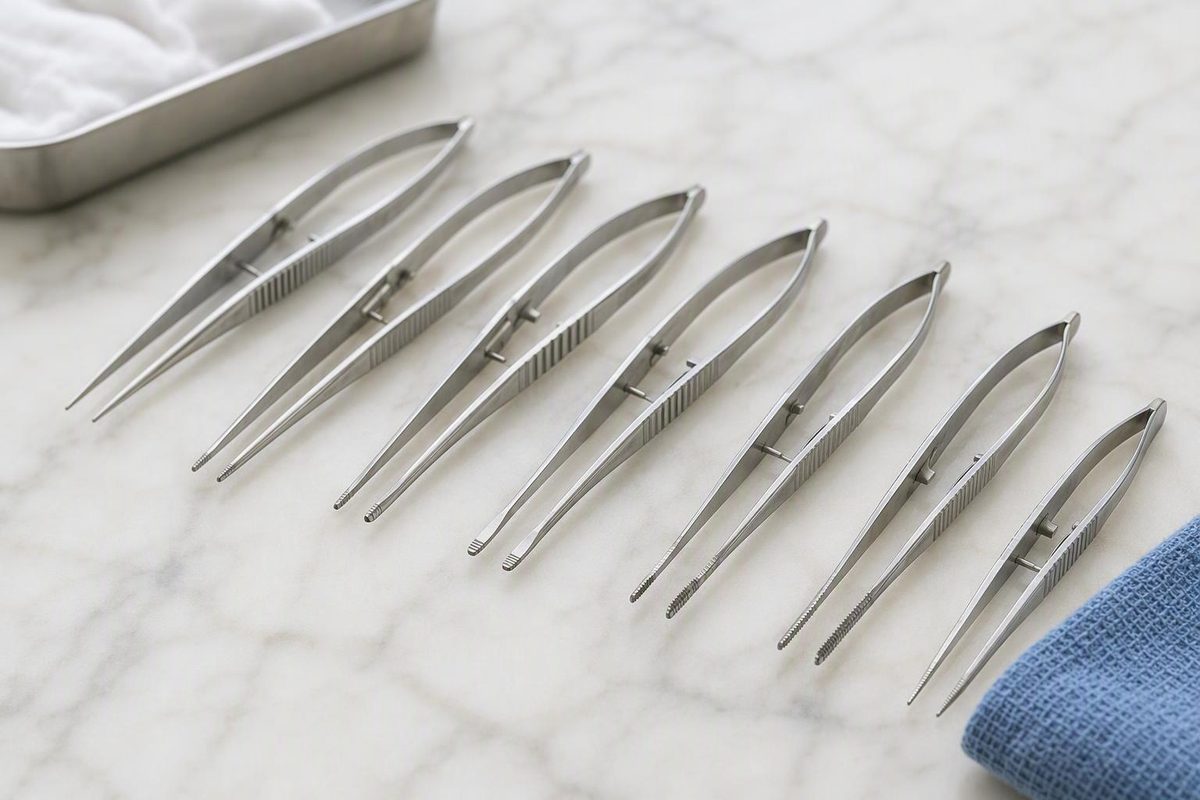
Thumb forceps are non-locking instruments with two spring arms that close when squeezed between the thumb and fingers. They have no finger rings, central hinge or ratchet. Also called pick-ups, grasping forceps or surgical tweezers, they are used to grasp tissue or objects (ACS surgical-instrument guide).
Select the mechanism, jaw construction and profile to narrow the identification.
Thumb Forceps Identifier
The result identifies the likely construction, not a definitive catalogue model.
Spring arms without rings establish the thumb-forceps mechanism. Smooth or serrated jaws without projecting terminal teeth commonly indicate dressing forceps. A straight profile is a model variant, not a separate operating family.
Catalogue Cross-Checks
Adson and Brown-Adson
Documented Adson examples are 4¾ inches (121 mm) with several jaw options. Brown-Adson examples at that length have 7 × 7 or 9 × 9 side-grasping teeth.
DeBakey and Semken
One documented DeBakey model is 6 inches (15.2 cm) with 1.5 mm atraumatic tips. Documented Semken examples include 5-inch (12.7 cm) and 6-inch (15.2 cm) variants with different jaws.
Cushing Bayonet
Documented 7¼-inch (18.4 cm) Cushing bayonet models include both serrated dressing jaws and 1 × 2 tissue jaws.
Sources: American College of Surgeons instrument guide; Integra Padgett and Miltex catalogues. Catalogue examples do not establish every manufacturer’s specification.
“Thumb forceps” identifies the operating mechanism, not a particular jaw pattern. To identify an individual instrument, inspect its tip under magnification and record the teeth or serrations, profile, overall length and manufacturer marking.
Identification at a Glance
| Feature | What to Look For | What It Suggests |
|---|---|---|
| Handle | Two joined spring arms; no rings or ratchet | Thumb-forceps family |
| Closure | Jaws meet while the arms are compressed | Non-locking action |
| Tip | Smooth or serrated, without projecting teeth | Common dressing-forceps construction |
| Tip | One tooth meeting two opposing teeth | 1 × 2 tissue-forceps construction |
| Tip | Several small side-grasping teeth on each jaw | Brown or Brown-Adson may be considered |
| Jaw surface | Fine atraumatic pattern without prominent terminal teeth | DeBakey may be considered |
| Profile | Straight, angled, curved or bayonet-shaped | Model-level variant |
Do not use serrated as a synonym for toothed when documenting an instrument. Catalogues commonly list serrated tips and 1 × 2 teeth as different constructions. In a 1 × 2 tip, one jaw has one tooth and the other has two; the single tooth closes into the gap between the pair (WPI comparison).
Dressing and Tissue Forceps Differ at the Tip
The quickest initial distinction is the terminal jaw construction.
Dressing forceps commonly have opposing smooth or serrated surfaces without projecting terminal teeth. Catalogue descriptions often associate them with grasping gauze, cotton and other materials.
Tissue forceps commonly have interlocking teeth or a specialized atraumatic jaw pattern. That construction provides a different hold and should not be treated as interchangeable with a non-toothed tip.
These are useful catalogue conventions, not universal naming rules. Integra’s Padgett catalogue, for example, lists generic thumb dressing forceps and thumb tissue forceps in the same overall range—4¾ to 12 inches (121 to 305 mm)—but distinguishes them by serrated tips versus 1 × 2 teeth (Padgett instrument catalogue). Length alone cannot settle the type.
Adson Does Not Specify the Jaw Construction
Adson forceps are commonly compact. In the Padgett catalogue, Adson dressing models are 4¾ inches (121 mm) long and have smooth, serrated or cross-serrated jaws. Adson tissue models at the same length include 1 × 2 teeth, 2 × 3 teeth and tying-platform variants (Padgett catalogue).
An instrument labeled only “Adson” therefore still needs a jaw description.
Brown-Adson Has Multiple Side-Grasping Teeth
Brown-Adson forceps have multiple small side-grasping teeth rather than a single 1 × 2 arrangement. Padgett lists 4¾-inch (121 mm) versions with 7 × 7 or 9 × 9 teeth, including straight and angular-tipped models.
Verify the tooth count instead of assuming it from the eponym. See the Brown-Adson identification guide for a closer comparison.
DeBakey Uses an Atraumatic Jaw Pattern
DeBakey tissue forceps use an atraumatic jaw pattern rather than prominent terminal teeth. The Miltex catalogue lists a lightweight model at 6 inches (15.2 cm) with 1.5 mm-wide atraumatic tips (Miltex surgical catalogue).
That documented model is longer than the conventional 4¾-inch Adson examples, but DeBakey length and tip width vary. Confirm both measurements against the product record rather than identifying the pattern from length alone.
Semken Is Available With Several Jaw Types
Semken is another pattern that does not specify one jaw construction. Miltex lists 5-inch (12.7 cm) Semken models with serrated tips, 1 × 2 teeth, 2 × 3 teeth or curved 1 × 2 tips, plus 6-inch (15.2 cm) variants (Miltex catalogue).
A complete Semken description therefore includes the jaw type, profile and length.
Bayonet Describes the Offset Profile
Bayonet forceps have an offset shaft that moves the hand away from the line of the tips. The offset is conspicuous in profile, but it does not determine the jaw construction.
The Miltex catalogue lists a 7¼-inch (18.4 cm) Cushing bayonet dressing forceps with serrations and a tissue version of the same length with 1 × 2 teeth (Miltex catalogue). Record “bayonet” together with the jaw pattern and overall length.
Use the Complete Specification to Identify a Pattern
- Confirm the mechanism. Look for two spring arms without finger rings, a central hinge or a ratchet.
- Inspect the tip under lighted magnification. Note smooth surfaces, serrations, 1 × 2 teeth, multiple teeth or an atraumatic pattern.
- Check alignment. Teeth should interdigitate correctly, and opposing surfaces should meet evenly.
- Record the profile. Identify it as straight, curved, angled or bayonet-shaped.
- Measure the overall length. Record both inches and centimetres or millimetres.
- Read every mark. A manufacturer name, catalogue number, material mark or single-use designation may resolve otherwise similar patterns.
- Match the complete specification. Do not assign a pattern from one feature or an eponym alone.
For the broader distinction between spring and ring-handled instruments, see forceps and tweezers. The surgical-forceps family guide places thumb forceps alongside locking clamps and other forceps designs.
Inspect Reusable Forceps After Decontamination
After decontamination, inspect reusable thumb forceps for cleanliness, tip alignment, corrosion, pitting, burrs, nicks, cracks and correct function. AORN’s published guideline summary says soiled or defective instruments should be removed from service until cleaned or repaired (AORN guideline summary).
Follow the manufacturer’s instructions and facility policy when handling forceps with bent tips, misaligned teeth, damaged jaw surfaces or failed spring action.
Cleaning, packaging and sterilization must follow the exact manufacturer’s validated instructions for use. Pattern recognition does not establish whether an instrument is reusable, supplied sterile, compatible with a particular process or suitable for a clinical task.