
Dressing Forceps: Jaw Patterns, Sizes and Identification
Compare documented dressing forceps sizes and jaw patterns, distinguish Adson dressing from tissue models, and verify sterile or reusable supply status.
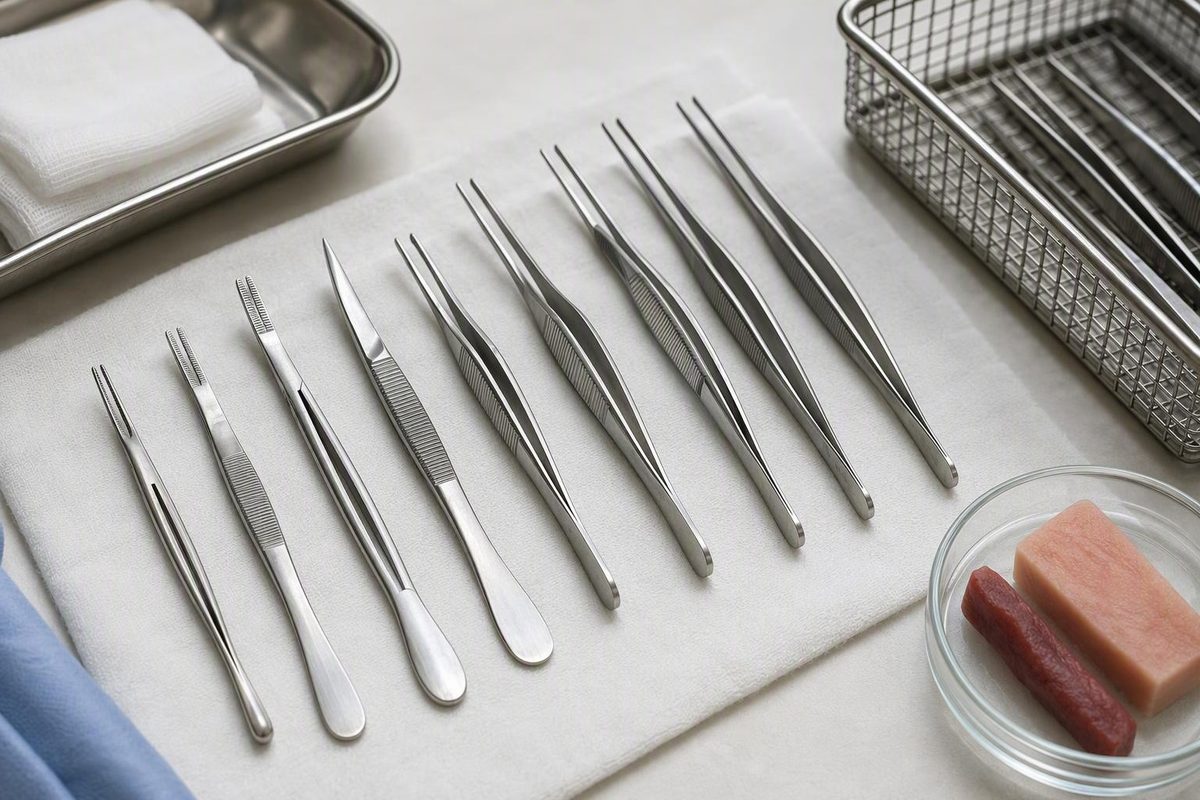
Dressing forceps are commonly tweezer-style thumb forceps used to hold dressing materials such as cotton and gauze. The familiar pattern has serrated gripping surfaces rather than projecting terminal teeth, but smooth-jaw dressing models also exist. Sklar describes both its standard serrated dressing forceps and its smooth Adson dressing forceps as instruments for handling dressing materials. The name identifies a catalogue category and intended role—not one fixed length, tip width or named pattern.
Choose a jaw surface and supply status to compare the documented models.
Compare Documented Dressing Forceps
Three are non-sterile and reusable; one is sterile and disposable. Expand a model for its specifications.
| Model | Length | Jaws | Supply |
|---|---|---|---|
B. Braun BD047RDetailsStandard pattern. Straight; 3.50 mm jaw width. Source: B. Braun BD047R catalogue entry. | 145 mm | Serrated | Non-sterile; reusable |
B. Braun Adson BD222RDetailsStraight, delicate; 1.50 mm jaw width. Source: B. Braun BD222R catalogue entry. | 120 mm | Serrated | Non-sterile; reusable |
Sklar Adson 50-3044DetailsStraight; 121 mm (4¾ in). Tip width: —, not supplied in the specifications reproduced here. Source: Sklar 50-3044 catalogue entry. | 121 mm | Smooth | Non-sterile; reusable |
B. Braun SUSI BD047SUDetailsStraight; 3.40 mm jaw width. Source: B. Braun BD047SU catalogue entry. | 145 mm | Serrated | Sterile; disposable |
Matches are a catalogue shortlist, not an instrument identification or clinical recommendation. No match means no example in this four-model comparison.
Sources: B. Braun and Sklar model specifications cited in the article; — means not supplied here.
Identify The Body Before Naming The Jaw Pattern
The usual dressing-forceps form has two spring arms joined at the rear. It does not have finger rings or a ratchet. WPI describes thumb forceps as spring, non-ratchet instruments in its thumb-forceps guide. That body construction places the familiar dressing pattern within the broader thumb-forceps family, which includes other jaw arrangements.
Body identification is the first step, not the final answer. An instrument with this construction can be described as a thumb forceps before its particular jaw pattern has been established. Calling it a dressing forceps requires the next checks: the gripping surface, the terminal tip, and any manufacturer or model information available.
Keep the handle description separate from the jaw description. A broad grasp area can suggest an Adson pattern, while the working end determines whether the particular model has smooth surfaces, serrations or terminal teeth. Sklar documents the wide thumb-grasp area on its Adson dressing model. That handle feature is useful evidence of the named pattern, but it does not establish whether another similar-looking Adson instrument has dressing or tissue jaws.
An instrument-room description should therefore move from the general construction to the specific working end. “Thumb forceps, straight, serrated” records what is visible. A manufacturer reference can then connect that description to a documented dressing model. Without that reference, the visible features remain an identification description rather than proof of an exact catalogue match.
Serrations And Terminal Teeth Are Different Features
Serrations are repeated ridges on the gripping faces. Terminal teeth are projecting structures at the tip. Those are separate observations, and an instrument can have serrated surfaces as well as terminal teeth. Recording only “serrated” leaves the tip pattern unresolved.
For similar Adson instruments, inspect the terminal teeth before relying on the handle or overall length. Marina lists serrated and smooth models in its Adson dressing range. Its Adson tissue range includes 1 × 2 and 2 × 3 teeth, and some of those tissue models also have serrated surfaces. In that comparison, serrations alone cannot distinguish dressing from tissue forceps.
Smooth jaws need their own entry in an identification record. The Sklar Adson 50-3044 is a documented smooth-tip dressing forceps, so the absence of serrations does not exclude an instrument from the dressing category. Conversely, finding serrations does not establish that the instrument is a dressing model when the terminal tip has not been examined.
The practical distinction is between surface texture and tooth arrangement. Record each independently: smooth or serrated gripping faces, then the presence and count of terminal teeth if visible. This avoids using “teeth” as a loose description for every ridge on the jaw.
These examples support a distinction between particular Adson dressing and tissue models, not a universal rule that every tissue forceps must have terminal teeth. For the separate identification problem posed by multiple-tooth Adson patterns, use the Adson-Brown identification guide.
Length Does Not Establish Tip Width Or Profile
Overall length and jaw or tip width describe different parts of the instrument. A length measurement cannot substitute for the working-end specification. Marina lists 12 cm Adson dressing models with 1.0, 1.3 and 2.0 mm tips. Those examples share a stated length while differing in tip width.
Profile is another independent feature. Marina’s Adson dressing range includes a 45-degree angled model as well as a straight variant. “Adson dressing forceps” therefore does not, by itself, establish a straight working end. Record whether the instrument and its working end are straight, curved or angled rather than filling that field from the pattern name.
Preserve the manufacturer’s wording for dimensions. A specification called “jaw width” should remain jaw width; one called “tip width” should remain tip width. The examples here do not establish that manufacturers measure those terms at identical locations. Recasting every width as the same measurement would imply comparability that the supplied specifications do not demonstrate.
The same caution applies to catalogue lengths. The table retains the stated metric values and, for the Sklar model, its stated inch designation. These are individual model specifications, not a standard size range for all dressing forceps. They can help compare documented instruments, but they do not establish minimum or maximum dimensions for the category.
Documented Models Differ In Jaws And Supply Status
The following examples show why a pattern name alone is insufficient for selection or identification. Each row represents a particular manufacturer reference. It should not be read as the specification for every standard, Adson or disposable dressing forceps.
| Manufacturer / Model | Length | Working End | Supplied Status |
|---|---|---|---|
| B. Braun BD047R | 145 mm | Straight; serrated; 3.50 mm jaw width | Non-sterile; reusable |
| B. Braun Adson BD222R | 120 mm | Straight; delicate; serrated; 1.50 mm jaw width | Non-sterile; reusable |
| Sklar Adson 50-3044 | 121 mm (4¾ in) | Straight; smooth tips | Non-sterile; reusable |
| B. Braun SUSI BD047SU | 145 mm | Straight; serrated; 3.40 mm jaw width | Sterile; disposable |
The Two 145 mm Examples Are Not Interchangeable Records
B. Braun’s standard BD047R and SUSI BD047SU are both listed as straight, serrated dressing forceps with an overall length of 145 mm. That shared description is not enough to distinguish them. The standard model has a stated jaw width of 3.50 mm; the SUSI model has a stated jaw width of 3.40 mm.
Their supply classifications also differ. BD047R is listed as non-sterile and reusable, while BD047SU is listed as sterile and disposable. A record containing only “145 mm serrated dressing forceps” loses both the model-specific width and the distinction between these supply statuses.
This comparison does not establish the material, performance or processing requirements of other instruments that happen to share those dimensions. It demonstrates why the reference number belongs beside the physical description: similar length and texture can occur on products with different documented classifications.
The Adson Examples Do Not Share One Jaw Surface
B. Braun Adson BD222R is listed at 120 mm, with a straight, delicate, serrated working end and a 1.50 mm jaw width. Sklar Adson 50-3044 is listed at 121 mm (4¾ in), with a straight working end and smooth tips. Both are supplied non-sterile and classified as reusable.
Their common Adson name does not make the jaws equivalent. One is explicitly serrated; the other is explicitly smooth. Nor should the Sklar model be assigned the B. Braun model’s width: a tip-width figure for Sklar 50-3044 is not supplied in the specifications reproduced here.
These examples also show the limit of using length as an identification shortcut. The documented lengths are close, but the surface patterns differ. A broad Adson grasp area and an approximate length can narrow an inspection; they cannot replace examination of the jaws or confirmation of the reference number.
Use The Comparison As A Shortlist, Not A Clinical Recommendation
The comparison tool filters only the four documented models in the table. Selecting a jaw surface and supply status gives a shortlist within that small set. It does not identify an unmarked instrument, establish suitability for a procedure or show the full market for dressing forceps.
A smooth, reusable selection points to the Sklar example because it is the only documented model here with that combination. A serrated, sterile-disposable selection points to B. Braun SUSI BD047SU. Those results describe the evidence included on this page, not exclusivity across manufacturers.
If a combination produces no match, read the result as “no documented example in this comparison.” Do not turn it into a claim that the combination cannot exist. Likewise, the tool leaves an unspecified width as unknown rather than assigning a value from another Adson instrument.
The supplied specifications do not provide prices or comparative grip measurements. They therefore cannot support a price ranking or a claim that one jaw surface holds dressing material better than another. The useful comparison here is the documented pattern, dimensions and supply classification, with the relevant gaps left visible.
Verify Sterility And Reuse From The Exact Product
Sterility and reuse status must come from the packaging and model documentation, not from the dressing-forceps name. The two 145 mm B. Braun examples make that limitation concrete: one is supplied non-sterile and reusable, and the other sterile and disposable.
Keep “supplied sterile” separate from an assertion about the current condition of an instrument. A catalogue entry describes how that product is supplied; it does not establish the present status of an instrument encountered outside its verified packaging. Similarly, a reusable classification does not provide a reprocessing method.
Follow the applicable instructions for use and local processing procedures for the exact product. None of the jaw descriptions or dimensions above supplies a cleaning sequence, sterilization cycle or permission to reuse a disposable model. Those decisions cannot be derived from a straight profile, a serrated surface or an Adson handle.
For an instrument-room record, capture the manufacturer and reference number alongside overall length, profile, jaw texture and terminal tooth count. Preserve jaw or tip width when it is documented, and record sterility and reuse status from the product information. If a field is unverified, leave it unresolved rather than copying a specification from a similar model.
The resulting identification is specific enough to distinguish a smooth Adson dressing model from a serrated one, and a reusable standard model from a disposable product of the same length. That is the useful endpoint: a documented instrument identity, not a category name standing in for all of its specifications.
Educational identification reference, not clinical instruction or a substitute for professional training.