
Adson-Brown Forceps: Identification, Teeth and Variants
Identify Adson-Brown forceps by their thumb-forceps body and multiple 7 × 7, 8 × 8 or 9 × 9 teeth; compare Adson tissue and dressing patterns.
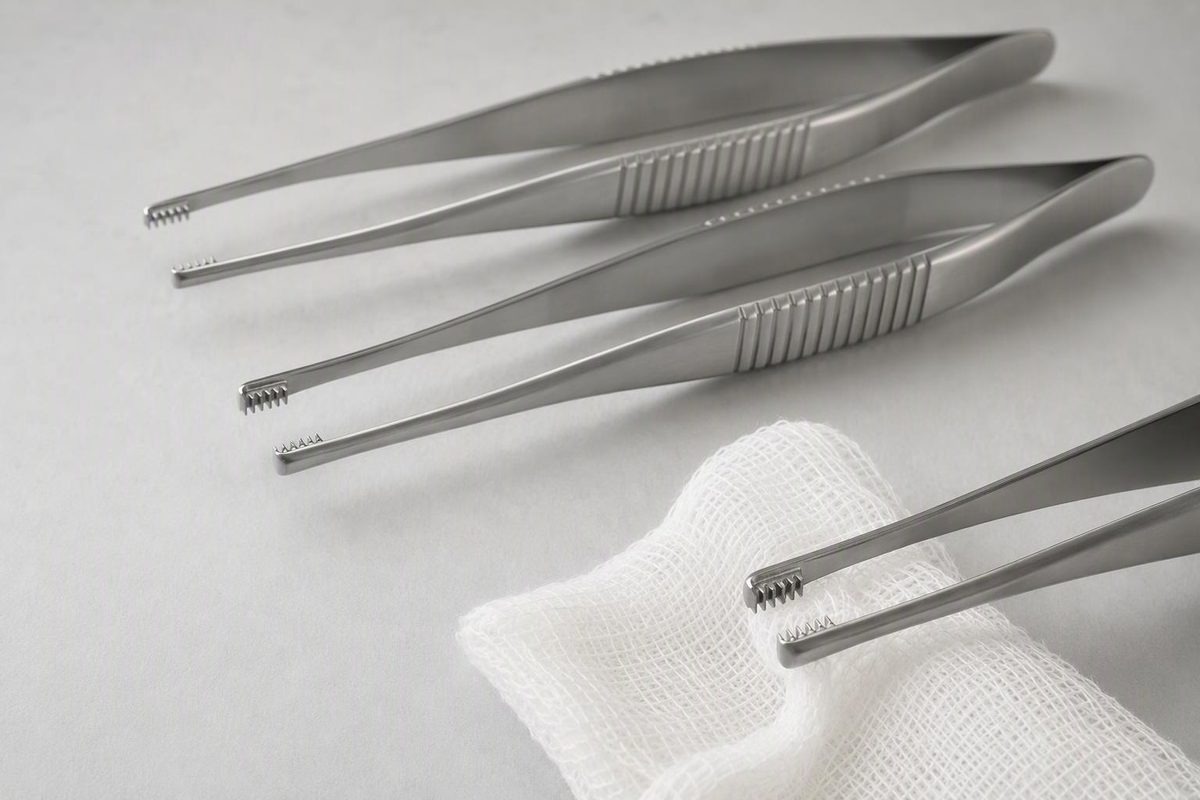
Adson-Brown forceps are thumb tissue forceps identified by multiple fine, side-grasping teeth along their short tips. Common catalog patterns are 7 × 7 and 9 × 9 teeth, often on an instrument about 12 cm (4.75 in) long. The repeated tooth rows—not the Adson-shaped handle or length alone—separate the Brown pattern from standard Adson tissue and dressing forceps.
Identification at a glance
| Feature | Typical Adson-Brown pattern |
|---|---|
| Instrument family | Thumb tissue forceps; no finger rings or ratchet |
| Jaw feature | Multiple fine, opposed side-grasping teeth |
| Common tooth counts | 7 × 7 or 9 × 9; 8 × 8 is also documented |
| Common length | About 12 cm (4.75 in) |
| Shape | Straight is common; angled and curved models also exist |
| Catalog role | Holding and manipulating delicate tissue |
A Bydand catalog describes a 12 cm Adson-Brown model as having 9 × 9 serrated teeth running horizontally down the tips. Sklar describes the Adson form as having a wide, flat thumb-grasp area, short jaws and narrow tips; its Adson-Brown models add multiple side-grasping teeth (Bydand catalog, Sklar).
“7 × 7” and “9 × 9” are manufacturer tooth-pattern specifications. On an unidentified instrument, inspect both opposed tips for repeated fine teeth rather than relying on the handle profile. A conventional 1 × 2 Adson instead has one tooth opposing two teeth.
Adson-Brown vs standard Adson forceps
Several instruments share the same compact Adson silhouette, so identify the jaw before relying on the handle.
| Pattern | Jaw or tip | Practical identification point |
|---|---|---|
| Adson-Brown tissue forceps | Multiple fine teeth, commonly 7 × 7 or 9 × 9 | Repeated toothed section along the tip |
| Adson tissue forceps | Often 1 × 2 teeth; other patterns exist | One tooth meets the gap between two opposing teeth |
| Adson dressing forceps | Serrated jaws without projecting tissue teeth | Grooved gripping surface rather than interlocking teeth |
Securos lists all three forms at 4.75 in: Adson-Brown models with 7 × 7 or 9 × 9 teeth, standard Adson tissue forceps with 1 × 2 teeth, and Adson dressing forceps with serrated jaws. Length is therefore a poor discriminator by itself (Securos Adson catalog). For the broader distinction between thumb and ring-handled patterns, see Forceps and Tweezers Differ More by Design Than Name.
Sizes and variants are model-specific
The name “Adson-Brown” does not settle the complete specification:
- Length: Integra lists straight 7 × 7 models at 124 mm and 151 mm, with corresponding catalog length labels of 4-7/8 in and 5-7/8 in. The 124 mm model has a stated 2 mm jaw width (Integra MicroFrance).
- Tooth count: Securos documents separate 4.75 in stainless-steel models with 7 × 7 and 9 × 9 teeth (7 × 7 model, 9 × 9 model). Medline also lists a 12 cm (4.75 in), straight-tip 8 × 8 version, so 7 × 7 and 9 × 9 are common rather than exclusive (Medline).
- Tip geometry: Marina lists straight, angled and fenestrated 7 × 7 versions in 12 cm (4.75 in) and 15 cm (6 in) lengths (Marina Medical).
- Jaw material: Tungsten-carbide-jaw versions exist alongside stainless-steel models. WPI specifies a 12 cm (4.75 in), straight, 7 × 7 stainless-steel model with tungsten-carbide jaws (WPI).
- Sterility and reuse: These are SKU-level attributes, not properties established by the pattern name. Sklar identifies model 95-778, a 121 mm (4.75 in), straight 7 × 7 instrument, as reusable and non-sterile (Sklar Surgi-OR).
For tray identification or replacement purchasing, record the manufacturer and catalog number, overall length, tooth count, straight or angled form, tip width, material, sterility and reuse status. If wear, damage or residue obscures the teeth, do not infer the exact model from the handle shape; check the instrument marking and the facility’s approved catalog or count sheet.