
Lahey Clamp: Identification, Teeth and Variants
Identify Lahey traction and goitre forceps by their prongs, ring handles and ratchet, and distinguish them from dissecting and gall duct patterns.
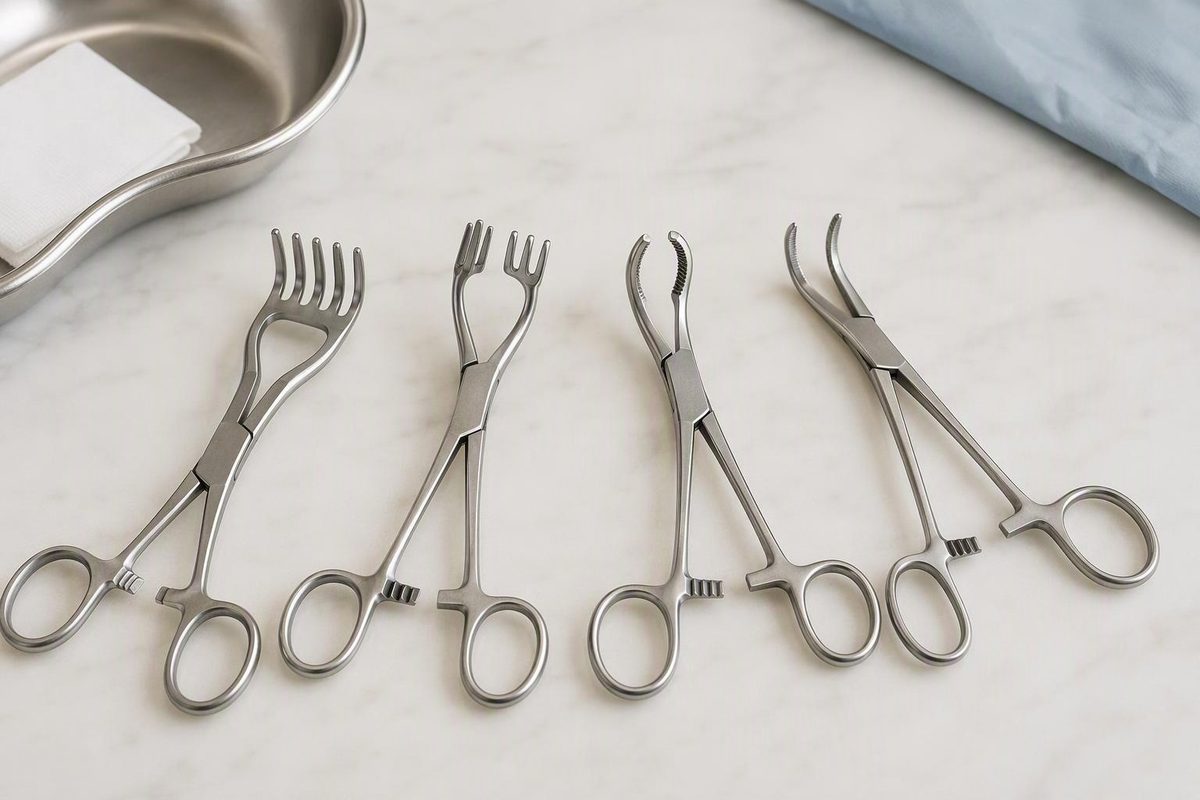
Lahey traction or goitre-grasping forceps have pointed, toothed jaws, finger rings and a ratchet lock. However, “Lahey clamp” is not a complete instrument identification: the Lahey name also appears on curved, serrated dissecting and ligature forceps and on gall duct forceps. Start with the working end, then confirm the full catalogue name and model. (Sklar traction forceps, SURTEX dissecting and ligature forceps, Pilling gall duct forceps)
Recognizing the traction or goitre pattern
The useful identifying combination is:
- Pointed teeth or prongs: documented examples have 2 × 2 or 3 × 3 teeth, rather than simply serrated gripping surfaces.
- Finger-ring handles: distinguish this form from spring-arm thumb forceps.
- A ratchet lock: the locking mechanism retains the jaws in the closed position.
Sklar describes its 6¼-inch Lahey traction forceps as perforating forceps for grasping fibrous tissue, with 3 × 3 sharp teeth. Its stated uses include grasping breast tissue during mastectomy and tissue or glands during thyroid surgery. SURTEX describes its Lahey goitre-grasping pattern for thyroid surgery, with toothed jaws, finger rings and a ratchet. These descriptions identify a tissue-grasping role; the word clamp should not be read as a promise of atraumatic handling. (Sklar description, SURTEX goitre-grasping forceps)
Documented lengths and tooth patterns
Dimensions below are manufacturer-listed overall lengths, not jaw lengths. They are examples, not a universal size range.
| Catalogue example | Overall length | Listed teeth or prongs | Profile information |
|---|---|---|---|
| Sklar 17-3562 | 159 mm / 6¼ in | 3 × 3, sharp | Listed as straight |
| Sklar 91-2080 | 203 mm / 8 in | 3 × 3 prongs | Listed as straight |
| SURTEX goitre-grasping example | 155 mm / 15.5 cm | 2 × 2 | Description notes inner jaw curves |
| SURTEX goitre-grasping example | 200 mm / 20 cm | 3 × 3 | Description notes inner jaw curves |
A Lahey-pattern instrument with 2 × 2 teeth is therefore not automatically misidentified. Nor should every instrument bearing the name be assumed to measure 6¼ inches.
Other instruments carrying the Lahey name
Lahey dissecting and ligature forceps: SURTEX model AF-519-18 has curved, longitudinally serrated jaws, ring handles, a box joint and a ratchet. Its listed length is 18.5 cm / 7¼ inches. This is a different working-end pattern from the pointed-prong traction forceps. (Manufacturer specifications)
Lahey gall duct forceps: Pilling catalogue number 172530 is listed as curved, 19 cm / 7½ inches. That entry does not specify the tooth or serration pattern, so the name and length alone cannot establish its detailed jaw design. (Pilling catalogue entry)
What to record for a tray identification
Record the manufacturer and catalogue number, full instrument name, overall length, jaw curvature, tooth count or serration direction, and presence of a ratchet. For another toothed, ring-handled pattern, see the Allis tissue forceps identification guide.
Sklar lists both traction examples above as reusable stainless-steel instruments supplied non-sterile. Reusable does not mean ready for use: consult the exact manufacturer’s reprocessing instructions and local policy. This guide supports identification, not clinical technique. (17-3562 specifications, 91-2080 specifications)