
Allis Tissue Forceps: Teeth, Sizes and Uses
Identify Allis tissue forceps by their ring handles, ratchet and interlocking teeth. Compare tooth counts, documented sizes, Babcock and Kocher patterns.
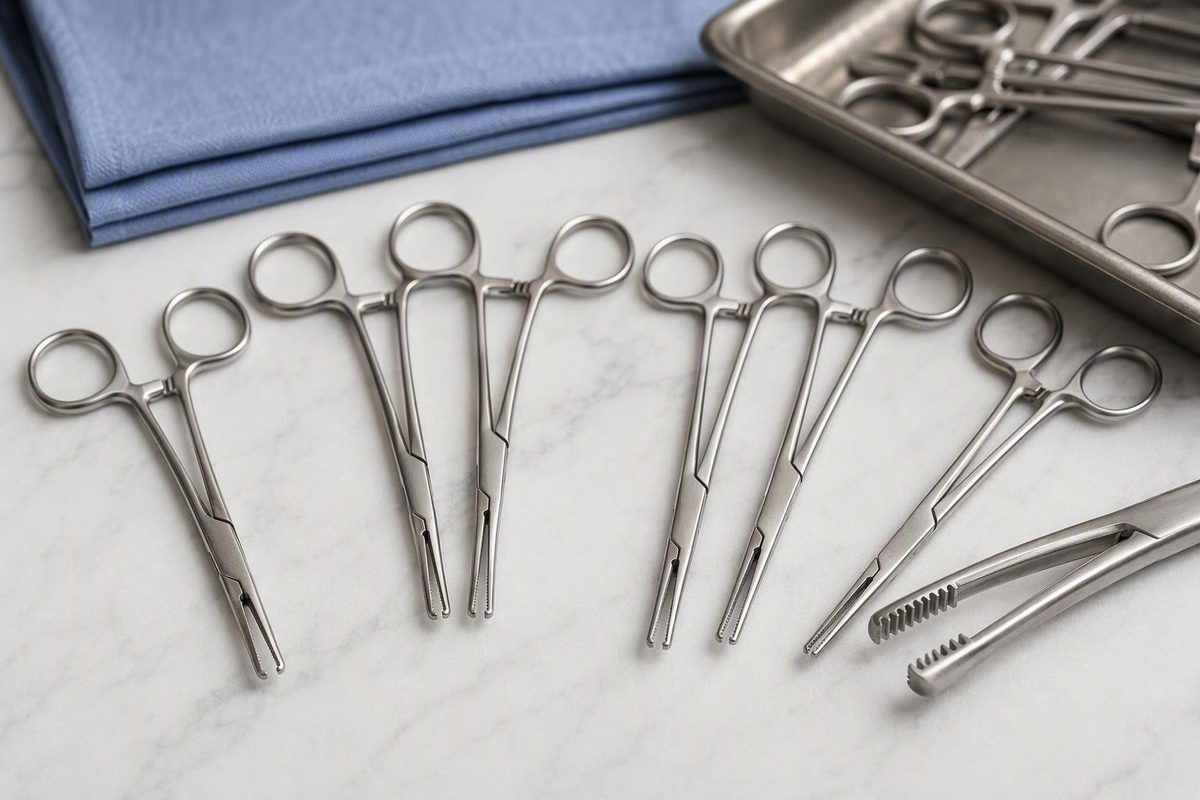
An Allis tissue forceps is identified by its finger rings, locking ratchet and short jaws with multiple interlocking teeth. Cataloged tooth patterns include 3 × 4, 4 × 5 and 5 × 6. Representative reusable models range from a 5⅛ in (130 mm) Baby Allis to a 10 in (255 mm) slender pattern, but length, jaw width and profile vary by model.
Select the handle, working-end and locking features to check the instrument pattern.
Instrument Pattern Check
Match the visible construction rather than relying on tray position or handle shape alone.
- Allis: short jaws with multiple interlocking teeth.
- Babcock: broad, rounded fenestrated jaws without an Allis tooth row.
- Kocher: elongated serrated jaws with teeth at the tip.
- Thumb forceps: spring handles rather than finger rings and a ratchet.
Source note: Identification features and tooth patterns are drawn from the Sklar, Integra Miltex and University of Saskatchewan references cited in the article.
How to Identify an Allis Tissue Forceps
- Look for finger rings and a ratchet. A conventional Allis is a hinged, locking instrument rather than a spring-handled pair of thumb forceps. Sklar describes its reusable 5½ in model as having finger rings, a ratchet and a straight profile (Sklar 22-6157).
- Open the jaws. An Allis has a short, toothed working end. The teeth interlock across the opposing jaws instead of terminating a pair of long, serrated clamping surfaces.
- Count both sides. Catalog descriptions include 3 × 4, 4 × 5 and 5 × 6 teeth. The notation records the opposing tooth counts: five teeth on one jaw engage six on the other in a 5 × 6 model.
- Check the profile. Straight models are common, but angled versions are also documented. Integra lists 5¾ in (146 mm) angled-jaw models with either 4 × 5 or 5 × 6 teeth (Integra Miltex ordering specifications).
- Confirm the exact model. Record overall length, jaw width, tooth count, curvature, material, manufacturer mark and catalog number. “Allis” names an instrument family, not one fixed specification.
Manufacturers describe the conventional pattern as a grasping instrument for organs and slippery or dense tissue. Its interlocking teeth and ratchet produce a secure, localized hold, but they also make it a traumatic rather than atraumatic pattern. A University of Saskatchewan teaching guide describes the hold as a combination of compression and tooth interdigitation (WCVM tissue-forceps guide). Intended clinical use remains specific to the model and procedure.
What 4 × 5 and 5 × 6 Teeth Mean
The numbers are tooth counts, not jaw dimensions. In a 4 × 5 pattern, four teeth on one jaw engage five on the opposing jaw. A higher count does not by itself establish that an instrument is longer, stronger or more delicate.
Integra, for example, lists both a 5½ in (14 cm), 4 × 5 delicate model with a 4 mm jaw and a 6 in (15.2 cm), 4 × 5 model with a 4.5 mm jaw. Its 156 mm, 5 × 6 model has a stated 5.5 mm jaw. Count the teeth, but measure the instrument and compare its other features before assigning a model.
Do not infer tooth count from the closed silhouette. Open the jaws far enough to inspect both sides, then check whether the teeth interdigitate evenly. Bent or missing teeth can make the pattern difficult to count and render the instrument unsuitable for service.
Documented Allis Sizes and Variants
These catalog examples demonstrate the available range; they are not universal size standards.
| Catalog Example | Length | Teeth | Distinguishing Detail |
|---|---|---|---|
| Aesculap EA012R Baby Allis | 5⅛ in (130 mm) | 4 × 5 | Straight, reusable (B. Braun) |
| Integra Miltex 16-4 | 5½ in (14 cm) | 4 × 5 | Delicate, 4 mm jaw |
| Teleflex Pilling 182850 | 6 in (15 cm) | 4 × 5 | Conventional catalog model (Teleflex) |
| Integra Miltex 16-8 | 156 mm | 5 × 6 | 5.5 mm jaw |
| Integra Miltex 16-24 | 7 in (174 mm) | 5 × 6 | Angular jaws |
| Teleflex Pilling 182875 | 9 in (23 cm) | 5 × 6 | Extended length (Teleflex catalog) |
| Aesculap EA018R | 10 in (255 mm) | 5 × 6 | Straight, slender pattern (B. Braun) |
Length alone does not indicate jaw weight or delicacy. Catalogs separately identify delicate, standard, slender, angular-jaw and specialty patterns. Material can also vary. Teleflex lists a 6 in (15 cm), 4 × 5 titanium version (Teleflex KM83544), while the cited Sklar delicate model is stainless steel.
When replacing an instrument, match the catalog number where possible. Two instruments described simply as “6-inch Allis” can differ in tooth pattern, jaw width, material or profile.
Allis Versus Babcock Forceps
Allis and Babcock forceps may both have finger rings, a box lock and a ratchet. The reliable distinction is at the working end.
| Feature | Conventional Allis | Babcock |
|---|---|---|
| Jaw form | Short opposing jaws with multiple interlocking teeth | Broad, rounded fenestrated jaws |
| Grasping surface | Countable tooth row, often 3 × 4, 4 × 5 or 5 × 6 | Smooth or longitudinally grooved inner surface; no Allis tooth row |
| General character | Firm, localized, traumatic grip | Broader, less traumatic grip |
The Saskatchewan guide characterizes Babcock jaws as less traumatic but less secure than Allis jaws. See Babcock forceps for open and laparoscopic variants.
A broad, loop-like or fenestrated working end points toward Babcock rather than Allis. Do not classify the instrument from the handles alone because the shared ring-and-ratchet arrangement is not distinctive enough.
Allis Versus Kocher Clamps
Do not identify an Allis as a Kocher merely because both instruments lock and have teeth. A conventional Kocher clamp has elongated serrated jaws with teeth at the tip. An Allis concentrates a wider row of several interlocking teeth at its short working end.
The position of the teeth is therefore more useful than the mere presence of teeth. Tip teeth on long serrated jaws indicate a different pattern from a short, multi-tooth Allis jaw.
Inspection and Processing Points
For identification and set assembly, open the instrument and verify that:
- the tooth count matches the tray list or model record;
- no tooth is bent, blunted or missing;
- opposing teeth interdigitate evenly;
- the ratchet engages and releases correctly;
- the box lock moves freely without excess play; and
- the length and curvature match the required model.
Process a reusable Allis according to its current manufacturer instructions for use and the facility’s validated procedures. Integra’s general reusable-instrument guidance calls for cleaning jaws, tips, ratchets and box locks, keeping hinges and box locks open during cleaning, and inspecting for worn ratchets, loose box locks and misaligned jaws (Integra/Jarit care guidance). Do not return a damaged or malfunctioning instrument to service.