
Alligator Forceps: Identification, Uses and Variants
Identify alligator forceps by their distal jaws and narrow shaft, then distinguish ear, laryngeal, rigid endoscopic and flexible models.
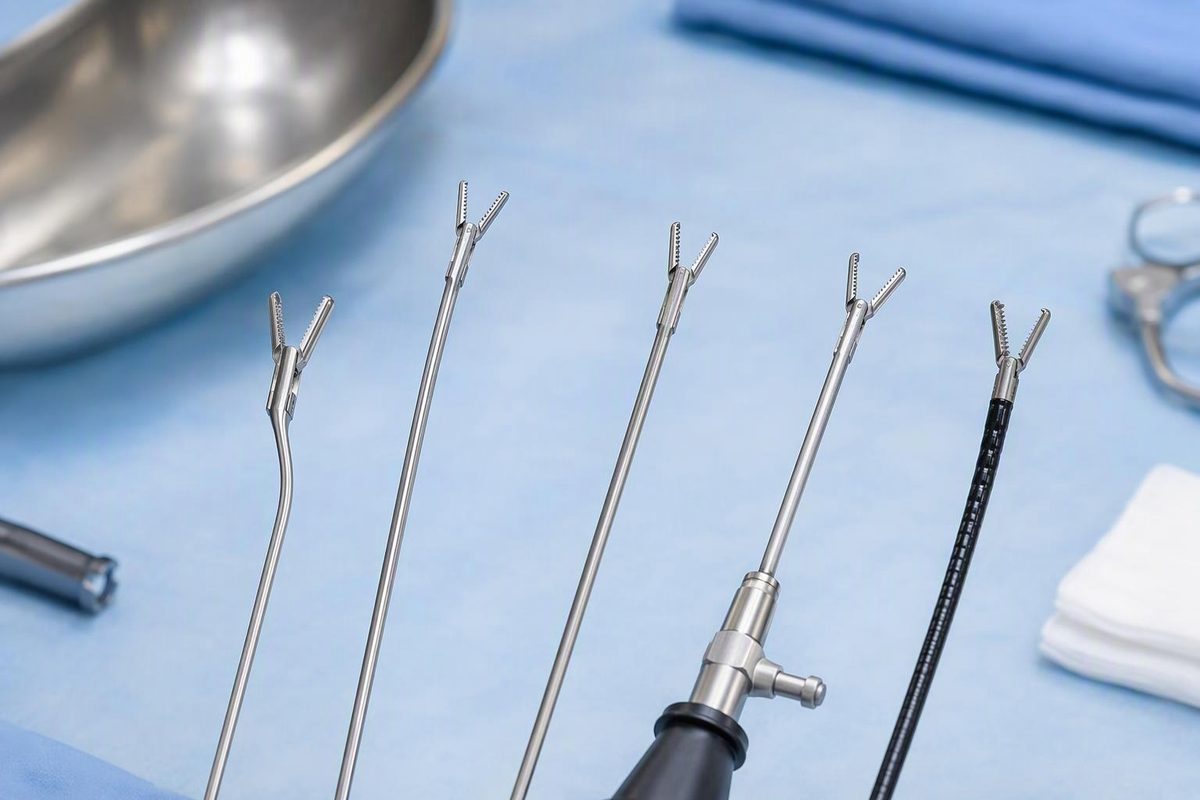
Alligator forceps have small opposing jaws at the distal end of a long, narrow shaft, with the handle operating those jaws from a distance. A familiar handheld version is the Hartmann-pattern ear forceps, but “alligator” does not specify one size, specialty or configuration. The name also appears on laryngeal and rigid or flexible endoscopic instruments.
For identification, record the handle, shaft, jaw surface, jaw direction, working length and manufacturer mark. Do not identify an unknown instrument from the alligator name alone.
Identification at a glance
| Feature | What to check |
|---|---|
| Working end | Short opposing jaws concentrated at the distal tip |
| Shaft | Long and narrow relative to the jaws; rigid on handheld patterns but flexible on some endoscopic accessories |
| Jaw action | Handle movement is transmitted along the shaft; some models specify double-action jaws |
| Jaw surface | Serrated, toothed and combination patterns are catalogued; cup and oval ear-forceps jaws can look similar |
| Direction | Straight, angled up or down, or curved left or right, depending on model |
| Handle | Common handheld ENT patterns have scissor-style ring handles; endoscopic versions use a control handle suited to their system |
| Lock | Check directly rather than assuming the instrument has the ratchet found on many hemostatic forceps |
This layout separates an alligator pattern from spring-arm thumb forceps and conventional ring-handled clamps, although instrument naming is not perfectly consistent. See forceps and tweezers for the broader handle distinction and types of surgical forceps for the main instrument families.
“Alligator” does not settle the specialty or size
Manufacturer catalogues show how widely the name travels:
- Hartmann alligator ear forceps: Integra lists two reusable, straight stainless-steel models with 66 or 66.5 mm working lengths, 3.6 or 4.5 mm jaws, and 128 or 126.5 mm overall lengths. Both are classified for otology. (Integra LifeSciences)
- Otology variants: Aesculap’s ENT catalogue lists 80 mm (3¼ in.) alligator forceps with straight jaws, 45° down-angled jaws, 55° up-angled jaws, and left- or right-curved jaws. Stated tip dimensions range from 0.8 × 3.5 mm to 1.5 × 6.0 mm. (Aesculap ENT catalogue)
- Long laryngeal pattern: Integra’s Jackson alligator grasping forceps has a 280 mm working length and a 22 × 4 mm serrated jaw. It is straight, reusable and classified for laryngology—substantially different from a compact ear model. (Integra LifeSciences)
- Rigid endoscopic pattern: A KARL STORZ model has a 45 cm working length, 2 mm shaft diameter, 3.5 mm outer diameter, straight serrated alligator jaws and double-action movement. Its listed applications include foreign-object removal in pediatric bronchoscopy as well as laryngology and esophagoscopy. (KARL STORZ)
- Flexible endoscopic accessories: Olympus lists reusable, autoclavable alligator-jaw graspers with 165 or 230 mm working lengths, 7.5 or 11.3 mm opening widths, and minimum channel requirements of 2.8 or 3.7 mm, depending on the model. (Olympus) Its rat-tooth alligator models have 11.3, 14.9 or 19.5 mm opening widths and require a 2.8 mm minimum channel. (Olympus)
These examples are not interchangeable specifications. “Hartmann,” “alligator” and even a stated length do not establish jaw geometry or system compatibility.
How to label an unknown example
Use a model-level description rather than a bare name:
Alligator forceps; rigid handheld ENT pattern; straight serrated jaws; jaw length ___ mm; working length ___ mm; overall length ___ mm; mark/SKU ___.
Check the jaws in the open position. Fine differences—serrations versus teeth, a cup versus a flat jaw, or an upward angle versus a straight tip—may be difficult to see when closed. Also distinguish working length, overall length, jaw length and opening width; manufacturers report these as separate dimensions.
For processing or tray assignment, match the instrument’s mark or SKU to its current manufacturer documentation. Reuse status, sterilization method and device compatibility are model-specific. The cited Integra handheld models are reusable, while Olympus identifies the cited endoscopic models as reusable and autoclavable. An unidentified look-alike should not inherit another alligator forceps’ processing instructions merely because its jaws appear similar.