
Russian Forceps: Identification, Uses and Documented Sizes
Identify Russian forceps by their cupped tips, compare documented lengths and jaw widths, and distinguish Adson and Mayo-Russian catalogue specifications.
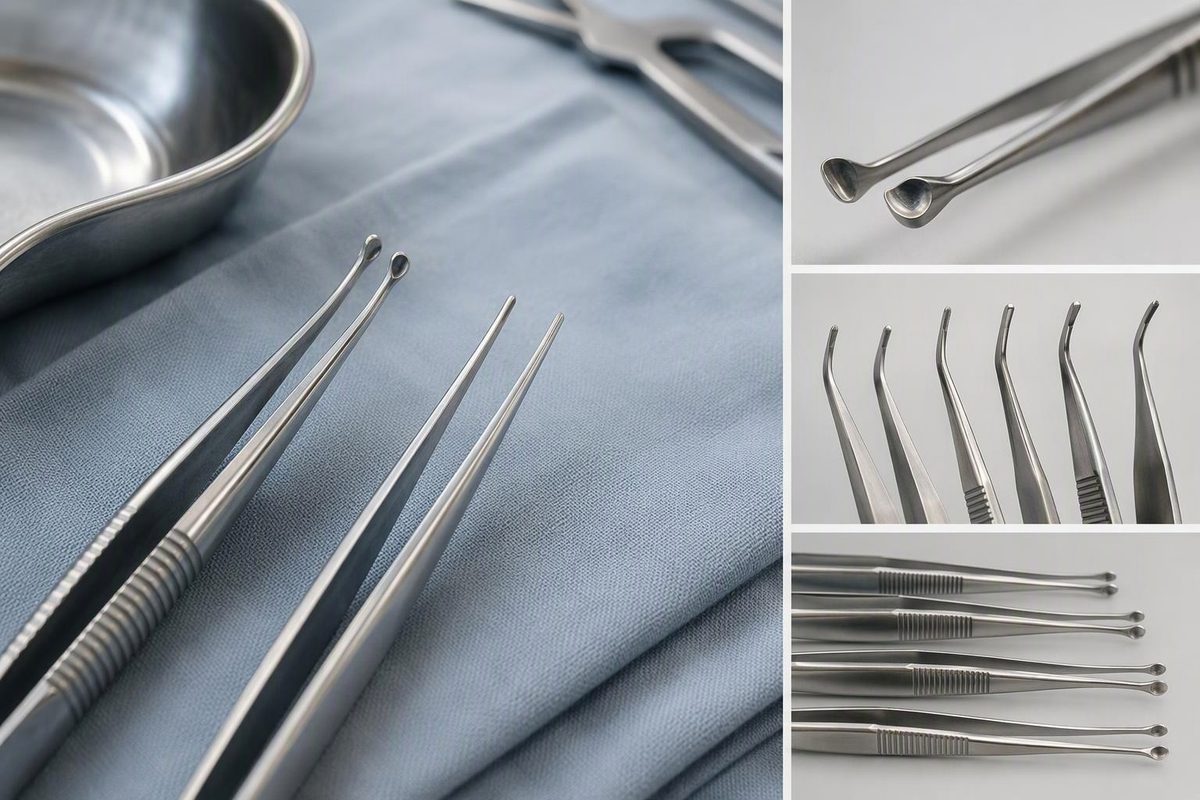
Russian forceps are thumb tissue forceps recognized by rounded, cupped or scoop-like tips with serrated gripping surfaces. The working end is a better identification clue than overall length. Sklar’s Russian tissue forceps 19-2280, for example, have a thumb handle, a straight profile and radially serrated, cupped tips, with an overall length of 203 mm (8 in). Those features identify the documented model; the length alone does not establish the pattern. Sklar product specification
Choose a catalogue model to compare its listed length, tip width and identification details.
Russian Forceps Model Lookup
Sklar Russian 19-2280
Listed length: 203 mm (8 in). Tip/jaw width: —.
Straight, thumb handle, radially serrated cupped tips. Reusable stainless steel; supplied non-sterile. Finish not stated.
| Model | Listed Length | Tip Width |
|---|---|---|
Sklar Russian 19-2280DetailsStraight, thumb handle, radially serrated cupped tips. Reusable stainless steel; supplied non-sterile. Finish not stated. | 203 mm (8 in) | — |
Jarit Russian 130-390DetailsStraight, serrated, reusable stainless steel. Mirror finish. Source: Integra Jarit ordering specifications. | 150 mm (5⅞ in) | 6 mm |
Jarit Russian 130-392DetailsStraight, serrated, reusable stainless steel. Mirror finish. Source: Integra Jarit ordering specifications. | 200 mm (7⅞ in) | 7 mm |
Jarit Russian 130-394DetailsStraight, serrated, reusable stainless steel. Mirror finish. Source: Integra Jarit ordering specifications. | 305 mm (12 in) | 7.5 mm |
Sklar Mayo-Russian 19-2320DetailsDescribed as “serrated with spoon,” with large rounded scoop ends and deep teeth. Tip width not stated. Source: Sklar 19-2320 specification. | 229 mm (9 in) | — |
Sources: Integra Jarit and Sklar product specifications cited in the article. Dimensions are listed values; — means not stated. With JavaScript disabled, compare the full table.
Cupped Tips Are the Main Identification Clue
Begin at the working end. A Russian-pattern candidate should have rounded, scoop-like gripping ends rather than the narrow tips shown on the documented Adson comparison below. Look at both the outline of the tips and the surfaces that meet when the instrument closes. A rounded outline and a serrated gripping surface describe different parts of the identification; neither should replace the other in a tray record.
For Sklar 19-2280, the relevant combination is a cupped tip shape with radial serrations. That is more specific than writing only “serrated forceps.” The latter description leaves out the feature that makes this model recognizable. It also gives someone ordering a replacement too little information to check whether the proposed instrument has the same working end.
Next, check the body. The documented Sklar Russian model has a thumb handle, not the ring-handled form of a clamp. The spring-arm body puts it in the thumb-forceps category, but that category includes other tip patterns. Use the thumb-forceps identification guide to establish the broad instrument type, then return to the tip shape to distinguish the pattern.
Finally, read the manufacturer’s name and item number, where available. A visual match can support identification, but it does not supply an unlisted jaw width or prove an exact catalogue match. If the markings cannot be read, keep the identification provisional rather than assigning the dimensions of a familiar model to the instrument in hand.
Tip Descriptions Differ Between Documented Models
Sklar describes its Mayo-Russian 19-2320 as having large, rounded, scoop ends with deep teeth. Its Russian 19-2280 description instead specifies radially serrated, cupped tips. The shared scoop-like appearance is useful for recognizing the family, but the wording does not establish that the two working surfaces are identical.
Catalogue descriptions may therefore use serrated, radially serrated or toothed, depending on the model. Preserve the wording attached to the item being recorded. Do not silently turn “deep teeth” into a tooth count, or turn “serrated” into a claim about the direction of the serrations. The specifications provided here do not give those missing details. Russian specification · Mayo-Russian specification
Documented Uses Concern Heavy or Dense Tissue
Sklar describes Russian forceps as medium-heavy instruments for grasping heavy or thick tissue and for use during wound closure. Its Mayo-Russian description also lists holding dense tissue during wound debridement and closure. These are manufacturer-documented roles for the models described, not a procedure-specific instruction to select either instrument.
For an identification reference, this use information helps explain why a cupped Russian tip belongs in a different description from a narrow Adson tip. It does not establish that every instrument sold under the Russian name has the same dimensions, gripping surface or approved application. Confirm the exact item before transferring a catalogue description into an instrument record.
Sklar also calls the Russian model’s tips “atraumatic.” Treat that as the manufacturer’s catalogue terminology, not a guarantee of injury-free handling. It does not, by itself, establish suitability for every tissue or make the instrument interchangeable with another forceps carrying the same label. Sklar Russian description
The sources used here do not supply a quantified tissue-injury comparison between Russian, Mayo-Russian and Adson forceps. They also do not provide a numerical gripping-force specification. No comparative safety ranking or force recommendation can be drawn from these product descriptions.
Listed Lengths and Tip Widths Vary by Item
There is no single Russian-forceps length represented by these catalogue examples. The documented Russian models range from the shorter Jarit entry to the longer Jarit entry shown below, and the Sklar Russian model has its own listed dimensions. A length is useful for narrowing a match, but it is not a substitute for the manufacturer and item number.
| Manufacturer and Item | Listed Length | Tip/Jaw Width | Finish |
|---|---|---|---|
| Integra Jarit 130-390 | 150 mm (5⅞ in) | 6 mm | Mirror |
| Integra Jarit 130-392 | 200 mm (7⅞ in) | 7 mm | Mirror |
| Integra Jarit 130-394 | 305 mm (12 in) | 7.5 mm | Mirror |
| Sklar 19-2280 | 203 mm (8 in) | Not stated | Not stated |
These are manufacturer-listed dimensions, not new inch-to-millimetre conversions. Preserve each paired measurement as listed when quoting the specification. The Jarit examples are straight, serrated, reusable stainless-steel instruments. The Sklar example is also reusable stainless steel and is supplied non-sterile. Integra ordering specifications · Sklar specification
The table separates overall length from tip or jaw width because they answer different identification questions. Overall length describes the instrument’s listed size. The width describes the working end more directly. Matching one measurement does not establish a match on the other, and the table does not support inferring a missing width from a listed length.
For Sklar 19-2280, the cited specification does not state a tip width or finish. “Not stated” means the figure or description is absent from the source used here; it does not mean the instrument has no measurable width or finish. A replacement request that depends on either detail needs confirmation from the exact item’s documentation rather than an estimate borrowed from a Jarit model.
A Similar Length Does Not Establish Equivalence
The Jarit 130-392 is listed at 200 mm (7⅞ in), while Sklar 19-2280 is listed at 203 mm (8 in). Those catalogue lengths are close, but the available entries do not establish equal jaw widths or identical tip geometry. The Jarit entry states a 7 mm width; the Sklar entry does not state one.
The same limit applies within the Jarit examples. Their listed widths are 6 mm, 7 mm and 7.5 mm, respectively. Retaining those widths prevents a record from reducing three documented variants to a single generic “Russian forceps” entry. It also makes clear which size was actually requested, without assuming that the longest instrument has the same working end dimensions as the shortest.
Russian and Adson Differ at the Working End
The documented Sklar Adson tissue forceps 50-3170 have short jaws, narrow tips and 1 × 2 teeth. That combination differs from the cupped, radially serrated tips described for Sklar Russian 19-2280. Both identification descriptions involve tissue forceps, so the thumb handle alone does not separate them. Sklar Adson specification
| Identification Feature | Sklar Russian 19-2280 | Sklar Adson 50-3170 |
|---|---|---|
| Tip Shape | Rounded, cupped | Narrow |
| Working Surface | Radial serrations | 1 × 2 teeth |
| Other Listed Detail | Straight profile | Short jaws |
This comparison is deliberately model-specific. It does not establish the specifications of every Adson variant or every Russian-pattern product. If an instrument has narrow tips, do not classify it as this Russian model solely because it is a thumb forceps. Conversely, “toothed” alone is not enough to identify this Adson model, because the Mayo-Russian description also uses tooth terminology.
For a practical identification note, put the distinguishing working-end description before the broad category: “cupped, radially serrated tips” is more informative than “thumb tissue forceps” alone. Once the pattern is established, add the manufacturer and item number to resolve the variant. If those details are unavailable, leave the exact model unresolved.
Mayo-Russian Requires Its Own Item-Level Check
Sklar groups Russian and Mayo-Russian items in one product family, but the family name does not make their specifications interchangeable. Its Mayo-Russian 19-2320 is listed at 229 mm (9 in) and described as “serrated with spoon.” Its description also identifies large, rounded, scoop ends with deep teeth. Sklar Mayo-Russian specification
For this model, keep “Mayo-Russian” in the record rather than shortening the name to “Russian.” That preserves the catalogue distinction and gives a supplier a clearer starting point. The 229 mm (9 in) listing belongs to 19-2320; it should not be treated as the standard length of every Mayo-Russian instrument.
The sources here do not establish a universal naming rule that all manufacturers follow. They also do not supply a tip width for this Sklar Mayo-Russian item. The useful conclusion is narrower: confirm the exact catalogue entry whenever the name changes, even when both descriptions mention rounded or scoop-like ends.
Record the Pattern Without Filling Documentation Gaps
A useful tray record or replacement request combines the exact name, manufacturer, item number, listed length and tip pattern. These fields separate what the instrument is called from the details that identify the particular variant. Include tip width when the source provides it; mark it as unconfirmed when it does not.
For example, the supported description for the Sklar Russian item is: “Sklar Russian tissue forceps, 19-2280, 203 mm (8 in), straight, thumb handle, radially serrated cupped tips.” That is a catalogue-based identification description, not a claim that an unmarked instrument has been confirmed as the same item. Its tip width and finish remain unstated in the cited specification.
For Jarit 130-392, the supported record can include the listed 200 mm (7⅞ in) length, 7 mm tip/jaw width, mirror finish, straight serrated pattern and reusable stainless-steel construction. Keeping the item number beside those details prevents the specifications from being mistaken for the entire Russian-forceps category.
Reusable status and supplied sterility are separate facts. The cited Sklar Russian item is reusable and supplied non-sterile; those statements do not supply a cleaning process or sterilization cycle. This reference does not contain model-specific reprocessing parameters. Use the exact instrument’s instructions for use rather than deriving care instructions from its pattern name, stainless-steel construction or catalogue family.
Educational instrument identification only; not a substitute for professional training or the instrument’s instructions for use.