
Forceps and Tweezers Differ More by Design Than Name
Forceps include spring-arm thumb models without rings and hinged ring models. Some ring-handled instruments have ratchets, while others are non-locking.
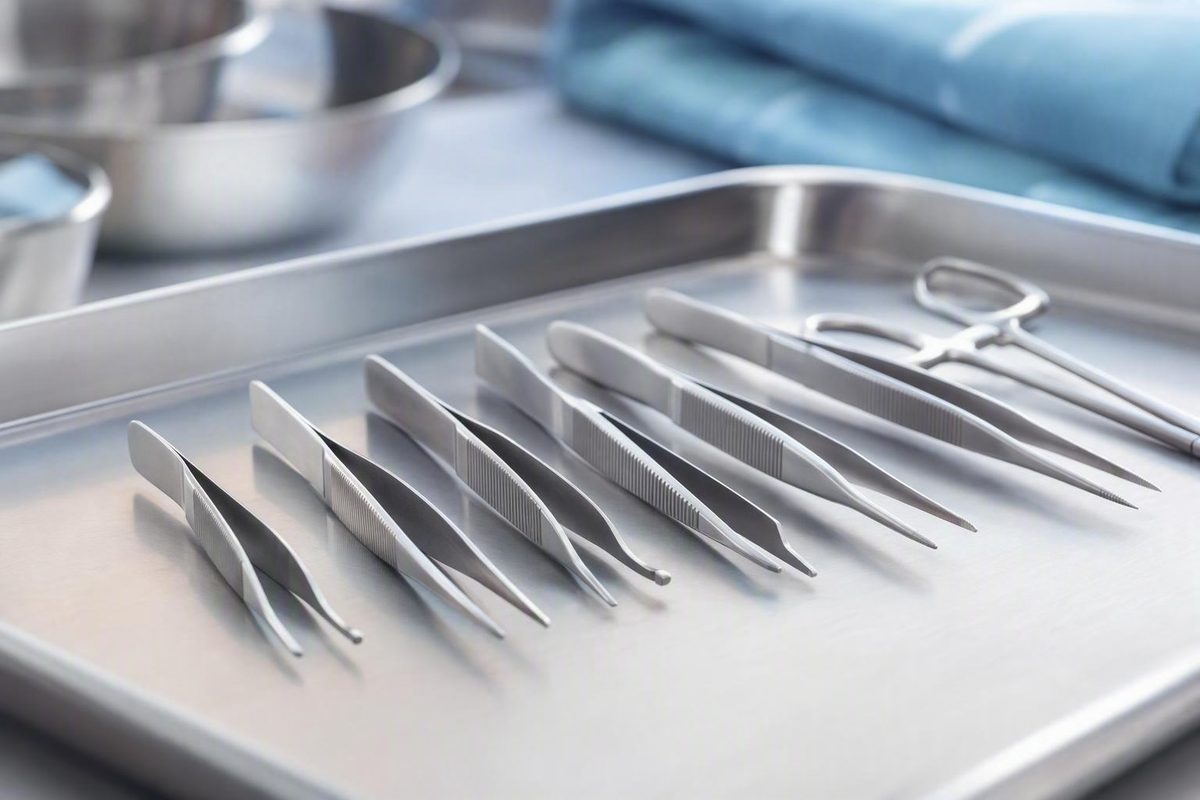
The short answer: What is the difference between forceps and tweezers?
Forceps and tweezers are handheld instruments with opposing tips or jaws. Both can grasp, hold, position, transfer, manipulate, or retrieve objects, materials, specimens, or tissue.
The categories overlap. Forceps can function as an umbrella term, and tweezer-like medical instruments are often called thumb forceps. The most useful distinction is therefore a general tendency, not an absolute definition:
- Tweezers and thumb forceps commonly have two spring arms joined at one end. Pressing the arms between the thumb and forefinger closes the tips.
- Instruments described more narrowly as forceps often have a hinge, finger-ring handles, and opposing jaws. Some include a ratchet that holds the jaws in a selected position.
Not all forceps have rings, and not all forceps lock. Most conventional tweezers are non-locking, but self-closing and other specialized designs exist. Similar tools may be sold as forceps, tweezers, thumb forceps, or tweezer-forceps. World Precision Instruments reflects this overlap by dividing forceps into ring and thumb designs while noting that tweezers may be called forceps in some settings in its comparison of forceps and tweezers.
| Feature | Tweezers or thumb forceps | Hinged or ring forceps |
|---|---|---|
| Actuation | Spring arms close under finger pressure | Handles pivot around a hinge |
| Handle form | Two joined arms, usually without finger rings | Shanks ending in finger rings or another hinged handle |
| Locking action | Usually non-locking; self-closing and specialized forms exist | May be non-locking or equipped with a ratchet |
| Grip duration | Commonly used for brief pickup or active manipulation | A locking model can maintain a selected jaw position |
| Common tip forms | Fine, pointed, blunt, broad, flat, straight, curved, or angled | Straight or curved jaws; smooth, serrated, toothed, fenestrated, or specialized |
| Representative tasks | Positioning small components, lifting coverslips, handling filters, or manipulating tissue and dressings | Sustained holding, clamping, grasping dressings or tissue, and tasks using hinged actuation |
The distinction should not be reduced to “medical forceps” versus “nonmedical tweezers.” Tweezers and thumb forceps appear in clinical settings, while both names also appear in laboratories, electronics, optics, watchmaking, jewelry, manufacturing, grooming, crafts, and mechanical work. Fisher Scientific’s general-purpose forceps and tweezers category, for example, groups instruments by their shared grasping function while listing varied mechanisms, materials, and tip forms.
The product name is consequently only a starting point. Reliable identification depends on how the instrument opens and closes, whether it locks, its handle form, the geometry and surface of its working end, its length and material, and the exact setting for which the product is intended.
Mechanisms and anatomy: spring arms, hinges, rings, and ratchets
The mechanism describes how movement at the handle reaches the working end. It also determines whether the instrument normally reopens when released or can retain a selected jaw position.
Spring-arm instruments
Conventional tweezers and thumb forceps consist of two arms joined at an apex or base. The free ends form the tips.
This arrangement supports brief pickup, release, and repeated repositioning.
Most conventional tweezers are non-locking, but the label tweezers does not guarantee one mechanism. Self-closing models use a different default action, while catalogs may also list guide pins, scissor-style handles, and other configurations. Identification should begin with the actual mechanism rather than an assumption based on the name.
Hinged and ring-handled instruments
Ring forceps have a scissor-like layout. Two halves cross and pivot around a hinge.
Closing the handles brings the jaws together. Jaw length, shank length, handle form, and the condition of the hinge are specifications to examine when distinguishing similar instruments.
Some ring forceps are non-locking. Others have a retaining mechanism—commonly a ratchet—near the finger rings. Rings alone do not prove that an instrument locks, just as the absence of rings does not necessarily make an instrument a general-purpose household tweezer.
What a ratchet changes
As successive positions engage, the handles and jaws are retained progressively closer together. In practical terms, the mechanism can maintain a selected jaw position without continuous squeezing.
That feature distinguishes sustained gripping from momentary manipulation. It does not establish that the instrument is universally safer, more precise, or more suitable for delicate work. The relevant considerations remain the intended task, target, jaw geometry, allowable pressure, instrument condition, and product labeling.
A hemostat, or hemostatic forceps, is a forceps intended to clamp blood vessels or assist with control of bleeding. Hemostats commonly combine hinged ring handles, jaws, and a ratchet. The reverse inference is not valid: a ratchet alone does not make every locking forceps a hemostat. Commercial descriptions of hemostatic and mosquito forceps illustrate this functional naming, although their veterinary examples should not be generalized into procedure-specific guidance.
For teaching and identification, an annotated side-by-side illustration is more informative than silhouettes alone. It should show the instruments open and closed and label:
- spring arms;
- joined apex;
- grip area;
- hinge or pivot;
- finger rings;
- ratchet;
- shanks;
- jaws;
- terminal tips;
- teeth; and
- serrations.
Showing both positions makes the spring action, pivoting action, and point of ratchet engagement easier to recognize.
The main instrument families and the names readers will encounter
Instrument names mix information about mechanism, function, handle form, and pattern. A useful taxonomy begins with how the instrument operates and what it is broadly intended to do, rather than treating every named design as a separate top-level category.
Thumb forceps and tweezer-style instruments
Thumb forceps are spring-arm instruments operated between the thumb and forefinger. They are commonly non-locking and may have smooth, serrated, or toothed ends. In clinical and commercial language, they may also be called tweezers.
The name does not define one tip shape. Thumb forceps may be fine or broad, straight or angled, blunt or pointed. Catalog descriptions associate different versions with tissue, dressings, sutures, splinters, laboratory objects, and technical components. Those broad associations do not replace the intended-use statement and specifications for the exact product.
Dissecting and dressing forceps
Dissecting forceps are commonly described as instruments for handling or manipulating tissue. They are often thumb-style instruments, although terminology varies.
Dressing forceps are commonly described as instruments for grasping gauze, drapes, or dressings. These functional definitions, along with the distinction between ring and thumb forceps, appear in a manufacturer’s overview of forceps and tweezers.
Neither label is a complete selection instruction. Two products bearing the same family name can differ in length, width, curvature, teeth, serrations, and intended environment.
Ring and locking forceps
Ring forceps are hinged, scissor-like instruments with finger-ring handles. Their jaws may be straight, curved, blunt, pointed, broad, narrow, smooth, serrated, toothed, fenestrated, or otherwise specialized.
Locking forceps are the subset equipped with a retaining mechanism such as a ratchet. Locking describes the mechanism; it does not by itself establish what the jaws are intended to grasp.
Hemostatic and mosquito forceps
Hemostatic forceps are intended to clamp blood vessels or assist with control of bleeding. The category includes different jaw forms, lengths, and serration patterns.
Mosquito forceps are a small locking form commonly associated with small vessels or delicate structures. A commercial surgical comparison lists mosquito, Kelly, Crile, Babcock, and Rochester Ochsner instruments among ring-handled forceps, but its clinical examples remain descriptive rather than procedure-specific recommendations in this guide to tweezers and forceps.
For actual clinical selection, a family name is insufficient. Straight or curved jaws, dimensions, serration layout, intended use, and manufacturer documentation still need to be confirmed by appropriately trained personnel.
Pattern names
Pattern names identify recognizable combinations of handles, jaws, tips, and gripping surfaces. Among thumb-style or precision forceps, catalogs may list:
- Adson;
- Adson-Brown;
- Dumont;
- Russian;
- Semken; and
- splinter designs.
Among ring-handled surgical forceps, readers may encounter:
- Kelly;
- Crile;
- mosquito;
- Babcock; and
- Rochester Ochsner.
A student-instrument forceps and tweezers category demonstrates how names such as Adson, Adson-Brown, Dumont, Russian, Semken, and splinter can appear within one commercial grouping.
Pattern names are useful identification and search clues. They are not procedure recommendations by themselves. Products sharing a broad pattern name may still differ by manufacturer, size, material, jaw profile, tip treatment, or other specifications.
Medical Forceps’ homepage lists a surgical-forceps identification guide described as covering thumb, tissue, hemostatic, and sponge forceps, along with Adson, DeBakey, Kelly, and Crile patterns. Because the supplied listing summarizes rather than reproduces that guide, it should be treated as an orientation point on the Medical Forceps homepage.
A practical way to decode an unfamiliar name is to ask:
- Does it describe actuation? Thumb and ring primarily indicate how the instrument is held and operated.
- Does it describe retention? Locking or ratcheted indicates that a selected position can be maintained.
- Does it describe function? Dressing, dissecting, and hemostatic refer to broad intended tasks.
- Does it identify a pattern? Names such as Adson or Kelly point to a design family whose exact specifications still require verification.
Tip shape and gripping surface: what the working end reveals
The working end often provides more useful identification information than the word forceps or tweezers. Tip width, curvature, alignment, surface texture, and the presence of teeth all help define what the instrument is designed to grasp and where it can reach.
Pointed, blunt, broad, and flat tips
Pointed tips concentrate contact in a small area. This supports precise pickup of small targets or access to narrow spaces, while making tip alignment and allowable pressure important considerations.
Blunt or rounded tips avoid a sharp terminal point. That feature alone does not guarantee that a fragile target will be protected; the complete jaw profile, pressure, surface condition, and intended use still matter.
Broad or flat tips provide a larger contact area. Catalogs associate these forms with thin or flat objects such as filters and coverslips. Their width must still fit the available workspace.
The useful question is not “Which tip is best?” but “What contact area and approach suit this target?”
Straight, curved, and angled access
Straight tips approach a target along the instrument’s axis.
Curved or angled tips provide an offset approach that may be relevant when a target is behind an obstruction or when the instrument body would otherwise occupy the viewing path. The direction and degree of curvature should be checked against the workspace rather than inferred from a photograph or general pattern name.
Length is part of the same access question. Extra-long forceps are cataloged for reaching specimens or objects in deep bottles, jars, and other recessed areas. Overall length alone is not enough: the jaw dimensions, opening clearance, material, and intended environment must also match the task.
Smooth, serrated, and toothed surfaces
A smooth gripping surface has no deliberate teeth or serration ridges.
A serrated surface uses grooves or ridges to increase purchase. Serrations vary in direction, depth, coarseness, and how far they extend along the jaw.
A toothed tip uses one or more projections that oppose or interlock.
There is no supported universal ranking in which smooth is always safest, serrated is always stronger, or toothed is always harmful. Suitability depends on:
- target fragility and surface;
- contact area and tooth geometry;
- applied pressure;
- duration of the grip;
- tip and jaw alignment;
- visible wear or damage; and
- operator technique and intended use.
Task-to-feature matrix
| Target or task | Features worth considering | Tradeoffs and checks |
|---|---|---|
| Tiny components | Fine pointed tips; straight or angled access; verified material properties where relevant | Fine tips concentrate contact and require correct alignment |
| Flat filters or coverslips | Broad, flat, rounded, or coated contact surfaces | Confirm working space and coating compatibility |
| Slippery materials | Serrations, textured surfaces, or a compatible tooth pattern | Added purchase may mark, puncture, or abrade unsuitable targets |
| Recessed objects | Curved, angled, or extra-long instruments | Confirm reach, opening clearance, visibility, and control |
| Gauze or dressings | Jaw width and texture suited to the material; mechanism selected for the required hold | The label dressing forceps does not independently establish clinical suitability |
| Tissue handling | Geometry and surface chosen for the particular product’s intended use and trained task | No tip style is universally atraumatic |
General-purpose catalogs document pointed, blunt, rounded, curved, angled, and flat tips; plain and serrated surfaces; self-closing or scissor-style mechanisms; guide pins; coatings; and extra-long forms. These listings establish the range of available configurations, not that any one configuration is clinically safer or more effective.
Where forceps and tweezers are used
The same basic grasping function appears in many environments. That explains why catalogs often group forceps and tweezers together, but it does not make every grouped product interchangeable.
Clinical and veterinary contexts
Commercial clinical and veterinary sources associate these instruments with broad tasks such as manipulating tissue, handling sutures or dressings, removing superficial foreign material, and clamping blood vessels. Depending on the task, the named family may be a thumb, dressing, dissecting, hemostatic, mosquito, or other specialized forceps.
These examples are descriptive, not procedural. They do not establish which product should be used for a particular patient or procedure, and veterinary descriptions should not automatically be transferred to human clinical practice.
Catalog categories may also place metal or plastic tweezers beside Kelly hemostatic forceps. Shared placement reflects a common grasping function; it does not show that the products have the same mechanism, processing requirements, or intended use.
Laboratories
Laboratory users may handle:
- microscope coverslips;
- filter papers and discs;
- small specimens;
- thin sheets;
- sample fragments;
- fragile objects; or
- items not intended to be handled directly with fingers.
Selection questions may involve tip form, reach, material, coating, cleaning instructions, and compatibility with the stated environment. The exact product specification is necessary when chemical exposure, temperature, contamination control, magnetic behavior, or another technical property matters.
Deep-container retrieval illustrates why length must be considered alongside the working end. A tip may have an appropriate shape but still be unable to reach an object in a deep bottle or jar. An extra-long design addresses reach only if the remaining specifications also fit the task.
Electronics, optics, and technical work
Electronics, optics, watchmaking, jewelry, research, manufacturing, and mechanical work frequently involve positioning or retrieving small components that are difficult to hold with fingers.
The relevant properties vary by setting. A technical user may need to verify tip precision, magnetic behavior, electrical or static-control requirements, chemical exposure limits, coating compatibility, or cleanliness. A general label such as precision tweezers does not establish any of those properties.
Grooming, crafts, and household precision work
Tweezers are familiar in grooming, modelmaking, crafts, hobbies, and household retrieval. These everyday uses help explain why tweezers has a broader general meaning than forceps, even though the mechanism can closely resemble a clinical thumb forceps.
Visual similarity does not establish equivalent construction, finish, packaging, cleanliness, intended use, or quality controls. Products should remain within the settings supported by their labeling and specifications.
Comparison by setting
| Setting | Typical target | Useful design questions | Limitations to verify |
|---|---|---|---|
| Clinical or veterinary | Tissue, sutures, dressings, superficial foreign material, vessels | Does it lock? What are the jaw form, size, pattern, and intended function? | Intended-use labeling, sterile or reusable status, processing instructions, professional and facility requirements |
| Laboratory | Coverslips, filters, specimens, fragile samples | Is the tip broad or pointed? Is extra reach needed? Is the material specified for the environment? | Chemical, temperature, contamination-control, and cleaning compatibility |
| Electronics | Components, wires, small fasteners | Is fine alignment needed? Are magnetic, electrical, or static properties relevant? | Verified material properties and worksite requirements |
| Optics and watchmaking | Lenses, precision parts, miniature mechanisms | Is an angled end useful? Is the contact surface appropriate? | Surface condition, coating compatibility, cleanliness |
| Jewelry and crafts | Stones, findings, fibers, thin materials | Does the target require a point, broad support, or textured purchase? | Marking, crushing, snagging, and required hand control |
| Manufacturing and mechanical work | Repeatedly positioned or recessed parts | Is sustained holding needed? Would locking or self-closing action fit the task? | Durability and environmental suitability of the exact product |
Examples of use do not amount to clinical instruction. Inclusion in a laboratory, industrial, emergency-supply, veterinary, or “medical” category also does not independently establish fitness for direct patient care.
Materials, coatings, and clinical suitability
Commercial catalogs list forceps and tweezers made from:
- stainless steel;
- anti-magnetic stainless steel;
- carbon steel;
- cobalt alloy;
- titanium;
- ceramic;
- disposable or reusable plastics;
- PTFE;
- PEEK;
- other polymers; and
- metal or polymer instruments with protective or gripping coatings.
This range reflects different product designs and environments. It does not create a universal hierarchy in which one material is always best.
Why the material name is not enough
A broad label such as stainless steel does not identify the exact alloy, heat treatment, finish, hardness, magnetic behavior, corrosion resistance, or validated processing compatibility of a product. Likewise, plastic, ceramic, titanium, PTFE, or PEEK is not a complete performance specification.
A coating is another product-specific feature to verify. Catalogs list protective and gripping coatings, but a generic phrase such as coated tips does not establish compatibility with a target, chemical, temperature, cleaning process, or controlled environment.
Before selecting a tool, check the available documentation for:
- exact alloy, polymer, ceramic, or coating;
- overall and working-end dimensions;
- environmental limits;
- relevant chemical and temperature compatibility;
- magnetic or electrical properties where required;
- reusable or disposable status;
- cleaning or processing instructions; and
- intended-use labeling.
Without product-specific documentation, claims that an instrument is corrosion-proof, non-magnetic, chemically compatible, sterilizable, durable, or clinically suitable are not supported merely by the material name.
Laboratory placement versus clinical suitability
General-purpose laboratory categories may include tools intended for cleanrooms, electronics, optics, filter handling, microscopy, research, and industrial production. Fisher Scientific’s category description expressly distinguishes its general-purpose listing from surgical, dissection, and other forceps intended for clinical procedures.
Accordingly, laboratory or industrial catalog placement does not by itself establish:
- sterility;
- biocompatibility;
- regulatory status;
- suitability for patient contact;
- compatibility with a healthcare facility’s processing system; or
- fitness for surgery.
For a proposed clinical application, verify the exact product’s intended use, supplied condition, reusable or single-use status, and applicable manufacturer instructions. Those checks must remain within professional training and facility procedures; this article is educational rather than clinical instruction, as stated in the Medical Forceps terms.
No material recommendation can be made in the abstract. Selection depends on the complete product specification, target, environment, required processing, and governing workplace requirements.
How to choose: a specification-first checklist
Begin with the target and task, not a familiar pattern name or top-level vendor category.
1. Define the target
Identify what will be grasped:
- How large is it?
- Is it flat, round, irregular, fibrous, or pointed?
- Is it rigid, flexible, slippery, fragile, or easily marked?
- Can it tolerate concentrated contact?
- Can it tolerate serrations or teeth?
- Are puncture, crushing, scratching, snagging, or contamination concerns?
A small rigid component and a thin coverslip may both require precise handling, but they do not necessarily require the same working end.
2. Decide whether the grip is brief or sustained
For brief pickup or repeated repositioning, a conventional spring-arm instrument may be appropriate. It normally requires continued finger pressure to keep the tips closed.
If a task requires a selected jaw position to be maintained, an appropriate locking instrument may be relevant.
Do not equate locks with better. Retention is a mechanism feature that should answer a defined task requirement.
3. Map the route to the target
Ask:
- Is access direct?
- Must the tip approach around an obstruction?
- Would the instrument body occupy the viewing path?
- Is the target inside a bottle, jar, recess, or narrow opening?
- How much space is available around it?
Compare straight, curved, angled, and extra-long forms accordingly. Confirm the overall length and working-end dimensions rather than relying on the general description alone.
4. Match the tip shape to the contact area
Consider the handling tendencies of each form:
- Pointed: localized contact for a small target or narrow space.
- Broad or flat: wider contact for a flat or fragile object.
- Blunt or rounded: no sharp terminal point, although pressure still requires consideration.
- Curved or angled: offset access.
- Fine: access to small targets, with greater reliance on alignment.
- Broad or heavy: more contact area, but a larger working end.
No geometry is universally superior. The relevant choice is the one supported by the target, access route, intended environment, and product specifications.
5. Select the gripping surface
Determine whether smooth jaws provide adequate purchase. If they do not, consider whether serrations, teeth, or a documented coating are compatible with the target.
A toothed or serrated surface is not automatically inappropriate if the exact product and target are intended to work together. Avoid universal safety rankings unsupported by the product documentation.
6. Consider alternative actuation features
Depending on the task, assess whether there is a documented need for:
- normal spring opening;
- self-closing action;
- a hinge and finger rings;
- a ratchet or other retaining mechanism;
- guide pins;
- a scissor-style handle;
- protective or gripping coatings; or
- an enlarged grip area.
These features should solve a defined handling problem rather than simply make an instrument appear more specialized.
7. Verify the exact specification
Before purchase, issue, or use, confirm:
- overall length;
- jaw and tip dimensions;
- tip alignment;
- jaw profile;
- curvature or angle;
- smooth, serrated, or toothed surface;
- material and exact grade where supplied;
- coating;
- locking or self-closing action;
- reusable, disposable, sterile, or non-sterile status;
- intended environment; and
- manufacturer’s intended-use labeling and instructions.
Treat photographs as an orientation aid. Use written dimensions and product documentation to verify scale, tooth arrangement, serration extent, and curvature.
8. Apply a separate clinical checkpoint
For patient care, do not infer suitability from appearance, pattern name, material, or placement in a general catalog. Confirm that the exact product is intended for the proposed use and that its supplied condition, processing requirements, and facility status are understood.
This article cannot determine whether a particular instrument is appropriate for a patient, procedure, or healthcare organization. That decision requires the product documentation, professional training, and applicable facility procedures.
9. Search under multiple labels
Vendor terminology is inconsistent. Useful search terms may include:
- forceps;
- tweezers;
- thumb forceps;
- tweezer-forceps;
- spring forceps;
- ring forceps;
- locking forceps; and
- the relevant functional or pattern name.
Compare specifications rather than prices, result totals, or popularity sorting. Catalog availability and category counts change, and overlapping labels can place the same type of product in more than one grouping.
Care, inspection, and the limits of a general guide
The available evidence does not support one universal cleaning, disinfection, or sterilization method for every forceps or tweezer. Materials, coatings, joints, intended uses, and reusable status differ.
For reusable clinical instruments, processing must be appropriate to the exact device and its intended use. Follow the manufacturer’s current instructions and the applicable workplace procedure rather than assuming that alcohol, hydrogen peroxide, a particular autoclave cycle, or another single method is suitable for every instrument. A veterinary vendor’s general care discussion calls for cleaning, disinfection, sterilization, and drying after use, but it does not establish one validated method for all products or settings in its forceps and tweezers comparison.
Observable inspection points
Identification and routine observation can focus on visible or operable features such as:
- whether the tips meet as expected;
- whether the arms, shanks, jaws, or tips appear bent or damaged;
- whether teeth are present and oppose one another;
- whether serrations show visible wear or surface buildup;
- whether corrosion, pitting, discoloration, or coating damage is visible;
- whether a spring-arm instrument opens and closes as expected;
- whether the hinge moves;
- whether a ratchet engages and releases; and
- whether required identification markings remain visible.
This list does not establish universal pass-or-fail limits, retirement thresholds, or repair instructions. Questions about an instrument’s condition should be handled under the applicable manufacturer guidance and the organization’s approved inspection, repair, replacement, or retirement process.
This article is an identification and selection reference, not medical advice, procedural training, or a replacement for manufacturer instructions. Medical Forceps describes itself as an educational instrument-room reference for students, technicians, and curious readers and says that it neither sells instruments nor accepts paid manufacturer placement on its About page.
Factual corrections can be submitted through the site’s editorial contact page.
Frequently asked questions
Are tweezers technically a type of forceps?
They can be. Forceps is often used as a broad category that includes ring forceps and thumb forceps, while tweezer-like clinical instruments are frequently called thumb forceps.
The terms therefore overlap rather than forming a strict either-or division. Mechanism, handle form, locking action, and working-end specifications provide a more dependable description than the product name alone.
Do all forceps have ring handles and a locking ratchet?
No. Forceps include spring-arm thumb forceps without rings as well as hinged ring forceps. Some ring-handled instruments have ratchets, while others are non-locking.
Inspect the handle and retention mechanism directly instead of inferring either feature from the word forceps.
What is the difference between locking forceps and a hemostat?
Locking forceps describes a mechanical category: the instrument has a mechanism that retains a selected handle or jaw position.
A hemostat is a forceps intended to clamp blood vessels or assist with control of bleeding. Hemostats are commonly locking instruments, but not every locking forceps has a hemostatic function. The intended use and jaw design—not the ratchet alone—determine the functional category.
Can laboratory forceps or tweezers be used clinically?
Do not assume so. Laboratory instruments may be intended for filters, coverslips, specimens, electronics, optics, cleanrooms, or industrial production. Catalog placement and visual resemblance do not establish patient-care suitability.
For clinical use, verify the exact product’s intended-use labeling, supplied condition, reusable or disposable status, processing instructions, and acceptance under the relevant facility procedures.
Are smooth, serrated, or toothed tips better?
No surface is universally better.
- Smooth jaws avoid deliberate teeth but may provide less purchase on a slippery target.
- Serrations can improve purchase but may mark or abrade an unsuitable material.
- Teeth can create a positive grip but may puncture, snag, crush, or mark a target that cannot tolerate them.
Choose according to the target, contact area, allowable pressure, grip duration, instrument condition, intended use, and trained technique.
The central rule
Identify forceps and tweezers by how they open and close, whether they lock, and what their tips, jaws, length, material, and intended use are designed to support—not by the category name alone.
Select in sequence: target, allowable pressure, grip duration, access, gripping surface, material, and product labeling. In clinical settings, actual selection, use, inspection, and reprocessing must remain grounded in professional training, approved facility procedures, and the manufacturer’s instructions.