
Sponge Forceps: Identification, Patterns and Sizes
Identify Foerster and Rampley sponge forceps by jaw shape, serrations, curvature and length, with documented models and reusable-instrument care notes.
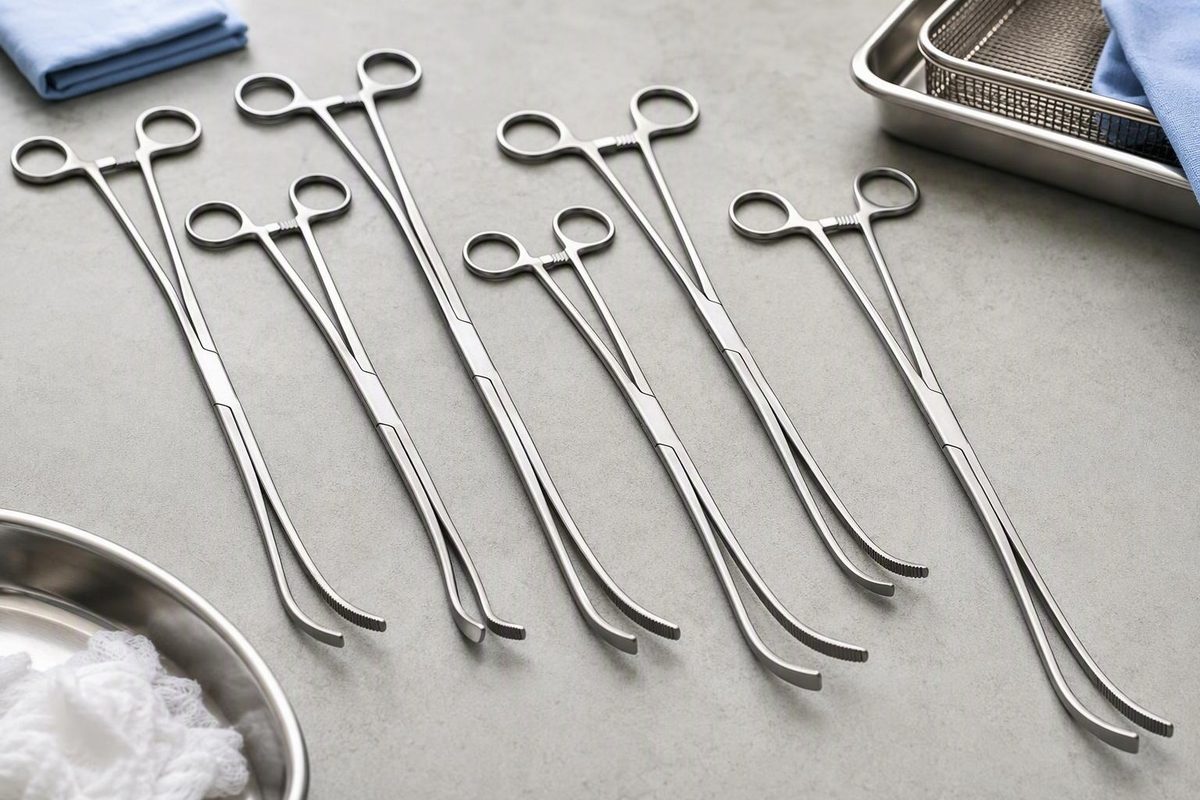
Common Foerster-pattern sponge forceps have finger-ring handles, a locking ratchet and oval, fenestrated jaws. They hold gauze or surgical sponges; fenestrated means each jaw has an opening through it. Both smooth and serrated working surfaces are available, so serrations are not essential to identifying the family. See Sklar’s Foerster catalogue description.
“Sponge-holding forceps” is a functional category, not a single exact pattern. Judd Medical’s catalogue entry includes both Foerster and Rampley under that heading and describes their role as grasping sponges or swabs during surgical procedures.
What to check for identification
Start at the jaws, then check the rest of the instrument:
- Jaw outline and openings: look for the oval, open-centred tips described in the Foerster and Rampley examples below. Do not confuse the jaw openings with the finger rings at the handle end.
- Working surface: record whether the contacting surfaces are smooth or serrated. “Fenestrated” describes the opening; “serrated” describes the gripping surface.
- Curvature: view the instrument from the side to distinguish straight from curved models.
- Joint and lock: record the joint construction and presence of a ratchet. Aesculap’s BF122R has a box-lock joint and ratchet; Sklar’s 87-2295 specifies finger rings with a ratchet.
- Length and markings: measure overall length and match any manufacturer or catalogue number to its documentation.
These checks reflect the features listed for Aesculap BF122R and Sklar 87-2295. For the wider classification of handle and jaw designs, see types of surgical forceps.
Foerster, Foerster-Ballenger and Rampley examples
Sklar states that its Foerster sponge forceps may also be called Foerster-Ballenger. Rampley is separately named in Aesculap’s catalogue. The examples below all have oval, fenestrated jaws, illustrating why that feature alone cannot establish the exact pattern.
| Manufacturer and model | Catalogue pattern | Listed overall length | Curvature | Working surface |
|---|---|---|---|---|
| Sklar 87-2195 | Foerster / Foerster-Ballenger | 241 mm (9½ in) | Straight | Serrated |
| Sklar 87-2295 | Foerster / Foerster-Ballenger | 241 mm (9½ in) | Curved | Smooth |
| Aesculap BF122R | Foerster-Ballenger | 245 mm (9⅝ in) | Straight | Serrated |
| Aesculap BF118R | Rampley | 250 mm (9¾ in) | Straight | Serrated |
Dimensions are reproduced as listed by each manufacturer. These are model examples, not universal pattern specifications. A measured length near 25 cm is therefore a useful catalogue check—not proof that an instrument is Rampley rather than Foerster.
Reusable-instrument inspection and care
As of 5 October 2026, all four models above are listed as reusable and supplied non-sterile. Neither the pattern name nor stainless-steel construction establishes readiness for use; verify the exact product’s supply status and instructions.
For its stainless-steel surgical instruments, Sklar’s May 2026 care guidance calls for attention to hinges, crevices and box locks during cleaning, followed by checks for cleanliness, damage, jaw alignment, hinge function and ratchet function. It also specifies open-position processing and warns that processing forceps with the ratchet closed can damage box locks or hinges. Sklar care and cleaning instructions
Use the applicable manufacturer instructions and facility procedures for reprocessing. This guide supports instrument identification, not clinical technique or a substitute sterilization protocol.