
Bayonet Forceps: Identification, Types and Jaw Patterns
Identify bayonet forceps by their offset profile, then use jaw pattern, tip size, connector, length and markings to distinguish common variants.
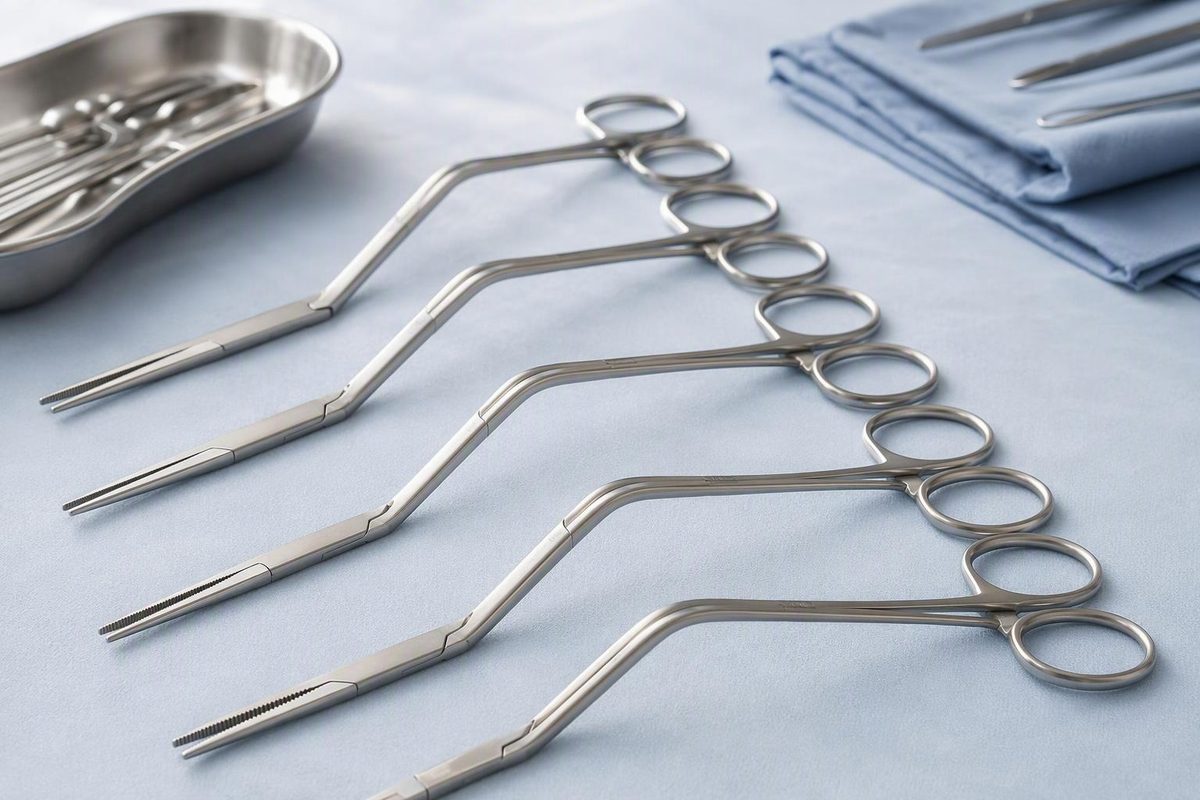
Identify bayonet forceps first by their offset profile: viewed from the side, the spring arms or handle step away from the working axis, leaving the narrow distal end less obstructed by the hand. Sklar likewise describes the offset handle of its Lucae pattern as providing an unobstructed view of a confined site (Sklar).
“Bayonet” describes this body geometry—not one jaw pattern, specialty or function. Models may have smooth surfaces, serrated tips, terminal teeth or bipolar electrosurgical tips. Most conventional examples are spring-handled forceps without finger rings or a ratchet.
Identification checklist
- Confirm the offset. Look from the side rather than relying on the top view. The handle or shanks should step out of the working line.
- Check the closing mechanism. Dressing and tissue patterns commonly close by squeezing two spring arms. Bipolar models have a similar spring form but add insulated tines and an electrical connection.
- Inspect the working end under magnification. Record whether it is smooth, serrated or toothed. Note the tip width, tip angle and any guide or stop.
- Read every marking. A name such as Cushing, Lucae, Yasargil, Gerald or Hardy can narrow the pattern, but the manufacturer and catalog number provide stronger identification.
- Keep measurements separate. Overall length, working length and jaw or tip width are different specifications.
For the wider spring-handle family, see the thumb-forceps identification guide.
Common bayonet-forceps patterns
| Catalog pattern | Features that separate it | Documented example—not a universal size |
|---|---|---|
| Cushing bayonet dressing forceps | Spring handle, bayonet offset, straight jaws and serrated tips; no tissue teeth on the cited model | Sklar 22-6972 is 7 in (178 mm), reusable stainless steel and non-sterile (Sklar). |
| Lucae bayonet ear forceps | Slim bayonet thumb-forceps form with serrated working ends; cataloged for ENT | Sklar 21-180 is 5.5 in (140 mm), disposable and non-sterile. Teleflex lists a separate standard Lucae model at 5.75 in (Sklar, Teleflex). |
| Bayonet micro dressing forceps | Fine smooth or serrated jaws; no terminal tooth on a smooth dressing model | Aesculap BD845R is 220 mm (8.75 in) overall with a 95 mm working length and 0.60 mm smooth jaw (B. Braun). |
| Bayonet micro tissue forceps | Fine terminal teeth distinguish a toothed tissue model from a smooth dressing counterpart | Aesculap FM174R is 210 mm (8.25 in) overall with a 90 mm working length, 1.10 mm jaw width and 1 × 2 teeth (B. Braun). |
| Bayonet bipolar forceps | Insulated tines, conductive tips and a connector for an electrosurgical cord; models may also have stops, irrigation or non-stick tips | Medtronic lists bayonet Cushing, Gerald, Hardy, Scoville-Greenwood and titanium models from 19.1 to 22.2 cm, with stated tip widths from 0.5 to 2.0 mm (Medtronic). |
The dimensions show why a loose description such as “8-inch bayonet forceps” is insufficient. Two instruments of similar length can differ in working length, jaw width, tooth pattern, intended role or electrical connection.
“Straight bayonet” is not a contradiction
Catalogs may describe an instrument as both straight and bayonet-shaped. Here, “bayonet” identifies the offset body, while “straight” identifies the working-end geometry. B. Braun uses both terms for the smooth BD845R dressing model and the toothed FM174R tissue model cited above. Do not classify an instrument as curved solely because its shanks are offset.
Avoid the common look-alikes
- Standard straight thumb forceps: The arms and jaws remain on one principal axis rather than stepping away from it.
- Alligator forceps: These have a long shaft and small distal jaws operated through a hinge, rather than two spring arms that meet along their length. See the alligator-forceps guide.
- Ring-handled clamps: Finger rings, a box lock and often a ratchet place these in a different mechanical family, even when the shaft is angled.
- Bayonet bipolar versus ordinary bayonet forceps: Insulated tines and the electrical connector distinguish the bipolar instrument. Silhouette alone is not enough.
What to record for tray identification or replacement
Record the manufacturer, catalog number, exact marked name, overall length, working length, jaw or tip width, smooth/serrated/toothed pattern, tip angle, material, connector, and reusable or single-use status. Never substitute working length for total length.
Cataloged status can differ even between similar-looking models: the cited Sklar Lucae is disposable, while the cited Sklar Cushing and Aesculap micro forceps are reusable. Bipolar connections also vary. Medtronic lists cords for different connector systems, while one B. Braun bayonet bipolar model specifies an Aesculap tab connector (Medtronic, B. Braun). A matching shape does not establish electrical compatibility.
Use the exact model’s current instructions and the facility’s validated procedures for processing, tray placement and accessory matching. This is an identification reference, not clinical-use instruction.