
Types of Dental Extraction Forceps: Patterns and Identification
Identify dental extraction forceps by beak shape, jaw, tooth group and markings, including 150, 151, molar, cowhorn, root and pediatric patterns.
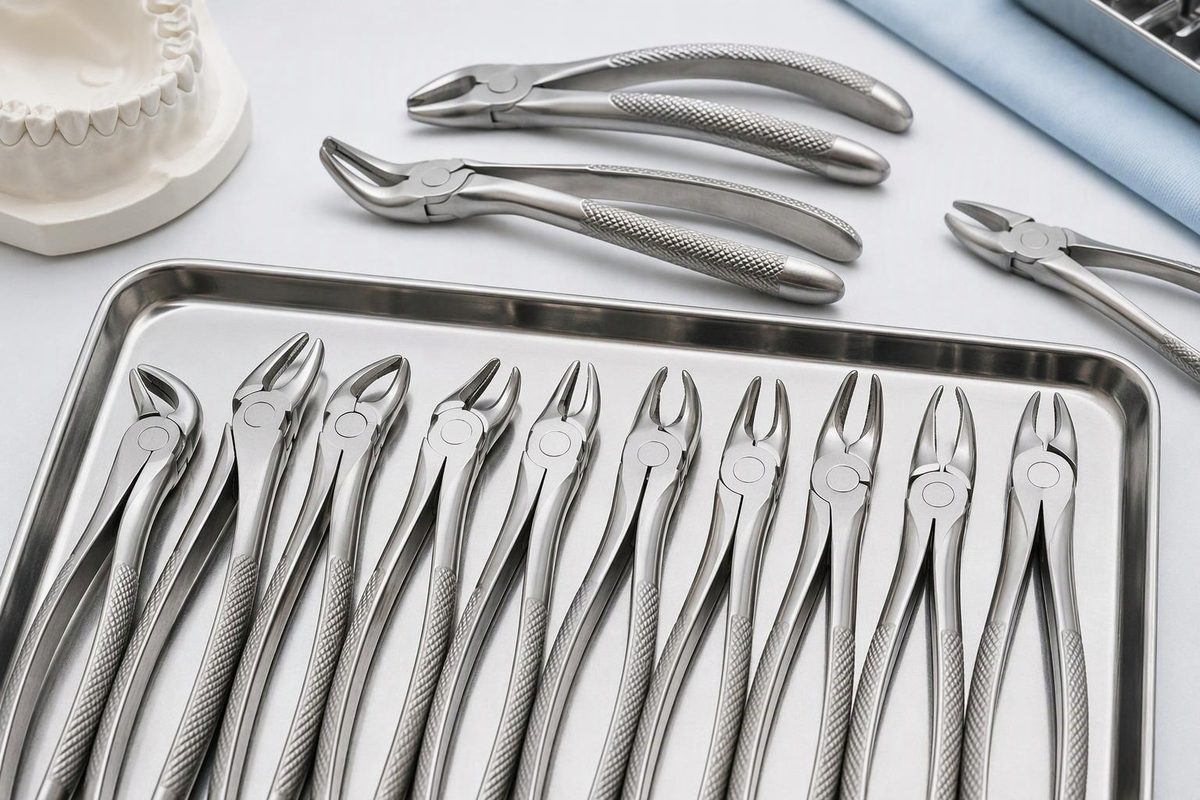
Dental extraction forceps are grouped by upper or lower jaw, tooth group, and beak design. The main types are anterior and premolar forceps, upper molar forceps, lower molar forceps, third-molar forceps, root forceps, and pediatric forceps. “Universal” describes the stated range of a particular pattern—not suitability for every tooth.
For identification, start with the beaks—the gripping jaws—then check the handle profile and full instrument marking. This is an instrument reference, not guidance for performing an extraction.
Common patterns at a glance
Maxillary means upper jaw; mandibular means lower jaw. Buccal is the cheek side, palatal the palate side, and a furcation is the region where roots divide.
The examples below are documented catalogue and textbook patterns, not a manufacturer-independent numbering standard.
| Type and example | Documented tooth or jaw designation | Identifying features |
|---|---|---|
| Upper anterior: No. 1 standard | Upper incisors and canines | Anterior-specific pattern; distinguish its designation from the broader No. 150 upper universal. Catalogue |
| Upper universal: No. 150 Cryer | Upper incisors, canines, premolars and roots; either side | Paired conical beaks designed for these tooth groups. Manufacturer specification |
| Lower universal: No. 151 Cryer | Lower incisors, canines, premolars and roots; either side | Conical beaks in the lower-arch counterpart to No. 150. Confirm the profile and marking, not just the similar tips. Manufacturer specification |
| Upper first- and second-molar: 18R/18L Harris; 53R/53L | Right or left upper molars | Asymmetric jaws: one rounded beak for the palatal root, one pointed beak for the buccal furcation. The reference patterns have one curved handle on No. 18, versus two straight handles on No. 53. Instrument reference, pp. 343–349 |
| Lower first- and second-molar: No. 17 | Lower first and second molars; either side | Matching pointed beaks shaped for the furcation between mesial and distal roots. Instrument reference, p. 371 |
| Lower molar cowhorn: No. 23; No. 16 | Lower first and second molars; either side | Cowhorn beaks with pointed ends for the furcation. In the reference patterns, No. 16 has one curved handle; No. 23 has two straight handles. Instrument reference, pp. 373–375 |
| Third-molar: No. 210; No. 222 | No. 210: upper; No. 222: lower; either side | Dedicated posterior patterns with matching beaks for the facial and lingual contours. Do not treat the two jaw designations as interchangeable. Instrument reference, pp. 355 and 377 |
| Root and fragment: No. 65 | Upper roots, fragments and overlapping incisors | Offset—or bayonet—profile with narrow, conical beaks. Manufacturer specification |
Root forceps are a wider family, not another name for No. 65. Hu-Friedy describes its root forceps as having long, slender bodies and delicate beaks. Documented examples include No. 300 for upper roots, No. 301 for lower roots, and No. 69 Tomes for upper and lower roots and fragments. Root-forceps design; catalogue designations.
Pediatric and specialized variants
Pediatric forceps retain tooth- and jaw-specific distinctions. For example, Hu-Friedy lists 150K for upper primary incisors and roots, 151K for lower primary incisors and roots, and 23K cowhorn for lower primary molars. The Kinder series is designed for small, shallow crowns and conical teeth. A small instrument is therefore not automatically a root forceps. Pediatric catalogue.
Other labels modify a basic pattern:
- Apical: Hu-Friedy’s apical series has thin, anatomically tapered beaks with longitudinal serrations; it still separates upper universal 150 from lower universal 151. Apical catalogue
- Split-beak: examine which jaw is split. The 150AS and 151AS are serrated split-beak universal variants; the upper-molar 88L/88R Nevius patterns have a split beak designated for the palatal root. Upper-molar variants
Avoid the two common identification errors
Do not identify by number alone. Even within one manufacturer’s catalogue, F17 denotes a lower-molar forceps, while FX17, a European-style pattern, denotes an upper-right-molar forceps. Preserve prefixes, suffixes and R/L markings when checking the catalogue or tray list. F17 designation; FX17 designation.
Do not confuse extraction forceps with other forceps on a dental tray. Hemostats have locking, scissor-like handles; dental rongeurs have cutting edges on their beaks. Oral-surgery instrument reference. Extraction forceps instead have jaws shaped to conform to tooth or root contours. Extraction-forceps reference. For the broader families, see types of surgical forceps.
For an unfamiliar instrument, record the complete marking, jaw designation, beak symmetry, points or splits, serrations, and handle offset. Compare those features with the exact manufacturer’s entry before assigning a pattern name.