
Reusable or Disposable Cataract Instruments: What to Compare
Compare cataract instruments by reuse labeling, tip geometry, processing requirements, per-case cost and waste—not by pattern name alone.
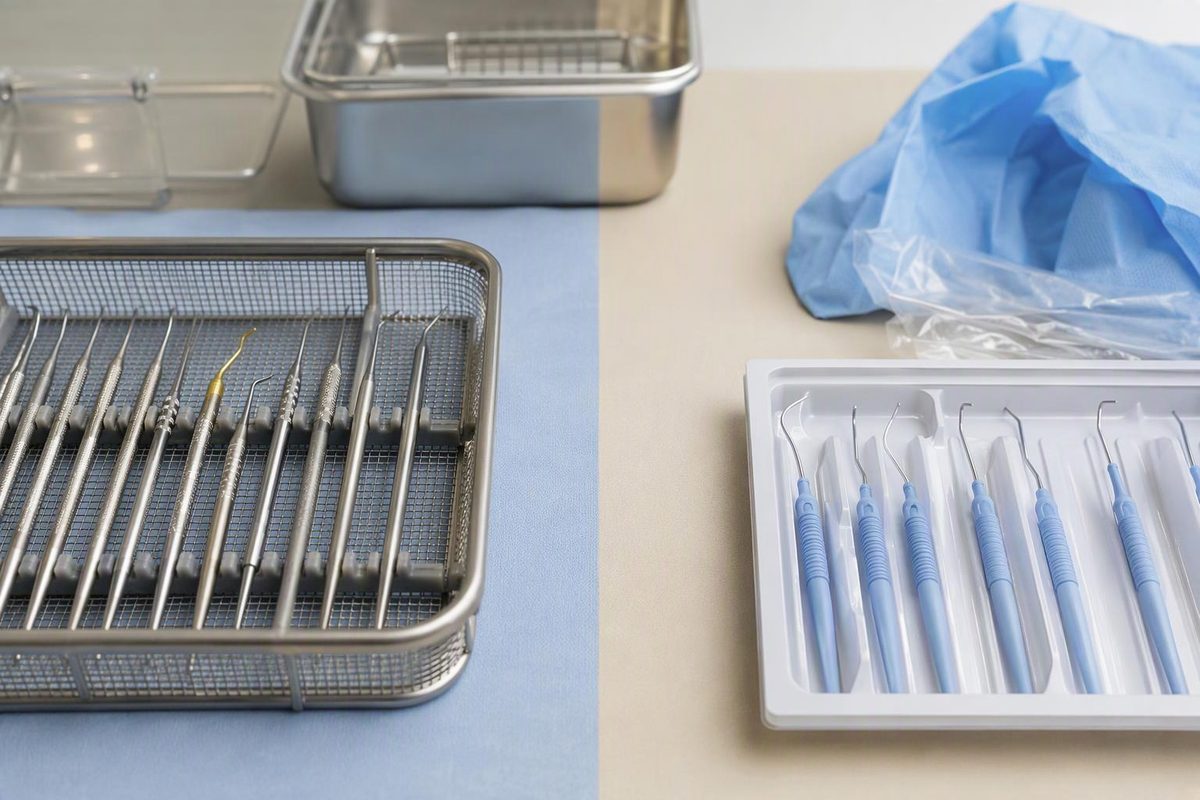
Neither reusable nor disposable cataract instruments are universally the better choice. First establish the exact instrument model and its labeled reuse status. Then compare its geometry, processing requirements and total cost per case. Reusable instruments require a supported reprocessing pathway; single-use instruments require replacement stock and an appropriate disposal pathway.
“Sterile” and “reusable” answer different questions. Sterile describes supply or processing status; reusable describes whether the device is intended for repeated use. For example, Ambler’s reusable Utrata MICS capsulorhexis forceps are supplied nonsterile and require inspection, cleaning and sterilization before first use and every reuse. Ambler instructions for use
Identify the model before comparing the alternatives
An instrument pattern name does not establish reuse status—or prove that two models are interchangeable. These two documented Utrata-pattern examples illustrate the difference:
| Model | Documented identifying features | Reuse and supply information |
|---|---|---|
| Ambler 2188T Utrata MICS capsulorhexis forceps | 3¼ in overall length (approximately 82.6 mm); angled shafts; 12.0 mm from bend to tip; delicate serrated grasping tips; 1.8 mm maximum tip spread; flat handle; titanium | Reusable; supplied nonsterile |
| Corza/Blink 11-5013 Utrata capsulorhexis forceps | 105 mm overall length; round handle; curved shaft; sharp tip | Listed as single-use; box of 10 |
Specifications are from the Ambler model-specific IFU and Corza product listing. They are identification examples, not equivalent replacements or product recommendations.
For a proposed substitution, compare the intended use, jaw or tip form, shaft curvature, handle, working dimensions and any stated incision or equipment compatibility. Confirm sterile supply status separately on the package and current instructions for use (IFU). A shared name or similar overall length is insufficient.
What changes in the instrument room?
Reusable instruments add a processing and condition-inspection workload. The US FDA’s March 2015 guidance recommends scientifically validated reprocessing instructions for reusable devices. A buyer therefore needs usable instructions—not merely a catalogue statement that an instrument is “autoclavable.” FDA reprocessing guidance
Cataract instruments also need ophthalmic-specific attention. The 2018 ASCRS/AAO/OOSS guidelines recommend cleaning ophthalmic instruments separately from nonophthalmic instruments and removing debris, including ophthalmic viscosurgical device material, before sterilization. They explain that minute chemical residues can cause toxic anterior segment syndrome (TASS), a severe inflammatory reaction distinct from infection. Sterilization is not a substitute for cleaning. Intraocular instrument cleaning and sterilization guidelines
Condition matters as well as cycle completion. Ambler’s IFU calls for inspection for cleanliness, function, breaks, cracks and other damage, using a microscope where possible. It states that useful life is normally determined by wear and damage rather than assigning a universal number of reuses. Do not apply that statement to another manufacturer’s device. Ambler inspection and reuse limitations
Single-use instruments avoid between-case reprocessing of those items, but do not remove the need to verify the supplied model and package instructions. Do not send an item labeled “do not reprocess” through the routine reusable-instrument pathway because it looks metallic or undamaged; Ambler’s IFU explicitly prohibits reprocessing single-use items. Ambler warnings
For background on steam-processing terminology, see autoclave sterilization of surgical instruments; it is not a cataract-specific cycle prescription.
Compare cost per case, not purchase price
A practical local comparison should include:
- Reusable: acquisition spread over actual use, cleaning and sterilization, inspection, repair and replacement, transport, and enough sets to cover processing turnaround.
- Single-use: price of the actual instruments or pack used per case, delivery, storage, expired or opened-unused stock, and waste handling.
A 2024 six-centre cost analysis found estimated single-use costs lower in two centres, similar in two and higher in two. Reported reusable sterilization costs ranged from €0.93 to €8.30 per instrument per cycle. Those figures show variation between facilities, not a transferable price schedule. The comparison used a five-instrument single-use set priced from one manufacturer; some authors disclosed relationships with that manufacturer. Original cost study
The same study modeled a lower carbon footprint for reusable instruments, but its environmental calculation omitted water consumption and gamma sterilization of finished single-use products because those data were unavailable. Its recycling scenario assumed recovery of all used instruments and packaging, which requires an actual recovery programme. Treat this as a model-specific finding, not a universal emissions ratio. Environmental methods and limitations
When a mixed inventory is worth assessing
A hybrid inventory can retain reusable instruments for routine work while keeping approved single-use alternatives for selected needs or backup. A 2026 Ophthalmology Times Europe discussion proposes this approach where processing capacity or instrument availability is constrained. That is an operational option, not proof that disposable instruments are inherently safer or better-performing. Hybrid instrument discussion
For each proposed alternative, document manufacturer and SKU, intended use, tip and shaft geometry, dimensions, compatibility, sterility, reuse labeling and current IFU. Have the responsible clinical and processing teams approve substitutions and the handling pathway before adding them to the inventory.
Educational instrument reference only; not surgical instruction or a substitute for professional training.