
Surgical Drain Clog Prevention Device: What Is Drain+?
Identify Drain+, distinguish it from Jackson-Pratt tubing and bulbs, and understand the limits of its compatibility and clinical claims.
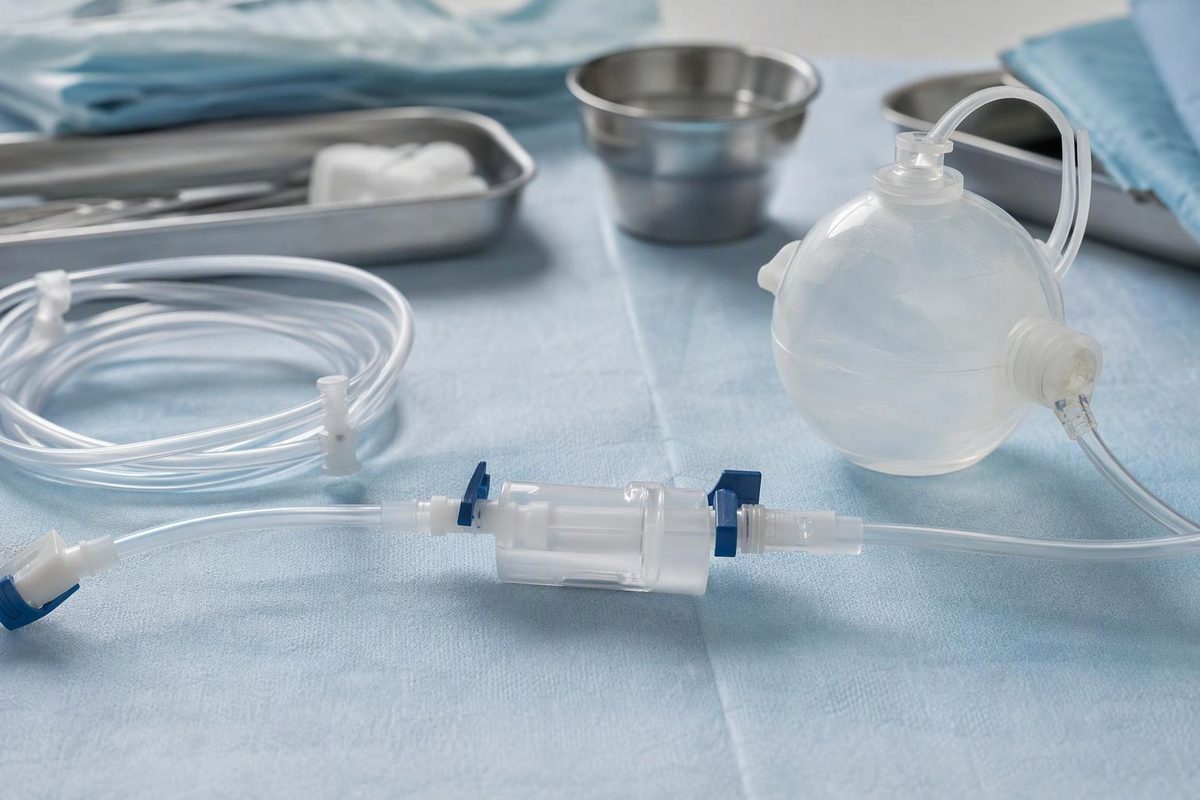
Drain+ is a small, external clip-on device designed to prevent surgical-drain clogs using gentle vibration. Dell Medical School describes it as an accessory to existing drains—not a replacement drain or a forceps pattern. Its announcement places the project in prototype development for an FDA regulatory pathway; it does not establish clinical effectiveness or authorization for routine use. Dell Medical School’s project announcement describes the design and development status.
How to distinguish the components
For students and instrument-room technicians, the important distinction is between the drainage system and the proposed anti-clog accessory.
| Component | Identifying feature | Role |
|---|---|---|
| Jackson-Pratt drain tubing | Flexible tube, with a drainage end placed at the surgical site | Carries fluid from the site to the collection bulb |
| Jackson-Pratt bulb | Soft plastic reservoir with a stopper | Creates gentle suction when compressed with the stopper closed |
| Drain+ accessory | Small device described as clipping externally onto an existing drain | Intended to use vibration to prevent blockages |
The Jackson-Pratt features are described in Memorial Sloan Kettering’s drain-care reference; the accessory description comes from Dell Medical School. The bulb supplies suction in a conventional Jackson-Pratt system. Drain+ is described as helping maintain flow, not as a separate suction pump.
What the announcement establishes
The student team led by Jordan Tanyi developed Drain+ through Dell Med’s Clinical Biodesign program. The school says its vibrations are calibrated to maintain consistent suction and fluid flow. It also describes the external attachment as avoiding interference with the sterile fluid path inside the tubing. These are the school’s descriptions of the proposed design, not independently demonstrated performance. Dell Medical School
The announcement does not provide controlled patient results, a measured reduction in clogs or infections, or evidence of earlier drain removal. It reports milestone-based funding to work on prototypes for FDA testing and approval. That wording should not be read as proof that the device is already FDA-cleared or approved.
For identification or purchasing purposes, the same announcement leaves several model-level questions unanswered:
- Compatibility: no named drain models, tubing diameters or material limits.
- Operating specifications: no vibration frequency, amplitude or power-source details.
- Care and supply status: no cleaning instructions, reuse labeling or commercial catalogue identifier.
“Attaches to standard surgical drains” is therefore not enough to verify compatibility with a particular drain. These limits reflect the information available in the Dell Med announcement, reviewed on October 28, 2026.
Not a substitute for prescribed drain care
An anti-clog accessory should not be interpreted as permission to stop monitoring a drain. Memorial Sloan Kettering’s Jackson-Pratt guidance includes clinician-taught tubing milking to move clots, emptying and recording drainage, and checking for problems. It advises contacting the healthcare provider right away if a clot cannot be moved into the bulb and there is little or no drainage in the bulb. Memorial Sloan Kettering’s drain-care guidance
This is an equipment-identification reference, not an attachment or drain-clearing procedure. Patients should follow their surgical team’s instructions rather than add an unverified accessory or improvise with clamps or forceps.