
Charnley Retractor: One Name but Different Systems
Matching blade depth or the word "standard" does not prove a blade will connect or lock correctly with another frame.
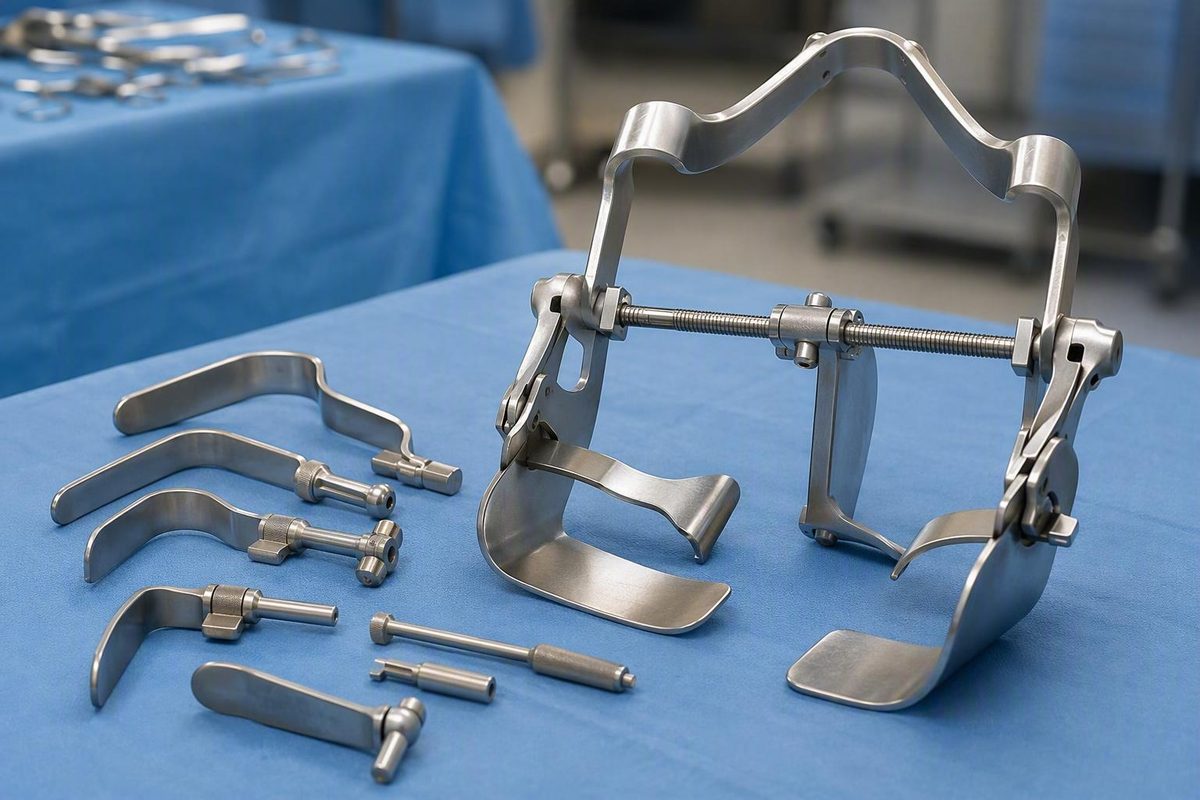
A Charnley retractor is best understood as a family of self-retaining orthopedic retraction systems, not as one standardized instrument with a universal frame, blade interface or set configuration. Depending on the manufacturer, the name may identify a complete set, a frame, an individual blade or a single instrument. Some catalogs also use Initial Incision Retractor, while “Charnley-style” may describe a related locking-frame design rather than an original or interchangeable Charnley system.
This guide is an educational reference for instrument identification, specification comparison, care-document review and procurement research. It does not provide surgical technique, clinical blade-selection advice or medical guidance. Clinical users must rely on professional training, facility policy and the current product-specific IFU, consistent with the site’s educational-use and non-medical-advice terms.
Editorial review note: Product descriptions were checked against the supplied manufacturer IFUs, manufacturer catalogs, distributor pages and reseller listings. Commercial details were reviewed on August 8, 2026. Current manufacturer documentation supersedes this article.
What is a Charnley retractor?
A Charnley retractor is a self-retaining orthopedic retraction system documented primarily for maintaining exposure during hip procedures. “Self-retaining” means the assembled instrument is designed to maintain retraction without continuous manual holding. It does not guarantee that an assistant is unnecessary or establish staffing requirements for a particular operation.
Terminology and documented applications vary by product:
- Teleflex calls its product an Initial Incision (Charnley) Retractor, classifies it as an orthopedic self-retaining retractor and says it is used primarily for hip procedures.
- Sklar also uses the name Initial Incision Retractor and describes its model as most commonly used during hip arthroplasty.
- Enztec documents Charnley frame systems for total hip arthroplasty.
- MPR identifies use during hip revision procedures, giving total hip arthroplasty as an example.
- Innomed describes its Alvi product as a Charnley-style set for anterior total hip arthroplasty.
These descriptions remain product-specific. They do not establish that every Charnley retractor is suitable for every hip operation, every arthroplasty or every surgical approach.
The important functional distinction is between a hand-held retractor and a self-retaining assembly. A hand-held instrument depends on someone maintaining its position. A self-retaining Charnley system uses a frame, blade attachments and a locking, adjustable or weighted arrangement to maintain its selected configuration. The details differ by product family.
Teleflex’s catalog illustrates the naming problem particularly clearly. One family includes a complete item, a frame-only item and multiple interchangeable sharp blades under separate numbers. The catalog also states that its images are representative and that the actual product may vary. Identification should therefore not rest on photographs alone.
In this article, Charnley retractor is a family-level term. Reliable identification requires the manufacturer, product family, frame type, blade design, dimensions, catalog number, included components, sterility status and current processing documentation.
Frame, blades, and accessories: the parts of the system
Although configurations differ, documented Charnley systems can usually be analyzed through four component categories:
- Frame: The supporting structure that maintains the assembly. It may be described as standard, fixed-blade, square, round-bar or locking.
- Fixed or anchoring blade: A blade attached at a defined point or used as the anchoring side of a system.
- Adjustable or interchangeable blade: A blade whose position relative to the frame can be changed, or a removable blade offered in alternative depths or profiles.
- Accessories: Components such as a weight and chain, specialty blades or separately sold replacement parts.
These are analytical categories rather than universal design requirements. Manufacturers may use different terminology, connection methods and component arrangements.
An attributed system example
The MPR documentation provides a clear system-level example. It describes a standard assembly consisting of a square stainless-steel frame, one fixed-length anchoring blade and one adjustable-length blade. The frame and the two blade families carry separate references, and the blades are available in several depths.
That architecture should not be projected onto other products. Teleflex uses interchangeable sharp-blade listings; Enztec distinguishes standard-frame and fixed-frame component families; and the reseller-listed DePuy configuration uses a round bar with standard blades and a weight and chain.
Complete set, frame only, blade only, or accessory?
Similar product names can represent very different sale units.
A complete set should have an explicit set number and an itemized component list. A frame-only listing supplies the supporting structure but does not prove that blades are included. An individual blade may be a replacement or optional part sold one each. An accessory may support a system without being included in its standard configuration.
Teleflex, for example, lists complete item KM52704 and frame-only item KM52704F within the same family. It also lists long and short sharp blades separately. Teleflex documents the complete item, frame-only item and separate blade family.
Millennium set 63-7445 is expressly listed as including frame 63-744501 and blades 63-745002 and 63-745502. The frame also appears as a separate product. Millennium itemizes the components supplied with set 63-7445.
The reseller-listed DePuy set 9622-56 includes a round bar, standard blades 9911-04 and 9911-05, and a weight and chain. Deep blades 9911-06 and 9911-07 are presented as optional rather than included. The reseller listing distinguishes the represented set contents from optional deep blades.
Sklar describes compatible blades and a weight-and-chain accessory. According to the manufacturer, the accessory can tilt the retractor by 45 degrees to provide greater anterior hip-joint exposure. This is an attributed product description, not comparative evidence that the arrangement produces better clinical exposure than another system. Sklar describes the accessory and its stated tilt function.
A catalog number therefore needs a noun attached to it: set number, frame number, blade number, accessory number or single-instrument number. The product name alone does not establish what will be supplied.
Recommended component illustration
For teaching or inventory documentation, a labeled illustration can identify:
- the frame;
- fixed or anchoring blade;
- adjustable or interchangeable blade;
- blade-to-frame connector;
- adjustment or locking area;
- optional weight-attachment point; and
- permanent catalog markings.
The illustration should be limited to component recognition. It should not depict blade placement, tissue engagement or surgical technique.
Charnley terminology and design variants
“Charnley” appears across related but nonuniform product families. It does not define one frame geometry, connector, blade profile or validated application.
Frame and adjustment terms
The following terms describe different characteristics and should not be treated as synonyms:
- Standard frame: A manufacturer-defined frame class. “Standard” does not mean industry-standard or cross-brand compatible.
- Fixed-blade frame: A frame intended for a specified fixed-frame blade family. It may have narrower compatibility than another frame in the same manufacturer’s range.
- Fixed-length blade: A blade whose listed length or attachment geometry is fixed within that design.
- Adjustable-length blade: A blade designed to connect at selectable positions or otherwise change its relationship to the frame.
- Interchangeable blade: A removable blade offered in alternative depths or patterns for a specified frame family.
- Locking frame: A frame using a locking mechanism, as documented for Innomed’s Charnley-style Alvi set.
- Initial Incision Retractor: An alternative product name used by Teleflex and Sklar. It does not prove that products bearing the term share an interface.
A “fixed frame” and a “fixed-length blade,” for example, describe different components. One refers to a frame family; the other refers to blade design. An interchangeable blade may still have a fixed physical depth.
Documented blade descriptions
Catalogs use a broad vocabulary for blade form and construction:
- Sharp blades: Teleflex lists long and short sharp blades in multiple depths.
- Standard and deep blades: The third-party DePuy listing distinguishes included standard blades from optional deep blades.
- Clawed and spiked retractors: Enztec lists both descriptions in several lengths.
- Fixed-length and adjustable-length blades: MPR separates these into two catalog families.
- Tapered blades: Included in Innomed’s Alvi Charnley-style set.
- Winged modified blades: Optional for the Innomed set.
- Radiolucent tapered blades: Also optional for the Innomed set.
These terms are useful identification clues. The supplied evidence does not establish clinical equivalence, relative safety or the correct anatomy, patient, approach or procedure for any profile. A deep blade should not automatically be treated as a longer version of every “standard” blade, and clawed, spiked, sharp, tapered and winged blades are not interchangeable descriptions.
What “Charnley-style” means
Innomed’s Alvi 7425-00 is described as a small Charnley-style locking-frame set for anterior total hip arthroplasty. Its standard set combines a locking frame with interchangeable tapered blades. Winged modified and radiolucent tapered blades are optional. Innomed identifies the product as “Charnley Style” and separates included from optional blades.
The wording Charnley-style should be retained when describing this product. It does not establish that the system is an original Charnley design or that its components fit products sold under the Charnley name by other manufacturers.
Promotional descriptions also vary by manufacturer. Enztec describes clearer exposure and freeing an assistant for its systems, while Innomed describes unobstructed exposure, freeing an assistant and gentler retraction for particular products or optional blades. These are product-specific manufacturer statements. The evidence pack contains no comparative clinical studies establishing improved outcomes, reduced tissue injury or lower staffing requirements.
Model and specification comparison
The table below normalizes the available catalog information while preserving source units. Conversions are included only when the source provides them. “Not stated” means the reviewed listing did not supply the information; it does not mean the specification is unavailable in other documentation.
| Manufacturer or seller | Product family | Set or frame number | Documented application | Frame dimensions | Blade type, depth or length | Included components | Optional or separate parts | Material or sterility | Source |
|---|---|---|---|---|---|---|---|---|---|
| Teleflex | Initial Incision (Charnley), MC-008133 | Complete KM52704; frame only KM52704F | Primarily hip procedures | Complete item: 11 3/4 in (30.0 cm) long; maximum width 9 5/8 in (24.5 cm) | Four sharp prongs; prong depth 1 1/4 in (3.2 cm); blade width 1 in (2.5 cm). Long and short sharp blades at 1 3/8, 2, 2 1/4, 2 1/2, 3, 4 and 5 in depths | KM52704 is the complete listed item; listed weight 3 lb | KM52704F frame and long or short sharp blades | Stainless-steel prongs; sterility not stated | Manufacturer catalog cited above |
| DePuy, as represented by A–Z Ortho | Charnley Initial Incision Retractor Set | Set and round bar 9622-56 | Not stated | Not stated | Standard blades 9911-04 and 9911-05; optional deep blades 9911-06 and 9911-07 | Round bar, two standard blades, weight and chain | Two deep blades | Not stated | Reseller listing cited above |
| Enztec | Charnley Standard Frame | Frame 4050-0150 | Total hip arthroplasty | 256 × 200 mm (10.1 × 7.9 in) | Clawed 4050-0161–0164 and spiked 4050-0171–0174, offered in 50, 75, 100 and 125 mm sizes; listed overall dimension 170 mm | Standard set contents not stated | Clawed and spiked family components | Material and sterility not stated | Manufacturer standard-frame page |
| Enztec | Charnley Fixed Blade Frame | Frame 4050-0151 | Total hip arthroplasty | 256 × 200 mm (10.1 × 7.9 in) | Fixed-frame clawed 4050-0181–0184 and spiked 4050-0191–0194, offered in 50, 75, 100 and 125 mm sizes; each listed as 79 mm wide | Standard set contents not stated | Fixed-frame-only clawed and spiked retractors | Material and sterility not stated | Manufacturer fixed-frame page |
| Millennium Surgical | Charnley Standard Retractor Frame and Blades | Set 63-7445; frame 63-744501 | Not stated | Not stated | Blades 63-745002 and 63-745502; dimensions and detailed functions not stated | Frame and two listed blades | Frame and related blade products appear separately | Not stated | Distributor listing cited above |
| MPR Orthopedics | MPR Charnley Retractor System | Frame MPR-7445-01 | Hip revision procedures such as total hip arthroplasty | 12 in frame | Fixed blades MPR-7455-02/-03/-04 and adjustable blades MPR-7450-02/-03/-04, in 2, 3 and 4 in depths; all blades 1 in wide; fixed blades 3 in long and adjustable blades 7 in long | Documented architecture: square frame, fixed-length anchoring blade and adjustable-length blade | Weight may be attached; standard inclusion is not established | Square stainless-steel frame; supplied non-sterile | Manufacturer IFU |
| Sklar | Sklar Charnley Retractor | 40-1811 | Most commonly hip arthroplasty, according to Sklar | Complete frame dimensions not stated | Curved, flat, long blade described as 25 × 76 mm; separate 25 mm instrument-length field is inconsistent or unclear | One instrument | Compatible blades and a weight-and-chain arrangement are described, but exact included accessories are not established | Reusable, non-sterile stainless steel | Medical-equipment retailer page |
| Innomed | Alvi Small Charnley Style Locking Frame Set | Set 7425-00; frame 7425-01 | Anterior total hip arthroplasty | 9 × 7 in (22.9 × 17.8 cm) | Included tapered blades 7425-02–7425-04 at 2, 3 and 4 in depths; each 1 in (2.54 cm) wide with a 7 in (17.8 cm) handle | Locking frame and three tapered blades | Winged modified and radiolucent tapered blades at 2, 3 and 4 in depths | Material and sterility not stated | Manufacturer catalog cited above |
Important reading notes
For Teleflex, the catalog provides a series of sharp-blade depths, but it does not populate every other dimension for every item number. Missing lengths, distal styles and other values should not be inferred across the family.
For the DePuy-labeled set, the evidence is a reseller listing rather than official DePuy documentation. It supports what the seller represented as included and optional, but it does not establish current manufacturer indications, authenticity, condition, regulatory status or compatibility beyond that representation.
For Sklar model 40-1811, both the manufacturer and retailer descriptions give a 25-by-76 mm blade measurement while separately listing instrument length as 25 mm. The discrepancy cannot be resolved by assuming that one field means width. The official manufacturer-page URL also has an unrelated product name in its slug, although the displayed record identifies SKU 40-1811 as the Sklar Charnley Retractor. Current primary documentation or direct manufacturer clarification is advisable.
Compatibility and set-completeness checks
Cross-brand compatibility is not established and must never be assumed from the Charnley name alone.
Visual similarity, matching blade depth or a shared word such as “standard” does not prove that a blade will connect correctly, lock securely or function as intended with another frame. Keep manufacturers’ components in separate family groupings unless current primary documentation explicitly states otherwise.
Product-family compatibility matrix
| Product family | Documented internal relationship | What is not established |
|---|---|---|
| Teleflex Initial Incision (Charnley) | Complete item, frame-only item and separately listed long or short sharp blades form one catalog family | Compatibility with another manufacturer’s frame, blades or accessories |
| Reseller-listed DePuy set | Round bar, two standard blades and weight and chain are represented as included; two deep blades are optional | Official DePuy confirmation, cross-brand fit, authenticity or completeness of a particular offered set |
| Millennium standard set | The set listing expressly joins one identified frame with two identified blades | Fit of related Millennium products unless separately documented; cross-brand compatibility |
| MPR Charnley System | The MPR frame is documented with MPR fixed- and adjustable-length blade families | Fit with non-MPR frames or blades |
| Sklar Charnley Retractor | Sklar describes compatible blades and a weight-and-chain accessory | Exact compatibility of unnumbered or third-party parts; cross-brand fit |
| Enztec Standard Frame | Enztec describes its standard-frame clawed and spiked retractors as compatible with Standard and Fixed Frames | Compatibility with non-Enztec frames |
| Enztec Fixed Blade Frame | Enztec describes its fixed-blade clawed and spiked retractors as compatible only with fixed frames | Fit with the Enztec Standard Frame or any other product family |
| Innomed Alvi set | The catalog identifies the locking frame, included tapered blades and matching optional blade families | Interchangeability with original or other named Charnley systems |
Enztec’s distinction shows why a family name or matching nominal length is insufficient. Its standard-frame retractors are described as fitting both Enztec Standard and Fixed Frames, while its fixed-blade retractors are limited to fixed frames. Connector-level restrictions can therefore exist within one manufacturer’s range.
Set-completeness checklist
Before labeling, assembling or ordering a system, verify:
- [ ] Exact set number
- [ ] Exact frame number
- [ ] Manufacturer and product family
- [ ] Frame type: standard, fixed, square, round-bar, locking or another documented form
- [ ] Number of included blades
- [ ] Blade catalog numbers
- [ ] Blade profile
- [ ] Blade depth or length
- [ ] Blade width, where specified
- [ ] Connector or frame family
- [ ] Whether a weight and chain is included, optional or absent
- [ ] Whether deep or specialty blades are separately sold
- [ ] Sterility status
- [ ] Current IFU and processing documentation
A frame-only listing is not a complete retractor system. A one-each blade listing does not show that a matching frame is included. Similarly, Sklar model 40-1811 is sold as one instrument; mention of compatible blades and a weight and chain does not prove that those parts are supplied with it.
Confirm catalog numbers and current compatibility with the manufacturer before ordering or assembling a system. This is particularly important for discontinued products, replacement parts, refurbished inventory and reseller offerings that may not match current manufacturer records.
Identification workflow for instrument-room staff and students
Identification should proceed from the most objective evidence to the least. Permanent markings and primary product documentation carry more weight than resemblance to an online image.
1. Classify the object
Determine whether the unfamiliar item appears to be:
- a frame;
- a blade or retractor component;
- a weight, chain or other accessory;
- an assembled system; or
- a group of parts represented as a complete set.
Do not label a collection complete until its documented contents have been checked.
2. Inspect permanent markings
Record every visible manufacturer name, logo, reference number, lot or serial marking, size and side designation. Photograph or transcribe markings exactly, including hyphens and leading zeros.
A catalog number is normally more discriminating than the word “Charnley.” Similar frame numbers can identify different frame families, so a missing or uncertain digit should not be silently supplied from a photograph.
Where markings are incomplete, record them as incomplete. An honest unresolved identification is preferable to a precise but unsupported one.
3. Measure the component
Use the dimension defined by the relevant manufacturer whenever possible. Record:
- overall frame width and length;
- bar or frame form;
- blade width;
- blade depth;
- overall blade or handle length; and
- connector dimensions or configuration, if facility policy permits measurement.
Preserve the original unit. If a conversion is added, label it as a conversion rather than presenting it as a manufacturer-supplied value.
Measurements are corroborating evidence, not proof of compatibility. Two blades with the same nominal depth may belong to different frame systems.
4. Describe the blade and attachment
Record observable features without inferring clinical purpose:
- flat, curved, tapered, winged or deep appearance;
- sharp, clawed, spiked, blunt or pointed features;
- fixed, sliding or adjustable configuration;
- connector shape;
- locking pin, hole, slot, knob or bar relationship; and
- apparent radiolucent construction, pending material verification.
A clawed or spiked appearance may narrow a catalog search, but it does not replace a product number. Likewise, describe an item as “adjustable” only when its mechanism or primary documentation supports that term.
5. Match the product family
Search current manufacturer documentation using the exact permanent marking first. Then compare:
- catalog number;
- manufacturer;
- frame family;
- connector form;
- blade profile;
- listed depth and width; and
- documented set contents.
If only a retailer or reseller listing is available, mark the identification as provisional and seek manufacturer confirmation.
6. Resolve contradictions rather than choosing the convenient value
Sklar model 40-1811 illustrates the correct response to conflicting specifications. Its description gives a 25-by-76 mm blade measurement, while a separate field lists instrument length as 25 mm. The page also lists a blunt tip and pointed working-edge style without explaining their relationship. Record these discrepancies and request clarification rather than deciding which field “must” be correct.
Catalog images have similar limits. Teleflex states that its images are representative and that the actual product may vary. An image alone should not establish delivered configuration, blade count, connector details or set completeness.
Identification worksheet
| Field | Observation |
|---|---|
| Manufacturer or logo | |
| Exact permanent markings | |
| Suspected catalog number | |
| Item category: frame, blade, accessory or set | |
| Frame form and dimensions | |
| Blade width | |
| Blade depth | |
| Overall blade or handle length | |
| Blade profile | |
| Connector or attachment form | |
| Fixed, adjustable, interchangeable or unclear | |
| Sterility or processing status | |
| Quantity present | |
| Suspected product family | |
| Documentation checked | |
| Contradictions or missing information | |
| Identification status: confirmed, provisional or unresolved |
An uncertain match should remain provisional or unresolved until corrected through primary documentation. That is safer for inventory control than presenting visual similarity as certainty.
Cleaning, inspection, and sterilization: product-specific guidance only
There is no evidence-supported universal reprocessing protocol for every Charnley retractor. Reusable construction, stainless-steel material or resemblance to another frame does not establish tolerance of the same detergent, washer cycle, lubricant, wrapping method or steam exposure.
The detailed requirements below apply only to the MPR Charnley Retractor System. They must not be extended to Teleflex, DePuy, Enztec, Millennium, Sklar or Innomed products.
What the MPR documentation requires
For the MPR system, the reviewed IFU states that:
- the device is supplied non-sterile and must be cleaned before use;
- it must be inspected for damage and proper function before use;
- components must be cleaned before sterilization;
- components are to be sterilized separately;
- components should be dried thoroughly;
- steel wool and abrasive soap cleaners must not be used because they can scratch the finish; and
- the device must not be placed in a milk bath or lubricated.
For this system only, the documented pre-vacuum steam cycle is:
- 132°C or 270°F;
- at least 4 minutes of exposure; and
- at least 30 minutes of drying.
These are product-specific processing and safety requirements. They must be checked against the current original IFU before use. The MPR IFU supplies the non-sterile status, inspection requirements, prohibitions and steam-cycle parameters.
The extracted MPR text contains apparent transcription or optical-character-recognition errors. Users should consult the original formatted document rather than relying on extracted wording. Current manufacturer instructions, facility procedures, applicable regulations and professional processing standards remain controlling.
What cannot be inferred for other products
Sklar describes model 40-1811 as reusable, non-sterile and stainless steel. Those facts do not provide a validated cleaning or steam-sterilization cycle for the instrument.
The reviewed Teleflex, DePuy reseller, Enztec, Millennium and Innomed pages likewise do not support applying the MPR cycle to their products. Obtain the current product-specific IFU for:
- point-of-use handling;
- disassembly;
- manual or automated cleaning;
- detergent limits;
- inspection criteria;
- packaging;
- sterilization method and parameters;
- drying;
- storage;
- lubrication, if any;
- service-life limits; and
- repair or retirement criteria.
If a component cannot be positively identified, its processing requirements are unresolved. As a conservative inventory-control principle, do not select a cycle from visual resemblance to another instrument.
Procurement checklist and evidence limitations
Procurement should begin with the intended documented system, not a generic search for “a Charnley retractor.” The purchasing record should define whether the requirement is for a complete set, replacement frame, individual blade, specialty blade, accessory or single instrument.
Pre-order checklist
Confirm the following before issuing a purchase order or accepting a substitute:
- [ ] Documented procedure or approach in current manufacturer information
- [ ] Manufacturer
- [ ] Exact product family
- [ ] Complete set, frame-only, blade-only, accessory-only or single instrument
- [ ] Set and component catalog numbers
- [ ] Frame type and dimensions
- [ ] Blade profile
- [ ] Blade depth, width and other stated dimensions
- [ ] Documented frame-to-blade compatibility
- [ ] Included component count
- [ ] Optional or separately sold accessories
- [ ] Weight-and-chain inclusion, where relevant
- [ ] Material
- [ ] Sterility status
- [ ] Validated reprocessing instructions
- [ ] New, refurbished, used, repaired or otherwise conditioned status
- [ ] Authenticity and traceability documentation
- [ ] Warranty and warranty provider
- [ ] Current availability and lead time
- [ ] Current product-specific IFU
Distinguish the source type
Manufacturer IFUs and catalogs should normally carry more weight for compatibility, warnings, assembly and processing than retailer or reseller summaries. Distributor pages can still help identify sale units and represented set contents, but their source type should remain visible.
The DePuy component list in this comparison is reseller-supplied rather than official DePuy documentation. It identifies what the seller represented as included and optional; it does not independently verify that a particular offered set is authentic, complete, in a stated condition or approved for a particular use.
Purchase format is not permanent
As observed on August 8, 2026:
- Teleflex placed pricing and availability behind account sign-in.
- Millennium directed purchasers to request a quote.
- The DePuy reseller offered quote and trial requests.
These are changeable commercial arrangements, not permanent stock, delivery, trial, warranty or quotation terms. A displayed retailer price is likewise unsuitable as a durable identification reference.
Ask the seller to state explicitly whether the offering is:
- a complete set;
- a frame only;
- one blade;
- one accessory;
- new;
- refurbished;
- used;
- repaired;
- incomplete; or
- assembled from separately acquired components.
For reseller sets, the supplied evidence does not verify authenticity or completeness. Photographs, packing lists, catalog-number checks, condition reports and manufacturer confirmation may all be necessary.
Clinical users should obtain the current product-specific IFU for indications, contraindications, warnings, precautions, assembly, use, disassembly and validated reprocessing. A commercial product page is not a substitute for that document.
The available sources establish product descriptions, catalog numbers, dimensions, represented set contents and selected compatibility statements. They do not establish that one Charnley retractor provides superior outcomes, lower complication rates, less tissue injury, reduced staffing or better performance than another retractor.
Medical Forceps describes itself as an educational, manufacturer-independent instrument-room reference. It does not sell instruments and states that manufacturers do not pay for placement.
Frequently asked questions
Is a Charnley retractor self-retaining?
Self-retaining operation is a common documented characteristic of the Teleflex, Enztec, Millennium, Sklar and Innomed products reviewed here. It means the assembled system is designed to maintain retraction without continuous manual holding.
It does not guarantee that an assistant is unnecessary, define staffing requirements or establish that every component labeled “Charnley” forms a complete self-retaining assembly. A frame-only or blade-only item remains a component rather than a complete system.
Is a Charnley retractor the same as an Initial Incision Retractor?
Sometimes the names are used together. Teleflex calls its family an Initial Incision (Charnley) Retractor, and Sklar says its Charnley retractor may also be known as an Initial Incision Retractor.
The names do not prove a universal design. Products may differ in frame form, blade profile, connector, dimensions, set contents and compatibility.
Are Charnley retractor blades interchangeable between brands or frames?
Not on the available evidence. Cross-brand interchangeability should not be assumed from the Charnley name, visual resemblance or matching blade depth.
Compatibility can also differ within a manufacturer’s range. Enztec describes its standard-frame retractors as compatible with its Standard and Fixed Frames, while its fixed-blade retractors are compatible only with fixed frames. Verify the exact blade, connector, frame family and current manufacturer documentation.
Is a reusable Charnley retractor supplied sterile?
Not necessarily. MPR states that its system is supplied non-sterile, and Sklar describes model 40-1811 as reusable and non-sterile. Sklar’s manufacturer record documents its reusable construction and non-sterile supply status.
Sterility status must be checked for the exact model and sale unit. Reusable or non-sterile status does not by itself establish which cleaning or sterilization cycle should be used.
Can the MPR steam-sterilization cycle be used for another manufacturer’s Charnley retractor?
No such extension is supported by the available evidence. The MPR parameters cited in the product-specific reprocessing section apply only to the MPR Charnley Retractor System.
Do not apply those parameters to Teleflex, DePuy, Enztec, Millennium, Sklar, Innomed or an unidentified component without the relevant manufacturer’s current validated instructions. Follow the exact product-specific IFU and applicable facility procedures.
The concise identification rule is: never treat the Charnley name as proof that components belong together. Confirm the manufacturer, product family, frame type, blade profile and depth, catalog number, set contents, sterility status and current IFU. The evidence supports instrument-room identification and procurement research—not clinical blade selection, cross-brand interchangeability or claims of superior outcomes.