
5 Deaver Retractor Facts: Uses, Sizes and Differences
A curved retractor might instead be a Harrington, a malleable ribbon retractor, or a Deaver-pattern blade made for a fixed frame.
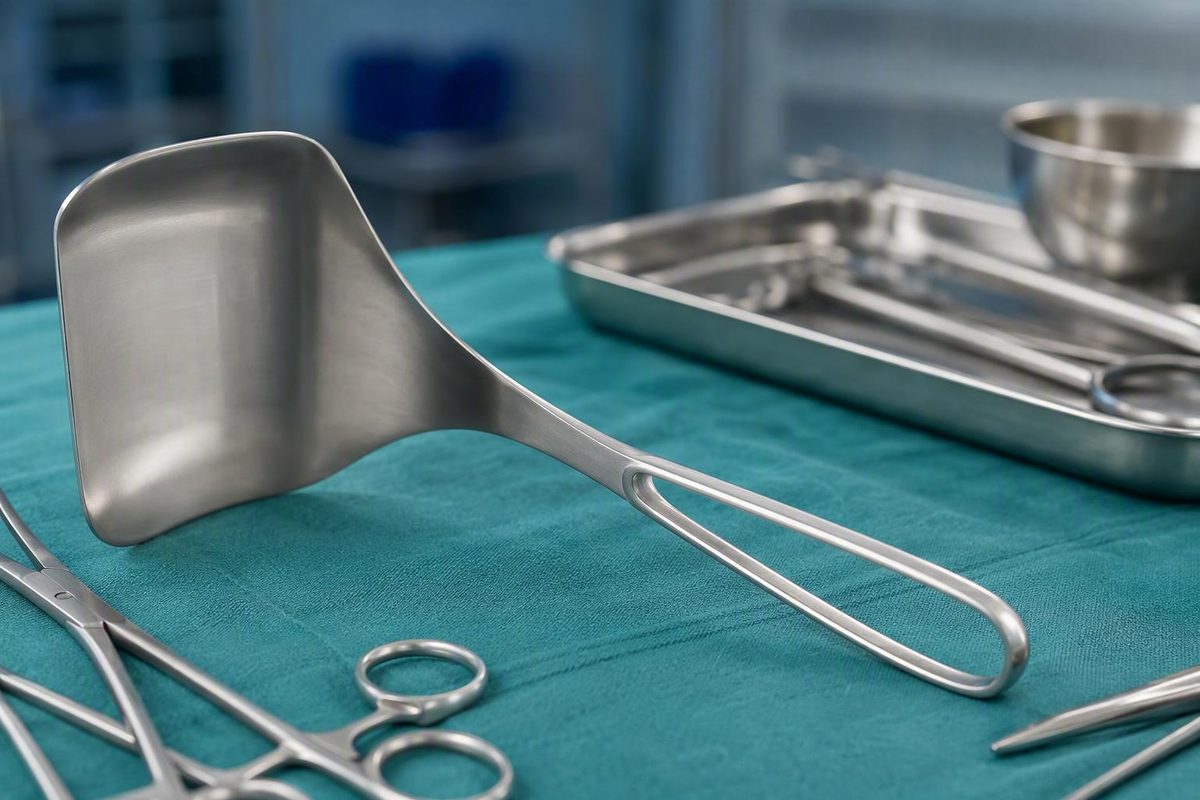
A Deaver retractor is best recognized as a manual, single-sided retractor with a long, broad blade that forms a pronounced continuous curve. Commercial instrument references associate the conventional pattern primarily with exposure of deep structures during open abdominal and thoracic surgery.
That basic profile is consistent across the available sources, but individual products are not. Overall length, working width, handle configuration, material, flexibility, illumination, reuse status, and system compatibility are model-specific and must be verified by manufacturer and part number.
This article is an identification and specification reference. It does not provide instructions for placement, retraction force, angle, duration, processing cycles, or patient-specific instrument selection.
Deaver retractor at a glance
A conventional Deaver is a handheld, single-sided surgical retractor, not an inherently self-retaining device. “Single-sided” means it has one working end rather than two opposing working ends. “Handheld” means it must be manually held or separately supported rather than locking itself open.
Its defining feature is a large blade with a deep, continuous curve. Catalogs commonly describe this as C-shaped or question-mark-shaped. Unlike a short, abruptly angled retractor, a Deaver has an elongated working blade that sweeps away from the handle before reaching its distal end. An independent instrument-identification guide classifies the Deaver among single-sided handheld retractors and identifies its “large curved end” as the principal visual feature (Operative Review’s retracting-instrument guide).
The Deaver belongs to the broader category of retractors used to hold tissue, organs, or the edges of an operative opening away from the field. The available commercial sources repeatedly associate the pattern with deep abdominal and thoracic exposure. These descriptions provide identification context, not formal indications or instructions for selecting or using the instrument.
Quick identification checklist
Look for these features together:
- One working end: The conventional handheld pattern is single-sided.
- A pronounced continuous curve: The blade resembles a broad C or question mark rather than a short right-angle bend.
- A long, broad, smooth blade: Width varies, but the working surface is generally described as flat and without prongs.
- A handle at the opposite end: Catalog terms include flat, plain, thin, grip, and hollow grip.
Shape alone cannot establish the exact model. A curved retractor might instead be a Harrington, a malleable ribbon retractor, or a Deaver-pattern blade made for a fixed frame. Verify the product name, manufacturer, part number, dimensions, and attachment style.
Blade, tip, handle, and overall profile
The Deaver’s working blade is generally long and relatively flat through its deep curve. This distinguishes it visually from retractors with short, abrupt right-angle working ends. In a side view, the continuous curve is usually the most recognizable feature. In a face view, the blade width and surface profile are easier to assess.
Some sellers describe their Deaver products as having a rounded distal tip and smooth edges. These are visual design descriptions, not evidence that the instrument prevents tissue injury.
Several measurement terms appear in catalogs:
- Overall length: The complete end-to-end length of the instrument.
-
Blade width: The transverse width of the working blade.
-
Blade length: The length of the working portion rather than the complete instrument.
- Handle style: The manufacturer’s description of the gripping or attachment section.
Catalogs do not always use these labels consistently. A listing described as “12 × 2 inches” may mean a 12-inch overall length and a 2-inch blade width, but that interpretation must be confirmed from the product specification. A 2-inch “tip” should not automatically be recorded as a 2-inch blade length.
Recurring handle configurations include:
- Flat or plain handle: A broad, relatively simple continuation from the blade.
- Thin handle: A narrower profile treated as a distinct product family by some manufacturers.
- Grip handle: A more substantial shaped gripping section.
- Hollow grip: A separately cataloged handle configuration.
- Bottom finger hook: A hook or flange at the handle end on some models.
- System attachment: An interface for connecting a Deaver-pattern blade to a fixed retractor frame.
These are catalog labels, not demonstrated ergonomic rankings. A hollow grip is not necessarily superior to a flat handle, and a finger hook does not establish reduced fatigue or better control.
Flexibility is also model-specific. Anthony Products describes its own Deaver pattern as flexible, but the evidence does not establish that all Deaver retractors share that property. An unfamiliar instrument should not be classified or manipulated as malleable without documentation for the exact model.
Recommended identification illustration: Provide side and face views of an isolated Deaver, labeled to show the continuous blade curve, working width, rounded distal end, handle, and optional finger hook. The image should not depict clinical placement or imply a retraction technique.
Commonly reported uses in open surgery
The most consistently reported use categories are deep abdominal and thoracic exposure. At a high level, commercial sources describe the curved blade as holding deep tissue or organs away from an operative field. This explains the instrument’s general category without specifying insertion, positioning, loading, or duration.
Anthony Products names the liver, stomach, and kidneys as examples of structures that may be held aside and associates its product with abdominal and thoracic exposure. It also lists general and orthopedic surgery among the product’s applications (Anthony Products’ Deaver catalog). Other commercial descriptions mention the intestines. These examples are vendor-attributed uses rather than formal indications or patient-selection rules.
Liver retraction is the most frequently repeated procedure-specific example in the supplied material. A Lumitex overview states that a Deaver may be used during cholecystectomy to retract the right lobe of the liver and during truncal vagotomy to retract the left lobe (Lumitex’s surgical-retractor overview). Lumitex is a medical-technology company, and the cited page is a commercial blog rather than a clinical guideline. Its examples should therefore be understood as descriptions of instrument use, not procedural instructions.
Other vendor-attributed abdominal examples include holding the stomach or liver during vagotomy and moving intestines during bowel surgery. Commercial thoracic descriptions refer more generally to deep chest exposure. These recurring abdominal and thoracic categories provide more reliable identification context than any single procedure list.
Some sellers also associate the Deaver pattern with:
- Gynecological procedures
- Urological surgery
- Orthopedic and spine surgery
- Trauma surgery
- Other operations requiring deep exposure
These applications are reported less consistently and should not be treated as formal indications for every Deaver model.
Meister Surgical describes the conventional Deaver as an instrument for open rather than laparoscopic surgery (Meister Surgical’s Deaver overview). Because that statement comes from a vendor-authored guide, it is best read as a description of the conventional handheld pattern—not as a rule covering every specialized product that may use a related name.
None of these reported applications determines whether a Deaver should be selected for an individual patient. Procedure, anatomy, available equipment, team training, manufacturer documentation, and professional clinical judgment all affect selection.
Sizes and Deaver retractor variants
There is no universal Deaver size. Dimensions must be checked against the manufacturer, part number, and measurement convention used in the applicable catalog.
Across the supplied adult catalog examples, commonly listed configurations are approximately 9 to 13 inches in overall length, with working widths around 1 to 3 inches. This is a catalog-derived summary, not an industry standard or a patient-sizing rule.
Anthony Products illustrates the variation within a single product family. Its catalog lists six configurations: 9 inches × 1 inch; 12 inches × 1 inch; 13 inches × 1 inch; 12 inches × 1.5 inches; 12 inches × 2 inches; and 12 inches × 3 inches. The listing identifies the first value as overall length and the second as blade width. These examples show why “Deaver retractor” is not a complete inventory description.
Example specification matrix
The table summarizes representative catalog listings. “Not stated” means the cited listing does not establish the characteristic; it does not prove that the characteristic is absent.
| Example configuration | Overall length | Blade width or tip | Handle | Pediatric or adult label | Illumination | Reuse status | Compatibility notes |
|---|---|---|---|---|---|---|---|
| Anthony standard pattern | 9, 12, or 13 in | 1, 1.5, 2, or 3 in | Flat; bottom finger hook described | General listing | Not stated | Not stated | Conventional handheld products |
| Ambler pediatric examples | 6.75 in | 8, 10, or 12 mm | Catalog-dependent | Pediatric | Not stated | Not stated | Conventional handheld products |
| GerMed pediatric examples | 7, 8, or 8.5 in | 3/4, 7/8, or 5/8 in | Catalog-dependent | Pediatric | Not stated | Not stated | No patient-specific sizing rule established |
| gSource product gS 36.3298 | 12 in | 2-in tip | Thin | Not labeled pediatric | Not stated | Reusable | Handheld product; material specified by vendor |
| Marina product 120-701L | 7 in | 2 in | Grip | Not stated | Light incorporated | Not stated | Required external light hardware not documented |
| Marina product 120-702L | 13 in | 3 in | Grip | Not stated | Light incorporated | Not stated | Required external light hardware not documented |
| Ambler Bookwalter-style examples | Not stated | 1, 1.5, or 2 in | System blade | Not stated | Not stated | Not stated | Catalog uses a 4.5-in blade-length listing; frame compatibility requires verification |
The Anthony dimensions come from its six-option product page. The Ambler catalog supplies the pediatric and Bookwalter-style measurements, while the GerMed category page provides the 7- to 8.5-inch pediatric examples (Ambler Surgical’s Deaver catalog; GerMed’s Deaver catalog). These dimensions establish that smaller cataloged products exist; they do not establish which size is appropriate for a particular child, anatomy, or procedure.
Handle configurations are similarly variable. Plain, flat, thin, grip, and hollow-grip products are commercially listed. Record the manufacturer’s exact term, especially when similar dimensions are available with different handles.
Illuminated and fiberoptic models
Illuminated and fiberoptic Deaver products are commercially listed. Marina Medical specifies two grip-handle models: product 120-701L at 7 inches long with a 2-inch blade width, and product 120-702L at 13 inches long with a 3-inch blade width (Marina Medical’s illuminated Deaver listing).
The listing does not document whether every required light source, cable, adapter, or accessory is included. It also does not provide model-specific processing instructions. An illuminated retractor should therefore be researched as part of an equipment system, not treated simply as an all-metal hand instrument.
Bookwalter-style Deaver blades
Before identifying or ordering one, verify:
- Whether a frame is required
- The attachment interface
- The compatible system and generation
- Whether an adapter is needed
- Which components are supplied
- The instructions applicable to each component
In this context, “Deaver” describes the blade pattern or geometry. It does not establish that the blade works independently or fits every Bookwalter or other fixed retractor system.
Deaver versus Richardson, Balfour, Bookwalter, and other retractors
Retractors can serve overlapping exposure purposes while differing substantially in geometry and retention method. For identification, compare the blade shape, number of working ends, and whether the instrument is handheld or self-retaining.
| Retractor | Identifying geometry | Sidedness | Retention method | Broadly reported exposure depth or context |
|---|---|---|---|---|
| Deaver | Long, broad blade with a pronounced C or question-mark curve | Single-sided | Handheld or separately supported | Deep exposure |
| Richardson | Shorter blade with a more abrupt right-angle profile | Single-sided | Handheld | Commonly contrasted with the Deaver as shallower or moderate-depth |
| Balfour | Abdominal frame with opposing blades and a spreading mechanism | Multiple components or sides | Self-retaining | Abdominal exposure |
| Bookwalter | Fixed frame accepting interchangeable blades | System-dependent | Fixed or self-retaining system | Variable according to blade and setup |
| Army-Navy | Two working ends of different lengths | Double-sided | Handheld | Generally superficial to moderate descriptions |
| Harrington | Large curved, heart-shaped or “sweetheart” blade | Single-sided | Handheld | Deep-exposure descriptions overlap with the Deaver |
The Deaver, Army-Navy, and Harrington classifications and their principal visual distinctions are summarized by Operative Review’s identification guide. Commercial comparisons describe the Deaver as intended for deeper retraction than the more right-angled Richardson and distinguish the handheld Deaver from the self-retaining Balfour (Acheron Instruments’ comparison guide). These are broad identification comparisons, not universal clinical-selection rules.
Deaver versus Richardson
The Deaver’s long blade continues through a deep curve. A Richardson generally has a shorter, more abruptly right-angled working blade. Commercial comparisons position the Deaver for deeper retraction and the Richardson for shallower or moderate-depth exposure.
That distinction should not be converted into a fixed selection rule. Richardson configurations vary, and clinical teams do not select an instrument solely by assigning each named pattern to one depth category.
Deaver versus Balfour
A conventional Deaver must be held or separately supported.
The instruments are readily distinguished when fully assembled. A loose Balfour component, however, should be identified through its attachment features, part number, and system documentation rather than by blade shape alone.
Deaver versus Bookwalter
Such a blade should be inventoried as a system component with its manufacturer, part number, attachment interface, and compatibility details. It should not be merged indiscriminately with standalone handheld Deavers.
Deaver versus Army-Navy and Harrington
An Army-Navy is double-sided, with a working end at each end of the instrument. A conventional Deaver has one working blade and a handle at the opposite end.
A Harrington can be more visually confusing because it also has a large curved working end. Its characteristic feature is a heart-shaped or “sweetheart” blade. The Deaver instead has an elongated blade that follows a broad C- or question-mark-like curve.
These differences support recognition, not claims of clinical superiority. Actual selection depends on the procedure, anatomy, equipment, manufacturer documentation, and trained clinical judgment.
How to read a Deaver retractor specification
Visual recognition answers, “What pattern does this resemble?” Procurement requires a more exact question: “What product is this?”
Use the following sequence when identifying, documenting, or ordering a Deaver:
- Manufacturer: Record the legal manufacturer or catalog brand, not only the distributor.
- Exact product name: Include qualifiers such as pediatric, thin handle, hollow grip, illuminated, fiberoptic, or system blade.
- Part number: Treat the SKU or catalog number as essential.
- Overall length: Confirm that the value covers the complete instrument.
- Blade width or tip size: Preserve the catalog’s exact term.
- Handle configuration: Record flat, plain, thin, grip, hollow grip, finger hook, or system attachment.
- Material: Confirm the construction specified for that SKU.
- Reuse status: Determine whether the exact product is reusable, single-use, or subject to another limitation.
- Supplied sterility status: Verify whether the product is supplied sterile or nonsterile.
- Compatibility: Check frames, clamps, light sources, cables, adapters, and proprietary accessories.
- Included components: Do not assume every item shown in a product photograph is supplied.
- Documentation: Obtain the current instructions for use and applicable regulatory and processing documentation.
The gSource listing for product gS 36.3298 shows the level of specificity required. It identifies a Deaver with a 12-inch overall length, 2-inch tip, thin handle, reusable status, and German surgical stainless-steel construction (gSource’s gS 36.3298 specification). Those facts apply to that product only. They do not establish that every Deaver is reusable, made from the same material, or measured using the same terminology.
Before purchase or acceptance, also verify:
- Current manufacturer instructions
- Validated cleaning and sterilization requirements
- Disassembly requirements
- Regulatory documentation applicable to the facility and jurisdiction
- Warranty terms
- Repair or refurbishment support
- Replacement-accessory availability
- Frame or illumination compatibility
- Packaging and supplied sterility status
Prices, discounts, and stock indicators are unstable listing details. They should not be treated as durable market benchmarks. Even a same-day price comparison can mislead unless dimensions, handles, materials, illumination components, included accessories, warranty terms, reuse status, and capture date are equivalent.
Catalog factors can organize product research, but they cannot prescribe an instrument for an individual operation or patient.
Reuse, cleaning, sterilization, and inspection boundaries
Reusable Deaver models exist. For example, gSource expressly labels product gS 36.3298 as reusable. That status cannot be generalized to every standard, illuminated, pediatric, or system-compatible Deaver.
Meister Surgical gives generic vendor guidance to clean Deaver retractors, sterilize them by autoclave, dry them thoroughly, and inspect for wear, pitting, or corrosion. The same page does not provide a validated model-specific cycle, and its advice should not be treated as an instruction for every product.
For each exact part number, obtain and follow the manufacturer’s current instructions and applicable facility policies addressing:
- Point-of-use handling
- Transport and containment
- Cleaning chemistry
- Manual or mechanical cleaning
- Disassembly
- Rinsing and drying
- Inspection
- Sterilization method
- Packaging
- Storage
- Tracking and maintenance
This list identifies information that should be verified; it is not a processing protocol.
The supplied Marina listing does not document those requirements. Instructions written for a conventional all-metal handheld retractor should not be presumed suitable for an illuminated product.
Fixed-system blades likewise require model-specific confirmation. Compatibility and processing requirements cannot be inferred from the shared word “Deaver.”
Visible corrosion, pitting, distortion, or edge damage should be evaluated under the applicable manufacturer and facility criteria.
What the available evidence does—and does not—establish
Most of the available Deaver sources are manufacturers, retailers, or commercial publishers. They are useful for documenting part numbers, dimensions, handle styles, product families, and vendor-attributed applications. They are weaker support for claims about comparative clinical performance, safety, ergonomics, or patient outcomes.
The evidence supports several practical identification conclusions:
- The conventional Deaver is classified as a handheld, single-sided retractor.
- It has a large, long, deeply curved working blade.
- The curve is commonly described as C-shaped or question-mark-shaped.
- Commercial sources repeatedly associate the pattern with deep abdominal and thoracic exposure.
- Multiple dimensions, handle configurations, pediatric models, illuminated products, and fixed-system blades are sold.
The available material does not establish that a Deaver:
- Reduces tissue trauma
- Prevents injury
- Improves patient safety
- Produces better exposure than competing patterns
- Improves operator control
- Reduces fatigue
- Produces better clinical outcomes
Rounded tips and smooth edges may be reported as design characteristics, but those descriptions do not guarantee safe retraction.
The evidence also provides no authoritative thresholds for placement, pressure, angle, or duration. Procedural technique should not be derived from retail descriptions. Material, supplied sterility, regulatory status, warranty, expected service life, and validated reprocessing requirements remain specific to the product and its documentation.
Medical Forceps describes itself as an educational, manufacturer-independent instrument reference that does not sell instruments or accept manufacturer-paid placement (About Medical Forceps).
Its terms state that the site provides educational information rather than medical advice and does not replace professional clinical training (Medical Forceps terms).
Frequently asked questions
Is a Deaver retractor handheld or self-retaining?
A conventional Deaver is a handheld, manually operated retractor. It does not inherently lock itself in place, so it must be held or separately supported.
Do not confuse it with a Deaver-pattern blade designed for a fixed frame. Such a blade can participate in a self-retaining system, but that does not make a conventional handheld Deaver self-retaining.
What sizes do Deaver retractors come in?
Sizes vary by manufacturer and part number. In the supplied adult catalogs, commonly listed examples are approximately 9 to 13 inches overall with blade widths around 1 to 3 inches. Anthony’s catalog provides examples within that range, while Ambler and GerMed list smaller pediatric models around 6.75 to 8.5 inches with narrower blades.
These are catalog-derived examples, not universal standards or patient-sizing rules. Always determine whether a stated dimension means overall length, blade length, blade width, or tip size.
How is a Deaver retractor different from a Richardson or Balfour retractor?
A Deaver has a long blade with a pronounced continuous curve. A Richardson is generally described as having a shorter, more right-angled working blade. Commercial comparisons commonly associate the Deaver with deeper retraction and the Richardson with shallower or moderate-depth exposure, but this is not a universal selection rule.
A conventional Deaver is handheld. A Balfour is a self-retaining abdominal retractor with a frame and opposing blades.
Is a Deaver retractor used in laparoscopic surgery?
A vendor-authored overview describes the conventional Deaver as an open-surgery rather than laparoscopic instrument. That characterization fits its handheld open-field design, but it should not be generalized to every specialized product using Deaver-derived terminology.
Verify the exact product name and documentation rather than relying on the pattern name alone.
Are all Deaver retractors reusable and autoclavable?
The evidence establishes that at least one specific Deaver model is reusable and that a vendor guide gives generic autoclaving advice. Neither fact proves that every Deaver—particularly an illuminated product or fixed-system component—is reusable or compatible with the same sterilization method.
Verify the manufacturer, part number, material, use status, supplied sterility, accessories, and current validated instructions before processing any model.
Practical recognition rule
Look for a single-sided handheld retractor with a long, broad blade forming a pronounced C or question-mark curve. Then verify the manufacturer and SKU rather than relying on appearance alone.
Length, width, handle, material, flexibility, reuse status, illumination, and frame compatibility are model-specific. Identification and catalog research can narrow the possibilities, but clinical selection, use, inspection, and reprocessing must follow professional training, facility policy, and the exact manufacturer’s validated documentation.