
What Is a Doyen Retractor? How Models Differ
Documented products fall into three catalog groups: general operating, abdominal and vaginal. The name alone does not identify one blade, length, handle or use.
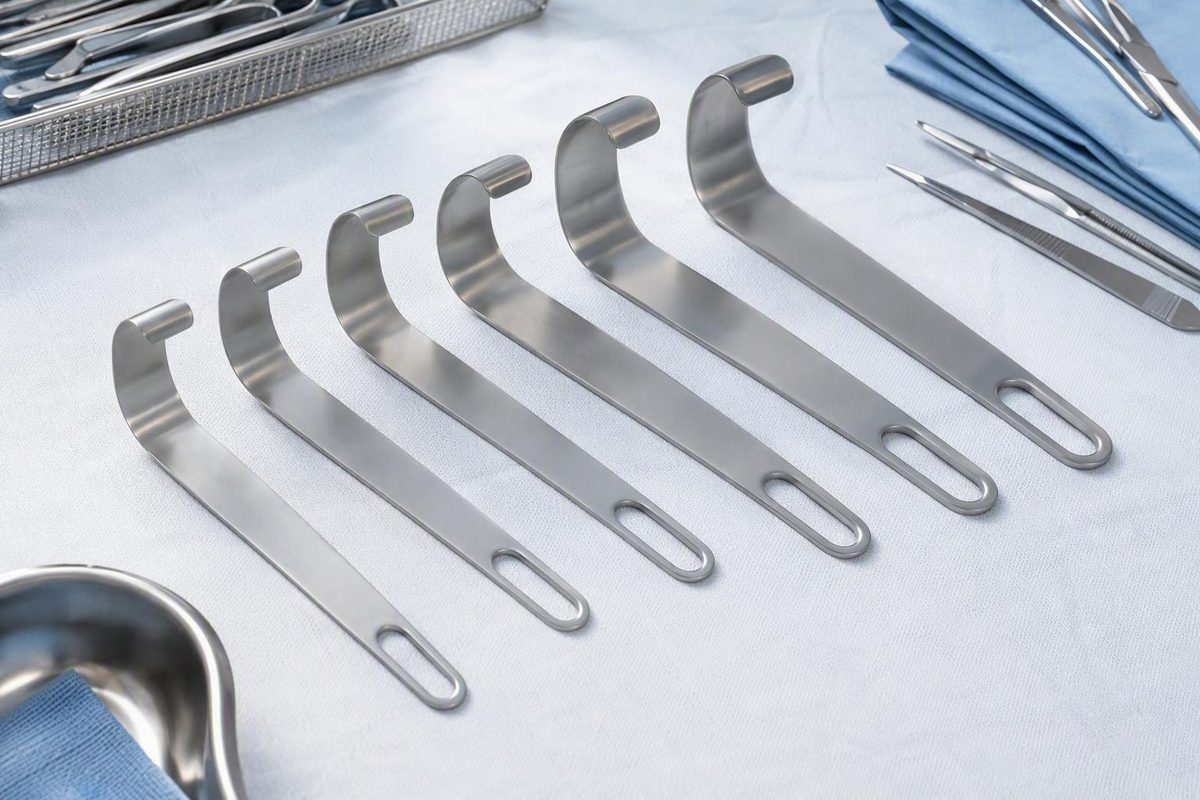
A Doyen retractor is best identified by its exact variant and catalog specifications—not by the eponym alone. Suppliers apply the name to several handheld retractors, including abdominal or general-operating patterns and separately described vaginal patterns. These products differ in overall length, blade dimensions, handle design, stated purpose, material description, reuse classification, and sterile-supply status.
For students, instrument-room personnel, sterile-processing technicians, and buyers, the practical lesson is simple: “Doyen” is only the beginning of an identification. A reliable record should also include the manufacturer, catalog number, named variant, measurements, configuration, reuse status, and whether the instrument is supplied sterile.
This article is an educational identification and procurement reference. It does not provide operative technique, patient-specific selection advice, or validated reprocessing instructions. Specifications and dated commercial details were checked against the cited manufacturer and seller records on August 16, 2026.
What is a Doyen retractor?
A Doyen retractor is a handheld surgical instrument sold for tissue retraction. The name appears in commercial catalogs, but it does not identify one universal blade, length, handle, or intended use.
Integra LifeSciences, for example, places three Jarit Doyen models in its general-operating retractor category. Those models share a right-angled configuration but have different working-tip dimensions. Other sellers use the name for an abdominal retractor, while Ambler’s page title and a separate commercial instrument guide identify vaginal Doyen retractors.125
That variation makes the eponym less precise than a complete catalog description. An inventory entry reading only “Doyen retractor” may omit the information needed to distinguish:
- An abdominal model from a vaginal model
- A general-operating catalog pattern from a specialty-specific listing
- One blade or tip size from another
- A hooked handle from a grip-style handle
- A reusable instrument supplied non-sterile from one whose supply sterility is not stated
- One manufacturer’s geometry from another manufacturer’s nominally similar product
The available evidence comes primarily from manufacturer and seller catalogs. These sources are useful for identifying the products they list because they provide model numbers, dimensions, materials, ordering details, and commercial classifications. They do not establish comparative clinical effectiveness, proper technique, contraindications, tissue-pressure limits, patient-specific suitability, or the superiority of one model.
The name’s historical attribution is also outside the scope of the evidence. A catalog database field associating the product with “Doyen” does not, by itself, provide an authoritative history of the eponym.
Identification features and measurement terminology
Several documented abdominal or general-operating Doyen retractors have a broad blade set at or near a right angle to the adjoining section. That description should not be treated as a universal definition; each catalog record must be read model by model.
Integra describes Jarit models 200-145, 200-147, and 200-149 as reusable, right-angled, 90-degree retractors with a satin finish and stainless composition. Each model is listed at 225 mm overall with a 95 mm working length, but the metric tip dimensions differ. These characteristics belong to the listed Jarit products, not necessarily to every instrument sold under the Doyen name.1
The MPM abdominal product has a more specifically described configuration: a blunt blade at 90 degrees and a hooked handle. Its catalog offers a fixed blade width with multiple depth choices. “Blunt” and “hooked handle” therefore describe that model; they should not be copied into a generic definition of every Doyen retractor.3
The page lists an 8.5-inch overall length and a blade 3 inches long by 2.125 inches wide. 2
These differences make measurement terminology especially important.
Its endpoints may depend on the manufacturer’s measurement convention. It should not be calculated as overall length minus handle length unless the applicable documentation defines it that way.
Catalogs do not always use the two terms consistently.
Which physical direction is called “width” may depend on product orientation and the supplier’s catalog format.
A stated 90-degree configuration should be recorded from the manufacturer’s specification rather than estimated from a photograph.
The following conceptual diagram shows the fields that may appear in a catalog. It is not a universal measurement protocol:
                    <------ blade width ------>
                         ┌────────────────┐
                         │                │
                         │     BLADE      │
                         │                │
                         └────────────────┘
                                  ↕
                           blade depth
                                  │
                              angle at
                           adjoining section
                                  │
                                  │
                             ┌──────────┐
                             │  HANDLE  │
                             └──────────┘

        <------------ overall length, end to end ------------>

 Working length: manufacturer-defined field; exact endpoints are
 not shown because their definition may vary by catalog or model.
Illustration rule: label only dimensions explicitly defined in the applicable catalog or technical document. Do not estimate working length, curvature, angle, or handle dimensions from a photograph.
Dimension order is another common source of error. A catalog may write “3 × 2.125 inches,” list tip length and width in separate fields, or present width before depth. The Jarit records demonstrate the problem particularly clearly: their ordering lines present imperial dimension pairs in an order that does not directly match the metric tip-length and tip-width fields. Those values should be preserved as separately listed catalog data rather than presented as exact ordered conversions.1
When transcribing specifications:
- Preserve the supplier’s original dimension labels.
- Record the units.
- Note the order in which dimensions appear.
- Avoid silently converting a “tip” measurement into a “blade” measurement.
- Keep calculated conversions separate from original catalog values.
- Flag internally inconsistent or non-equivalent metric and imperial entries.
- Do not infer missing dimensions from another brand’s similarly named product.
Abdominal, general-operating, and vaginal Doyen variants
The documented products fall into three catalog-description groups: general operating, abdominal, and vaginal. These labels support identification and purchasing, but they are not interchangeable with independently validated clinical indications.
General-operating models: Integra categorizes its three Jarit products as general-operating retractors. This is useful when matching a catalog record or count-sheet description, but the category should not be expanded into an unsupported claim that the models are suitable for every general operation.
Abdominal model: MPM markets product 123-5541 as a handheld abdominal retractor for abdominal obstetric and gynecological procedures. The seller gives abdominal hysterectomy, cesarean delivery, and procedures involving ectopic pregnancy as examples.3
Those examples are seller descriptions. They do not explain how the instrument should be positioned, which blade depth should be selected, what tissue limits apply, or whether the instrument is suitable for a particular patient.
Vaginal models: Ambler’s product-page title identifies item 71-541 as a Doyen vaginal retractor, while the page body describes it more generally as a tissue-retraction instrument. A separate GerMedUSA commercial guide lists a nine-inch “Doyen Vaginal Retractor” for retracting the vaginal wall during obstetric and gynecological procedures.25
These are separately documented listings and should not be assumed to represent the same model. Ambler’s item is listed at 8.5 inches, while the vendor guide describes a nine-inch instrument but provides no model number, construction details, blade geometry, handle description, contraindications, or technique.
A vaginal listing should remain a separate identification branch from an abdominal model. Similar overall lengths do not establish equivalence. Purpose, blade profile, working dimensions, curvature, and handle geometry may differ even when the common name and approximate length overlap.
Similarly, the placement of other products under a website’s related-products heading should not be used to invent an intended specialty. In particular, BOSS’s related-product categorization does not establish that its featured Doyen abdominal retractor is intended for neurosurgery.
Catalog-listed uses can help answer identification and procurement questions such as:
- Is this an abdominal or vaginal listing?
- Which supplier’s catalog should be consulted?
- Does the count sheet use a broad category or an exact product name?
- Is the item being ordered consistent with the existing inventory description?
They cannot answer patient-specific questions or replace current manufacturer documentation, institutional policy, professional training, or qualified clinical judgment.
Verified Doyen retractor sizes and model numbers
The table compares only publicly documented fields. “Not stated” means that the cited page did not establish the information; it does not mean that the specification is unavailable elsewhere.
Jarit’s metric and imperial entries are shown as separately listed catalog values—not exact conversions. In particular, the stated 225 mm overall length is not mathematically equivalent to the separately displayed 8¾-inch ordering length. The imperial blade pairs also appear in a different order from the catalog’s metric tip-length and tip-width fields.1
| Supplier or brand | Model or SKU | Named variant | Overall length | Working length | Blade or tip dimensions | Angle or handle | Material | Sterile-supply status | Reuse status |
|---|---|---|---|---|---|---|---|---|---|
| Jarit / Integra1 | 200-145 | Doyen retractor; general-operating category | Metric field: 225 mm; ordering line: 8¾ in | 95 mm | Metric fields: tip length 65 mm, width 45 mm; ordering line: 1¾ × 2½ in, with axis order not defined there | Right-angled; 90°; satin finish | “Stainless” | Not stated | Reusable |
| Jarit / Integra1 | 200-147 | Doyen retractor; general-operating category | Metric field: 225 mm; ordering line: 8¾ in | 95 mm | Metric fields: tip length 75 mm, width 55 mm; ordering line: 2⅛ × 3 in, with axis order not defined there | Right-angled; 90°; satin finish | “Stainless” | Not stated | Reusable |
| Jarit / Integra1 | 200-149 | Doyen retractor; general-operating category | Metric field: 225 mm; ordering line: 8¾ in | 95 mm | Metric fields: tip length 90 mm, width 58 mm; ordering line: 2¼ × 3½ in, with axis order not defined there | Right-angled; 90°; satin finish | “Stainless” | Not stated | Reusable |
| Ambler Surgical2 | 71-541 | Doyen vaginal retractor in page title; “Doyen retractor” in page body | 8.5 in | Not stated | Blade: 3 in long × 2.125 in wide | Grip handle | Stainless steel | Non-sterile | Reusable |
| MPM Medical Supply3 | 123-5541 | Doyen abdominal retractor | 9.5 in | Not stated | Width: 1.75 in; depth options: 2.125, 3.375, or 4.5 in | Blunt 90° blade; hooked handle | German stainless steel | Non-sterile | Reusable |
| BOSS Instruments4 | 18-2140 | Doyen abdominal retractor | 9.5 in | Not stated | Not stated | Not stated | Not stated | Not stated | Reusable |
| GerMedUSA vendor guide5 | Not stated | Doyen vaginal retractor | 9 in | Not stated | Not stated | Not stated | Not stated | Not stated | Not stated |
BOSS confirms that SKU 18-2140 is a reusable 9.5-inch Doyen abdominal retractor, but its public product page does not state the blade dimensions, material, working length, or sterile-supply status.4 Those fields should not be completed with specifications taken from a related BOSS item or a similarly sized model from another brand.
The Jarit series illustrates why overall length alone is inadequate for identification. All three listed models share the same cataloged overall and working lengths, but their metric tip dimensions increase across the series. The dimensions—not the common name or length—separate the three catalog records.1
Ambler’s 3-by-2.125-inch blade is nominally close to the imperial dimensions displayed for one Jarit model. That resemblance does not establish identical axis orientation, blade profile, curvature, working length, intended use, or interchangeability. The catalogs also label and order the dimensions differently.21
The MPM listing uses another sizing system: one fixed blade width with three selectable depths. A procurement record that says only “large Doyen” or “9.5-inch Doyen” would discard information needed to identify the selected configuration.3
Material descriptions also vary. Jarit says “stainless,” Ambler says “stainless steel,” and MPM specifies “German stainless steel.” These descriptions do not establish a universal alloy or grade across all Doyen retractors. If alloy, hardness, corrosion resistance, or finish standards matter to a purchase, the buyer should obtain documentation for the exact model.
Reusable does not mean supplied sterile
Three separate questions must be answered for any Doyen retractor:
- Is the instrument designed and labeled for reuse?
- Is it supplied sterile or non-sterile?
- Which validated reprocessing instructions apply to that exact product?
The answers are not interchangeable. “Reusable” describes the product’s usage classification. It does not mean the instrument arrives sterile, and it does not identify a validated cleaning or sterilization method.
Ambler 71-541 and MPM 123-5541 are each explicitly listed as reusable and non-sterile. 23
That status must not be generalized to every Doyen retractor. The supplied Jarit and BOSS pages do not state supply sterility, while the vendor guide’s nine-inch vaginal entry reports neither supply sterility nor reuse status. For those records, the correct value is “not stated,” not “non-sterile by association.”
As conservative facility guidance, personnel should obtain the current model-specific manufacturer’s instructions for use and follow applicable institutional policies. The evidence supplied for this article did not include validated reprocessing parameters for the listed models. This article therefore does not prescribe detergents, water quality, temperatures, cycle types, exposure times, lubrication methods, packaging systems, inspection criteria, or service-life limits.
Procurement and sterile-processing workflows should be coordinated before first processing. Ambler states that an eligible non-sterile instrument becomes nonreturnable after sterilization. This makes it prudent to verify the item number, ordered size, received quantity, visible condition, and consistency with the purchase order before processing changes the product’s return status.2
A receiving record should keep the relevant fields separate:
| Field | Example entry |
|---|---|
| Usage classification | Reusable |
| Supplied condition | Non-sterile |
| Applicable reprocessing document | Current model-specific IFU, including document number and revision |
| Institutional pathway | Facility-approved policy or work instruction |
| Processing status of received item | Not yet processed / processed, as applicable |
Catalog silence about sterility should trigger document retrieval rather than an assumption. Likewise, knowing that an instrument is supplied non-sterile does not reveal which validated process applies.
How to distinguish similar-looking Doyen models
A consistent identification sequence reduces the risk of treating a familiar silhouette or close dimension as proof of a match.
1. Read the etched identifier. Look for the manufacturer, brand, item number, SKU, or another traceable marking. Record the characters exactly. If a mark is incomplete or difficult to read, do not reconstruct the missing portion from appearance alone.
2. Determine the named variant. Separate an explicitly named abdominal retractor from a vaginal retractor and from a product categorized only as general operating. Preserve the wording used by the manufacturer or supplier, including any discrepancy between the page title and product description.
3. Measure overall length. Measure the complete instrument end to end using the facility’s approved method. Compare the result with the catalog entry while preserving the original unit and stated precision. Do not assume separately listed metric and imperial values are exact conversions.
4. Measure the blade in both documented axes. Record width and depth or length according to the applicable catalog labels. Avoid an unlabeled pair such as “3 × 2.125,” because the order may later be reversed.
5. Check working length where documented. Working length can help distinguish or confirm a model, but only when the manufacturer supplies that field. Do not calculate it for a product whose page reports only overall length.
6. Verify blade angle and profile. Check whether the exact model is described as right-angled, 90 degrees, or blunt. Compare curvature and profile with current manufacturer documentation rather than relying on the Doyen name.
7. Inspect the handle pattern. A grip handle and a hooked handle are different catalog descriptions. Record the design without making unsupported claims about comfort, control, or fatigue reduction.
8. Compare every available field. A credible match should account for the manufacturer, SKU, named variant, overall length, working length where reported, blade dimensions, angle, profile, handle, material, finish, reuse classification, and sterile-supply status.
Applied to the documented products, this sequence separates models that could otherwise be confused:
- The three Jarit products share their listed overall and working lengths, so their tip dimensions are the principal catalog distinction.
- Ambler 71-541 is an 8.5-inch grip-handle product whose page title identifies it as vaginal.
- MPM 123-5541 is a 9.5-inch abdominal model with a hooked handle, fixed blade width, and selectable depth.
- The vendor guide’s nine-inch vaginal entry remains a separate record because it has no model number or detailed construction fields.1235
A useful inventory naming pattern is:
Common name — named variant — manufacturer — SKU — overall length — blade or tip size
Examples based on the cited catalog records include:
- Doyen retractor — general operating — Jarit — 200-145 — cataloged 225 mm overall — tip length 65 mm × width 45 mm
- Doyen abdominal retractor — MPM — 123-5541 — 9.5 in — 1.75 in wide × selected depth
- Doyen vaginal retractor — Ambler — 71-541 — 8.5 in — blade 3 in long × 2.125 in wide
- Doyen vaginal retractor — GerMedUSA guide — model not stated — 9 in — blade dimensions not stated1325
Where available, recording the manufacturer and SKU alongside the common name is more reliable than using “Doyen” alone. It also makes document retrieval, replacement research, and discrepancy investigation easier.
Nominal dimensions cannot establish cross-brand equivalence. Instruments may differ in blade profile, edge form, curvature, working length, shaft geometry, handle shape, finish, balance, material specification, and stated purpose. A close measurement is a reason to continue checking—not a reason to declare a match.
Procurement checklist and limits of the available evidence
Before ordering a new Doyen retractor or replacing an existing one, verify:
- [ ] Exact manufacturer or brand
- [ ] Catalog number, model number, or SKU
- [ ] Complete product name
- [ ] Named variant: abdominal, vaginal, or another catalog designation
- [ ] Intended catalog category
- [ ] Overall length and units
- [ ] Working length, if specified
- [ ] Blade width
- [ ] Blade depth or length
- [ ] Tip or jaw measurements, with labels and dimension order preserved
- [ ] Blade angle
- [ ] Blade profile, including whether it is described as blunt
- [ ] Handle style
- [ ] Material description
- [ ] Finish
- [ ] Reuse or single-use classification
- [ ] Sterile or non-sterile supply status
- [ ] Unit or package quantity
- [ ] Current model-specific instructions for use
- [ ] Regulatory or conformity documentation applicable to the buyer’s jurisdiction
- [ ] Available service, repair, refurbishment, and inspection information
- [ ] Fit with the existing tray, rack, storage location, and count-sheet description
The public pages cited here do not establish all relevant regulatory documents, model-specific reprocessing instructions, or service and repair arrangements. Buyers should request those materials directly and confirm that each document applies to the exact catalog number under consideration.
When replacing an existing instrument, identify which characteristics must remain consistent with the tray and workflow. Storage space, rack geometry, count-sheet wording, and existing instrument markings may all affect the purchasing specification. That does not establish that products from different manufacturers are compatible or interchangeable.
Stable specifications should be separated from time-sensitive commercial information. Catalog identifiers and documented dimensions may remain relatively stable, although they should still be checked against current documentation. Price, stock, shipping, warranty, and return terms may change without notice.
Commercial details checked August 16, 2026: Ambler’s page displayed item 71-541 at $259 and marked it in stock. It described full credit for eligible returns within 30 days of the invoice date, a 20% restocking fee for returns after 30 but before 45 days, and stated that an instrument becomes nonreturnable after sterilization.2
On the same review date, MPM displayed each of the three 123-5541 blade-depth options at $107. The seller said qualifying non-warranty, non-custom returns required authorization, had to be made within 30 days of delivery, and were subject to a restocking fee. MPM also described a lifetime warranty against defects in workmanship and material while excluding damage associated with improper care or cleaning. These are seller-stated commercial terms, not an independent assessment, and buyers should verify the current language before ordering.3
Evidence-quality limit
Manufacturer and seller catalogs can establish what those organizations list under particular model numbers. They can support identification of dimensions, materials, configurations, reuse classifications, stated commercial categories, and supplied-condition fields.
They do not establish clinical superiority, comparative safety, proper operative technique, contraindications, tissue-safety limits, validated reprocessing parameters, patient-specific blade selection, or cross-brand equivalence.
Frequently asked questions
What is a Doyen retractor used for?
It is a handheld instrument sold for tissue retraction, but its stated purpose depends on the exact listing. Jarit categorizes its documented models as general-operating retractors. MPM markets its version as an abdominal retractor for specified abdominal obstetric and gynecological procedures. Ambler’s page title and a separate vendor guide identify vaginal variants, with the guide describing vaginal-wall retraction.1325
These catalog descriptions help identify products. They do not provide technique, contraindications, patient-selection criteria, or proof that one configuration is preferable.
Is a Doyen retractor abdominal or vaginal?
It can be either, depending on the named product. Commercial catalogs apply the Doyen name to abdominal or general-operating patterns and to separately identified vaginal retractors.325
Do not determine the variant from the eponym or overall length alone. Check the complete product name, manufacturer, SKU, catalog category, blade geometry, handle, and measurements.
Is a reusable Doyen retractor supplied sterile?
Not necessarily. Reuse classification and sterile-supply status are separate specifications. Ambler 71-541 and MPM 123-5541 are explicitly listed as reusable and non-sterile.23
The available pages do not establish supply sterility for the Jarit models, BOSS 18-2140, or the vendor guide’s nine-inch vaginal listing. Staff should verify current model-specific documentation rather than assume all Doyen retractors are supplied in the same condition.
What is the difference between overall length, working length, and blade size?
Blade size describes one or more dimensions of the blade or tip, commonly width together with depth or length.
These values are not interchangeable. Instruments can share an overall length while having different working-tip dimensions, as the three Jarit records demonstrate. Catalogs may also reverse dimension order or use terms such as “tip,” “jaw,” “blade length,” and “blade depth,” so labels and numbers must be compared together.1
How should a facility choose among Doyen blade sizes?
A facility should begin with documentation for the exact manufacturer and model, the intended catalog variant, qualified clinical input, and the requirements of the existing tray or count sheet. Comparison fields may include blade width, depth, profile, angle, working length, handle style, and overall length.
Catalog dimensions alone do not establish that a blade is appropriate for a procedure, patient, or anatomy. Similar dimensions also do not prove that models from different suppliers are interchangeable. The selected product should be documented by exact manufacturer and SKU and supported by current instructions and applicable facility policies.
Conclusion
Accurate Doyen retractor identification begins with the exact variant and model rather than the eponym alone. First distinguish abdominal or general-operating products from vaginal listings. Then compare correctly labeled measurements, confirm the manufacturer and SKU, and keep reuse classification separate from sterile-supply status.
Before purchase, processing, or use, consult current documentation for the exact model. Catalog specifications can support identification and procurement research, but they cannot replace clinical judgment, professional training, institutional policy, or validated manufacturer instructions.
Medical Forceps describes itself as an educational instrument-room reference, says it does not sell instruments or accept manufacturer-paid placement, and states that its material does not substitute for professional training.6 Its terms likewise characterize the site’s content as informational rather than medical advice.7