
9 Hohmann Retractor Patterns & Specs
Reviewed catalog examples span approximately 4.75 to 16 inches in overall length and about 4 to 70 mm in stated blade or tip width.
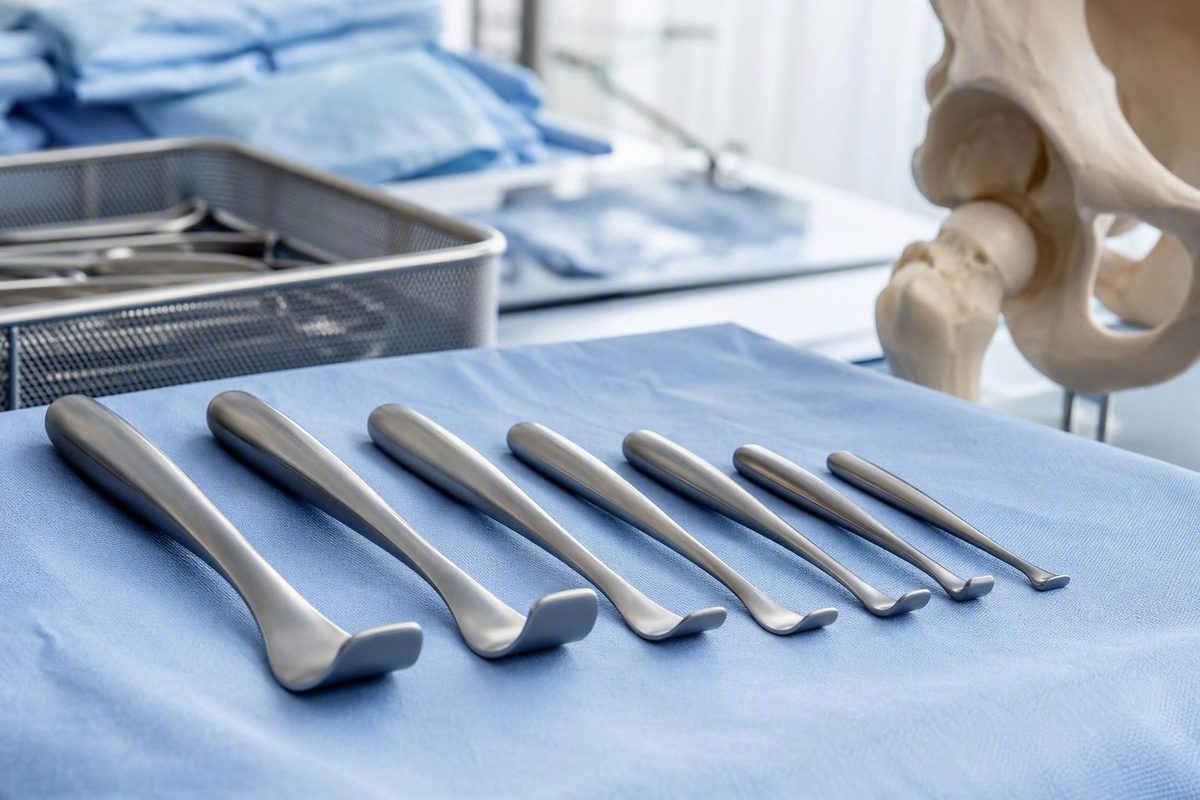
What is a Hohmann retractor?
A Hohmann retractor is a family of orthopedic retractors that commercial instrument sources commonly describe as handheld and single-ended. Its general purpose is to retract tissue so an underlying bone surface or joint margin can be exposed. Catalogs also use the names bone lever and bony lever retractor. Enztec, for example, describes the Hohmann as a single-ended handheld instrument used for tissue retraction and recognizes numerous modern variants rather than one fixed design (Enztec’s Hohmann retractor overview).
Those commercial descriptions use several related but distinct ideas:
- Retracting soft tissue: moving tissue away from the area being exposed.
- Exposing bone or a joint margin: the result when adjacent or overlying tissue is retracted.
- Assisting with bone manipulation: applying leverage or helping control bone in a model- and procedure-specific context.
These statements are not interchangeable. The alternate name “bone lever” does not establish that every Hohmann model is intended to perform the same kind or degree of bone manipulation. Likewise, a family-level reference to tissue retraction does not establish that a particular blade, tip, bend, or prong is suitable for every orthopedic procedure.
Many Hohmann patterns share a recognizable visual sequence: a handle leads into a flat or contoured blade, the blade incorporates a bend, drop, or curve, and the working end terminates in a tip or prong. That outline is useful for first-pass recognition, but it is not enough for positive identification.
Hohmann is a family name, not a complete specification. Hohmann-labeled instruments can differ in:
- overall length;
- blade or tip width;
- blade contour and thickness;
- bend angle and location;
- working depth;
- pointed, blunt, rounded, square, leaf-shaped, tear-drop, or pronged ends;
- number of prongs;
- handle shape and hole count;
- left or right orientation;
-
material;
-
retention or accessory mechanisms.
Treat “Hohmann retractor” as a broad catalog category. The name narrows the field, but the physical geometry, permanent markings, manufacturer, and exact stock-keeping unit—usually abbreviated SKU—distinguish one model from another.
This guide is limited to non-procedural identification and interpretation of commercial catalog specifications. The available evidence consists primarily of manufacturer and seller materials, which can document product dimensions and vendor-stated use contexts but cannot independently establish clinical superiority or universal safety. Medical Forceps describes itself as an educational instrument-room reference rather than a substitute for professional training (about Medical Forceps).
Instrument anatomy and the features used for identification
Examine an instrument methodically from handle to working end. Do not identify a Hohmann solely from the silhouette of its curve.
Handle
The handle is the portion held by the operator or connected to a compatible accessory. Reviewed catalogs show configurations including:
- flat handles;
- bent handles;
- finger-ring designs;
- solid handles without visible holes;
- one-hole, two-hole, and three-hole handles;
- handles associated with ratcheted or stackable configurations.
Hole count can be a useful identifier, but the reviewed evidence does not establish that holes necessarily improve grip, leverage, cleaning, sterilant contact, weight distribution, or clinical performance. Record the feature without assigning an unsupported benefit.
Blade
The blade is the working portion extending from the handle toward the terminal end. It may be flat, contoured, straight, curved, narrow, wide, or shaped through more than one bend.
Blade width is a transverse measurement across the working blade or end at a point defined by the manufacturer. It is not the same as:
- overall instrument length;
- blade length;
- working depth;
- prong length;
- handle length.
That distinction is essential when comparing listings. A 24 cm instrument with a 4 cm prong does not have a 4 cm-wide blade unless the source separately identifies that figure as blade width.
Bend, angle, and drop
A bend, angle, or drop describes a change in the geometric relationship between the handle and working blade. Catalogs use terms such as bent, angled, right-angle, curved, and double-bent. Some provide a numeric angle.
Copy a stated angle exactly from the manufacturer’s listing or drawing. Without a diagram, it may be unclear where the angle was measured or which centerlines were used. Two instruments called “90-degree” models may still differ in blade width, tip geometry, working depth, handle configuration, and bend location.
Working depth
Working depth is a linear reach measurement. In some reviewed Innomed listings, it is reported as the distance from the bend. It is distinct from bend angle, blade width, and overall length.
Not every catalog supplies working depth. If it is absent, record not stated rather than estimating it from a photograph or deriving it from overall length.
Terminal tip or prong
The terminal tip is the distal end of the blade. Commercial catalogs use terms including:
- pointed or sharp;
- blunt;
- rounded or round;
- square;
- leaf-shaped;
- straight;
- angled;
- tear-drop;
- single-prong;
- double-prong.
Terminology is not always consistent across sellers. “Straight” may describe the terminal profile, the blade path, or the relationship between blade and handle. “Rounded” may refer to the outline of the end rather than a defined edge radius or documented clinical bluntness. Use the current model drawing and device documentation when available.
Overall length
Overall length is the end-to-end length of the complete instrument. It can help separate short, standard-length, and long examples, but it does not establish working reach.
Two retractors with the same overall length may divide that length differently among the handle, bend, and working blade. Record overall length and working depth as separate fields.
Orientation
Some specialized products are offered in left- and right-oriented forms. Record orientation only when it is stated in current documentation, marked on the instrument, or established by a model drawing. Turning an unidentified instrument over can reverse its apparent visual orientation.
What a labeled illustration should show
A useful identification illustration would depict the instrument outside an operative field and label:
- handle;
- blade;
- blade width;
- bend or drop;
- bend angle;
- working depth;
- terminal tip or prong;
- overall length.
It should not depict placement around tissue, bone, implants, or neurovascular structures. Ambler’s catalog illustrates why multiple labels are necessary: its Hohmann listings vary in overall length, blade width, tip form, angle, drop, and flat-handle hole count (Ambler’s Hohmann catalog).
General use in hip and knee surgery
Commercial sources most consistently associate Hohmann retractors with orthopedic hip and knee procedures, particularly tissue retraction at or near joint margins. This describes how manufacturers and sellers position the instrument family; it is not an independent clinical recommendation or placement protocol.
In hip-related catalogs, vendor-stated contexts include:
- anterior or posterior acetabular-brim exposure;
- general acetabular exposure;
- anterior hip replacement;
- direct anterior approaches;
- general hip exposure;
- posterior-inferior and other approach-oriented working corridors.
Innomed maps individual Hohmann-style models to anterior hip replacement, acetabular exposure, joint-margin retraction, and general hip surgery. These mappings help explain why the manufacturer offers different geometries, but they remain manufacturer-stated contexts rather than comparative clinical guidance (Innomed’s Hohmann-style hip catalog).
For knee surgery, commercial descriptions refer to handheld Hohmann retractors being used around joint margins to retract tissue and improve exposure. Yasui similarly describes the Hohmann as a single-blade retractor generally used in hip and knee surgery, including tissue retraction at joint margins (Yasui’s orthopedic retractor overview).
Keep four kinds of catalog language separate:
- Retracts soft tissue identifies what is moved.
- Exposes bone identifies what becomes visible or accessible.
- Engages bone describes a relationship between the terminal end and a bony surface.
- Assists with bone manipulation suggests limited leverage or control in a specified context.
A seller may move among these phrases without defining them precisely. Do not convert them into assumptions that every model retracts bone directly, that every pointed end is intended to engage in the same way, or that leverage is an appropriate use for an unidentified instrument.
Specialized geometry can provide an identification clue. A wide curved model cataloged for acetabular exposure, an extra-narrow model associated with an anterior approach, or a posterior-inferior pattern may have been designed around a particular working corridor. Similar-looking instruments can nevertheless differ in intended use, orientation, dimensions, material, or accessory compatibility.
Clinical selection, placement, direction, depth, and force are outside the scope of this guide. Those decisions belong to trained professionals working under institutional protocols and current documentation for the exact device.
Major Hohmann retractor patterns
The most dependable way to organize Hohmann retractors is by observable geometry. Vendor names remain important for ordering, but the same term can cover different dimensions in different catalogs.
Standard and straight patterns
It does not mean that all brands share one standardized geometry. One supplier’s standard model may differ from another supplier’s in blade width, tip profile, handle, bend, or overall length.
Straight also requires context. It may mean that the instrument lacks a pronounced lateral curve, that the blade follows a relatively straight path, or that the terminal configuration is described as straight. Record the descriptor together with an image or drawing and all available dimensions.
Mini and extra-narrow patterns
Ambler displays mini models with 6 mm and 8 mm blades, including examples with a 45-degree drop. Those figures identify particular products, not every instrument sold as a mini Hohmann.
Innomed lists modified extra-narrow models with 12 mm blades and bends of either 30 or 90 degrees. Those 12 mm products are wider than some examples another supplier calls mini, demonstrating why category names cannot establish relative size across brands.
Narrow and wide patterns
For example, Innomed lists a narrow bent model with a 19 mm blade and a wide bent model with a 41 mm blade. Another catalog might list either dimension without applying the same qualifier. Record both the vendor’s descriptor and the stated width.
Width does not establish overall reach, working depth, bend angle, or prong length. A wide blade is not necessarily deep, and a narrow blade is not necessarily mini.
Bent, angled, right-angle, curved, and double-bent patterns
These terms describe changes in the relationship among the handle, blade, and working end:
- Bent: a general change in direction, sometimes without a numeric angle.
- Angled: an oblique configuration, with or without a stated angular value.
- Right-angle: generally used for a 90-degree configuration, although the measurement reference still requires confirmation.
- Curved: follows an arc rather than one sharply defined bend.
- Double-bent: incorporates two directional changes.
The name alone does not indicate where a bend begins or how much blade extends beyond it. Those details must be compared before two products can be considered dimensionally similar.
Deep patterns
The most useful listings provide a measured depth or a dimensioned drawing.
Do not substitute overall length for working depth. A long retractor may obtain much of its length from the handle, while a shorter model may allocate more length to the working section after the bend.
Posterior-inferior and other approach-oriented patterns
Names such as posterior-inferior, anterior, and acetabular combine geometry with a manufacturer-stated working context. They are especially poor substitutes for an SKU.
Terminology can also conflict within commercial material. Related GerMedUSA listings have used both “posterior-inferior” and “posterior-interior.” Such a discrepancy should be preserved and verified rather than silently corrected.
Single-prong and double-prong patterns
A single-prong model has one terminal projection; a double-prong model has two. Prong count is easy to document and can be valuable when sorting instruments.
Prong count alone does not establish retention, resistance to slipping, reduced tissue injury, or any other safety or performance outcome. Those conclusions would require evidence beyond a catalog description or photograph.
Stackable patterns
Stackable models are designed by their manufacturer to interlock or work in combination. Innomed lists Goytia stackable Hohmann versions described as standard, bent, wide, and deep, along with a separate lateral-retraction handle.
A stackable Hohmann may therefore be part of a defined system rather than a generic standalone instrument. Confirm:
- exact model numbers;
- compatible companion components;
- required handles;
- orientation;
- permitted configurations;
- current manufacturer instructions.
Do not assume that another brand’s components—or another line from the same brand—will interlock correctly.
Specialized anterior-hip and acetabular models
Commercial catalogs include modified Hohmann patterns associated with anterior hip and acetabular exposure. Examples include narrow bent, curved wide, double-bent, radiolucent, and stackable configurations.
These categories can help staff determine where an unfamiliar item belongs in a manufacturer-defined set. They do not demonstrate clinical superiority, suitability for every patient, or interchangeability with another product marketed for the same approach.
The practical rule is simple: use the pattern name to begin identification, not to finish it.
How to read Hohmann retractor sizes and specifications
Read specifications in a fixed order so one familiar measurement does not obscure a difference elsewhere:
- Manufacturer and SKU
- Overall length
- Blade or tip width
- Tip profile
- Bend angle or drop
- Working depth
- Prong count and prong length
- Handle style and hole count
- Orientation
- Material and product-status fields
Across the reviewed commercial catalogs, displayed examples extend from approximately 4.75 to 16 inches in overall length and from about 4 to 70 mm in stated blade or tip width. These are catalog examples, not the boundaries of an internationally standardized Hohmann size range. Ambler supports the 4.75-inch length example, while GerMedUSA lists human-surgical examples extending to 16 inches and angled models with 4 mm tips; its standard range also includes blades up to 70 mm (GerMedUSA’s Hohmann listings).
Model-specific comparison
The measurements below remain attached to their cataloged models rather than being combined into a fictional “standard” Hohmann. A dash means the reviewed listing did not supply that field.
| Catalog source and model | Overall length | Blade, tip, or prong measurement | Other stated detail |
|---|---|---|---|
| Integra/Miltex MH27-213 | 6.25 in; listed as 160 mm | 6 mm blade | Veterinary orthopedic catalog entry |
| Integra/Miltex MH27-215 | 9.25 in; 23.5 cm | 10 mm blade | Veterinary orthopedic catalog entry |
| Integra/Miltex MH27-218 | 9.5 in; listed as 240 mm | 41 mm blade | Related 27-218 entry states 43 mm |
| Innomed 7110, narrow bent | 23.8 cm | 19 mm blade | 12.1 cm depth from bend |
| Innomed 6590, wide bent | 23.8 cm | 41 mm blade | 12 cm depth from bend |
| Innomed 6215, curved wide | 33 cm | 43 mm blade | Cataloged for acetabular exposure |
| Carnegie 528-69024 | 24 cm | 4 cm prong length | Straight; prong length is not blade width |
The three Miltex rows come from an Integra page categorized as veterinary orthopedic ordering information. They show Hohmann-labeled configurations but should not be used to infer human-surgical intended use. The page also illustrates why discrepancies should not be “cleaned up” silently: MH27-218 is listed with a 41 mm blade, while the related 27-218 entry states 43 mm. Another entry pairs 9.25 inches with 24.0 cm even though the calculated conversion is approximately 23.5 cm (Integra’s Miltex ordering information).
The three Innomed rows document how models of similar overall length can differ in width and measured depth, while the longer curved-wide model is described separately for acetabular exposure. These remain manufacturer-specific dimensions and use descriptions, not standardized size classes.
Carnegie model 528-69024 is listed as 24 cm overall with a 4 cm prong. A comparison sheet that placed “4 cm” in a generic blade-width column would misstate the specification because the seller identifies it as prong length (Carnegie model 528-69024).
Preserve original units and conflicts
When normalizing catalog data, retain the original measurement and place any calculated conversion beside it:
- Original catalog value: 9.25 in
- Calculated conversion: approximately 23.50 cm
- Catalog metric value: 24.0 cm
- Status: conversion conflict; confirmation required
Do not replace a source value with a calculated one as though the source contained no discrepancy. The difference could reflect rounding, a typographical error, or two related entries that do not describe precisely the same item.
Label calculated values as calculated. Avoid false precision: converting a nominal 10 mm blade into a long decimal in inches does not make the source measurement more exact.
Do not assume cross-brand equivalency
Two products described as “9.25-inch Hohmann, 10 mm blade” may still differ in:
- where blade width was measured;
- blade thickness;
- terminal outline and edge finish;
- bend location;
- working depth;
- handle width and hole pattern;
- material;
- manufacturer-stated intended use;
- accessory compatibility;
- processing requirements.
Vendor cross-reference tables may identify candidate products, but they do not independently establish interchangeability. Compare exact geometry, dimensions, documentation, material, intended use, and system compatibility before treating one model as a substitute for another.
Tips, blades, materials, and handle configurations
Product differences can be documented without turning catalog forms into claims of clinical superiority.
Tip and end forms
A sharp or pointed tip has a visibly tapered terminal profile. A blunt tip lacks a sharp terminal point, although its exact radius or edge finish may not be stated. A rounded end has a curved outline, while a square end is broader and more rectangular. A leaf-shaped end widens and then narrows in a leaf-like profile.
A straight end may align with the blade or may simply be the vendor’s name for that terminal form. An angled end changes direction near the working tip. A tear-drop end broadens into a rounded, tapered outline. A pronged end terminates in one or more projections.
These are descriptions of cataloged forms. The reviewed evidence does not independently establish that blunt or rounded ends are always safer, that pointed ends provide better engagement, or that pronged designs are more secure.
Blade width and geometry
A wider blade has a greater stated transverse width than a narrower blade when both measurements use the same definition. Bent and angled blades change the spatial relationship between the handle and terminal end.
Those facts support identification, not patient- or procedure-specific selection. Width alone does not establish tissue pressure, visibility, access, or clinical suitability. Bend angle alone does not establish reach because bend location and post-bend length also matter.
Handle configurations
Flat, bent, ringed, solid, and perforated handles appear in the broader Hohmann family. Some cataloged handles have one, two, or three holes; specialized systems may use a separate attachment handle.
For identification, record:
- flat, rounded, or bent profile;
- solid or ringed construction;
- hole count;
- surface pattern, if stated;
- attachment feature;
- ratchet or other retention mechanism;
- permanent markings.
Do not infer the purpose of a hole, ring, or surface feature unless current manufacturer documentation explains it.
Stainless-steel descriptions
Reusable stainless-steel models are widely represented in commercial Hohmann catalogs. However, terms such as surgical grade, medical grade, German stainless steel, and made in Germany are not interchangeable technical specifications.
“Made in Germany” is a stated country of origin, not an alloy. “German stainless steel” is a vendor material description rather than a complete material specification. “Surgical grade” and “medical grade” may be marketing or category terms unless accompanied by a defined alloy, standard, certification, and device-specific documentation.
Do not infer corrosion resistance, hardness, biocompatibility, or expected service life from those phrases alone.
A documented composite exception
Not every Hohmann-labeled instrument is stainless steel. Innomed identifies model 7110-R OrthoLucent as a radiolucent carbon-fiber PEEK composite instrument and describes it as steam sterilizable. Those attributes apply to that model only (Innomed’s model catalog).
Radiolucency does not by itself establish compatibility with every imaging workflow, sterilization cycle, cleaning chemistry, inspection method, or repair process. Nor does it demonstrate greater safety, durability, or effectiveness than stainless steel.
Sterile, reusable, and latex status
Material does not determine sterile status, reuse status, or latex status. Carnegie lists model 528-69024 as reusable, non-sterile, and latex-free. Those status fields apply only to that SKU.
For every model, verify separately:
- supplied sterile or non-sterile;
- single-use or reusable;
- latex status;
- material;
- country of origin;
- validated processing requirements;
- packaging or shelf-life requirements, if applicable.
Never overwrite model-specific status with a family-level assumption.
Handheld, ratcheted, and related retractor terminology
Commercial sources usually describe the conventional Hohmann as a handheld retractor. In that arrangement, an operator or assistant maintains its position rather than relying on a conventional self-retaining frame.
A self-retaining retractor uses a retaining or locking mechanism to maintain separation after adjustment. As a high-level comparison, Yasui describes the Gelpi as double-bladed and self-retaining, while characterizing the Hohmann as a single-blade retractor.
That contrast is useful, but “all Hohmann retractors are non-locking” would be too absolute. Integra’s veterinary orthopedic ordering page lists Miltex model MH27-4 as a standard-size Hohmann with a ratchet. Other commercial catalogs include interlocking stackable designs and working ends with two prongs.
These are best described as cataloged Hohmann-labeled variants with ratcheted, stackable, or multi-prong characteristics. The available evidence does not establish that they form universally accepted formal subclasses.
Also distinguish blade count from prong count. One working blade can terminate in two prongs; that does not automatically make the instrument a double-bladed self-retaining retractor.
Checklist for preventing identification mix-ups
Before assigning a model name, inspect:
- Blade count: one working blade or two opposing blades?
- Retention mechanism: no lock, ratchet, screw, interlock, frame, or another mechanism?
- End profile: pointed, blunt, rounded, square, leaf-shaped, straight, angled, tear-drop, or pronged?
- Prong count: none, one, or two?
- Bend: straight, bent, right-angle, curved, or double-bent?
- Dimensions: overall length, width, depth, angle, and prong length where stated?
- Handle: flat, bent, ringed, perforated, ratcheted, or accessory-compatible?
- Orientation: neutral, left, or right?
- Markings: manufacturer, model number, lot information, and other permanent identifiers?
- SKU: does it match the current catalog or set list?
Chandler and illuminated retractors are separate named instrument categories. Shared orthopedic use or superficial visual similarity is not enough to treat them as Hohmann equivalents.
Procurement, reprocessing, and evidence checks
Procurement should begin with the exact product rather than a generic request for “a Hohmann.” A complete specification request should include:
- manufacturer;
- catalog number or SKU;
- full product name;
- overall length;
- blade or tip width;
- tip profile;
- prong count and prong length, if applicable;
- bend type and angle;
- working depth;
- handle configuration and hole count;
- left or right orientation;
- material and any stated alloy or composite;
- country of origin where required;
- sterile status;
- single-use or reusable status;
- latex status;
- manufacturer-stated intended use;
- accessory and system requirements;
- imaging compatibility where relevant;
- current instructions for use;
- applicable processing documentation.
Catalog extracts may be incomplete, outdated, truncated, or internally inconsistent. Resolve conflicting dimensions against current manufacturer documentation before ordering, assembling a set, or placing an instrument into service.
Seller-listed prices, inventory, and displayed product counts are volatile commercial observations. They should not form part of an evergreen identification standard.
What the available evidence does—and does not—establish about reprocessing
The reviewed sources do not provide one complete, validated reprocessing protocol applicable to the entire Hohmann family. The product range includes one-piece stainless-steel instruments, ratcheted models, stackable components, and a carbon-fiber PEEK composite model, so one generic web instruction cannot be assumed to cover all of them.
Cleaning, inspection, disinfection, assembly, packaging, sterilization, storage, repair, and retirement are separate concerns. This article does not prescribe agents, equipment, cycle parameters, disassembly steps, inspection limits, or sterilization methods because the supplied evidence does not establish model-wide requirements.
A veterinary seller publishes generic washing, sterilization, and storage suggestions, but it also describes ultrasonic processing in a way that conflates cleaning equipment with sterilization. That material should not be treated as a universal protocol for human-surgical Hohmann retractors (GerVetUSA’s veterinary article).
Obtain the current instructions for use for the exact SKU and follow the facility’s validated policy. If the model or its applicable documentation cannot be confirmed, the evidence reviewed here is insufficient to supply a substitute processing protocol.
Evidence-quality check
Documented specification
A manufacturer lists a model number together with dimensions, material, or status fields. This can support a model-specific catalog record, subject to confirmation that the document is current.
Manufacturer-stated use context
A supplier associates a curved model with acetabular exposure or an extra-narrow model with an anterior approach. This explains the manufacturer’s product positioning but is not independent clinical guidance.
Unsupported performance assertion
A seller states that a design minimizes injury, produces superior leverage, reduces fatigue, anchors securely, improves outcomes, or lasts longer without comparative evidence. The reviewed material does not establish the claim as fact.
Claims requiring particular scrutiny include:
- minimized tissue injury;
- atraumatic performance;
- superior leverage;
- reduced operator fatigue;
- secure anchoring;
- reduced slippage;
- improved visualization beyond a basic exposure description;
- enhanced durability;
- fewer complications;
- better clinical outcomes;
- superiority of one tip, material, or pattern.
Frequently asked questions
Why is a Hohmann retractor also called a bone lever?
“Bone lever” and “bony lever retractor” are alternate commercial names for the Hohmann pattern. The terminology reflects the family’s association with orthopedic exposure and, in some vendor descriptions, limited assistance with bone manipulation.
The name is not a complete use instruction. Many commercial descriptions emphasize soft-tissue retraction to expose an underlying bone surface or joint margin. Whether manipulation involving bone falls within the intended use depends on the exact model and its current documentation.
Is a Hohmann retractor handheld or self-retaining?
The conventional Hohmann is generally cataloged as a handheld instrument maintained in position by an operator or assistant. A self-retaining retractor instead uses a locking or retaining mechanism to maintain separation after adjustment.
The family name is not an absolute mechanical definition. Commercial catalogs also contain a ratcheted Hohmann-labeled model, stackable designs, and multi-prong products. Inspect the blade arrangement, retention mechanism, handle, markings, manufacturer, and SKU before classifying an unfamiliar instrument.
What sizes do Hohmann retractors come in?
The reviewed commercial examples span approximately 4.75 to 16 inches in overall length and about 4 to 70 mm in stated blade or tip width. These are catalog examples, not universal minimum and maximum sizes.
Size involves more than length and width. Models may also differ in working depth, bend angle, drop, prong length, handle dimensions, and orientation. Keep every size description attached to its manufacturer and SKU.
What is the difference between sharp, blunt, rounded, square, and pronged Hohmann tips?
The words describe visible terminal geometry:
- Sharp or pointed: tapers to a defined point.
- Blunt: lacks a sharp terminal point.
- Rounded: has a curved or radiused outline.
- Square: has a broader, more rectangular end.
- Pronged: terminates in one or more projections.
These labels help distinguish products but do not independently establish which design is safest or most suitable for a procedure. Exact edge finish, dimensions, blade contour, and intended use may not be apparent from the category name.
How should a reusable Hohmann retractor be cleaned and sterilized?
Use the current manufacturer’s instructions for the exact SKU together with the facility’s validated reprocessing policy. The reviewed evidence does not provide a universal protocol that covers every stainless-steel, ratcheted, stackable, or composite Hohmann variant.
Do not derive cleaning agents, equipment settings, sterilization cycles, disassembly requirements, or inspection criteria from a generic family name. Those details require authoritative, model-specific documentation.
Recognizing a curved orthopedic blade is only the beginning of Hohmann identification. Document the exact tip, blade width, bend, working depth, overall length, handle, material, markings, orientation, and SKU.
Commercial catalogs can establish model specifications and manufacturer-stated use contexts. They cannot, by themselves, prove universal safety, interchangeability, or clinical superiority. Before procurement, reprocessing, or use, match the exact instrument to current manufacturer documentation, facility policy, and professional training.
Medical Forceps publishes educational instrument references rather than medical advice or clinical instruction. Dimensional conflicts, catalog updates, and identification corrections can be submitted through the Medical Forceps contact channel.