
Cooley Clamp: Identification, Uses and Variants
Identify Cooley vascular clamps by fine jaw teeth, ring handles and ratchet. Compare documented multipurpose, anastomosis and aortic variants.
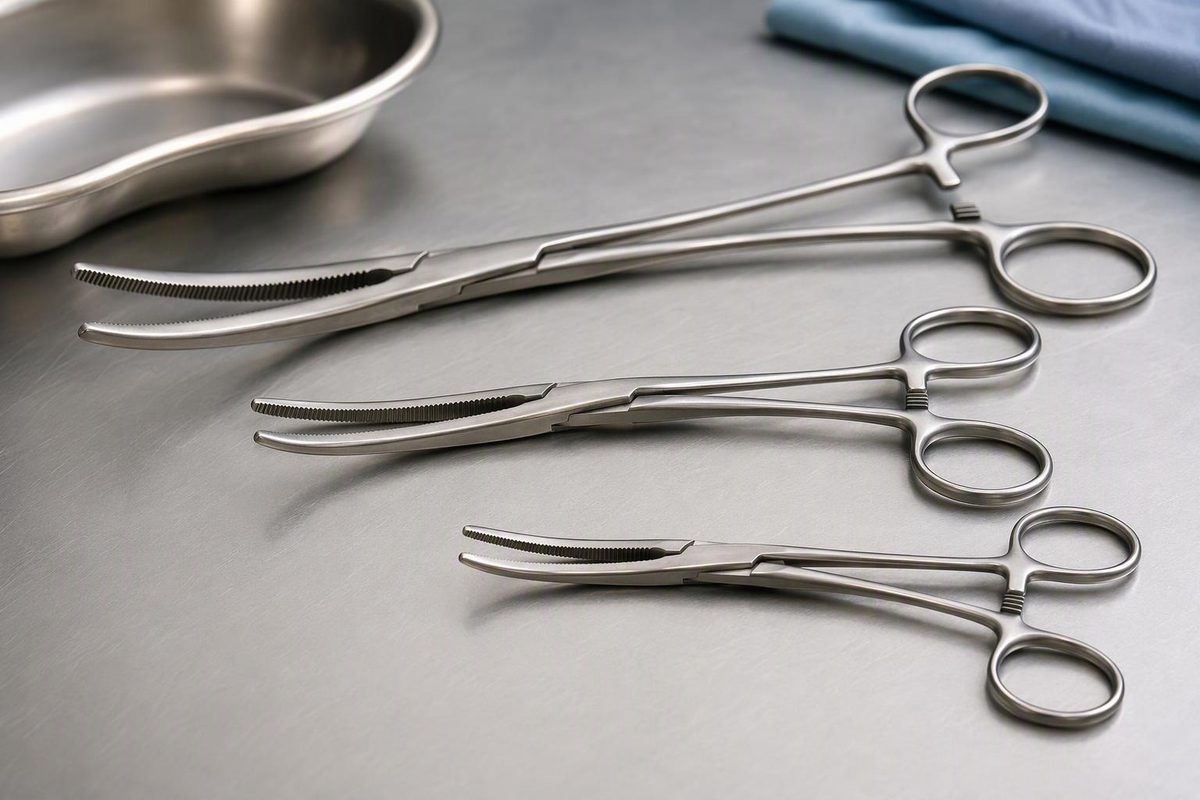
A Cooley clamp is a vascular clamping instrument, but the name covers several patterns rather than one fixed shape or size. Documented examples have finger-ring handles, a ratchet lock and fine, multi-row gripping surfaces described as atraumatic. Multipurpose patterns clamp vessels; anastomosis patterns control blood flow while vessels are joined. Sklar multipurpose clamp and anastomosis clamp document these features and roles.
What to look for
Start with the inner jaw surfaces and the jaw profile, not overall length alone:
- Fine rows of teeth or serrations: Sklar’s multipurpose and anastomosis models have 2 × 2 rows of fine, atraumatic teeth. These are the gripping surfaces, not a description of large terminal prongs.
- Ring handles and ratchet: Both Sklar models are ratcheted, finger-ring instruments with blunt tips.
- Pattern-specific geometry: The multipurpose model has jaws angled 45°; the anastomosis model has tips angled twice to form a basket shape. Both are 165 mm (6½ inches) long, so length cannot distinguish them. Sklar multipurpose specifications, Sklar anastomosis specifications.
“Atraumatic” describes the intended tissue-sparing jaw design; it should not be read as a guarantee that clamping cannot injure a vessel. Nor does every Cooley-labelled model have the same tooth arrangement: Surtex’s aortic model specifies three rows of serrations. Surtex Cooley aortic clamp.
Documented Cooley variants
These are individual catalogue examples, not universal dimensions for each pattern.
| Pattern and manufacturer code | Overall length | Identifying jaw details | Catalogue role |
|---|---|---|---|
| Sklar Cooley multipurpose, 52-6902 | 165 mm (6½ in) | 45° angled jaws; 2 × 2 rows of fine teeth | Clamping vessels of different sizes. Source |
| Sklar Cooley anastomosis, 52-6960 | 165 mm (6½ in) | Double-angled, basket-shaped tips; 2 × 2 rows of fine teeth | Blood-flow control during anastomosis. Source |
| Surtex Cooley aortic, CV-527-32 | 320 mm | Slightly curved, 115 mm jaws; three rows of serrations | Aortic blood-flow occlusion. Source |
| Surtex Cooley-Parry anastomosis, CV-523-29 | 295 mm | Double-angled jaws; 70 mm working end; atraumatic serrations | Vessel clamping during anastomosis. Source |
Confirming an unfamiliar clamp
Record the manufacturer and any instrument code, then compare overall length, jaw length, jaw angle, shank profile and gripping-surface pattern with that exact catalogue entry. Keep jaw length separate from overall length: the 320 mm aortic example above has a 115 mm working end.
Ring handles, a ratchet or an angled jaw are useful clues, but none alone confirms a Cooley pattern. For neighbouring vascular instrument families, consult the separate DeBakey clamp guide and Satinsky clamp guide. This reference supports identification, not selection of a clamp or technique for a particular vessel.