
5 Satinsky Clamp Questions: Function and Types
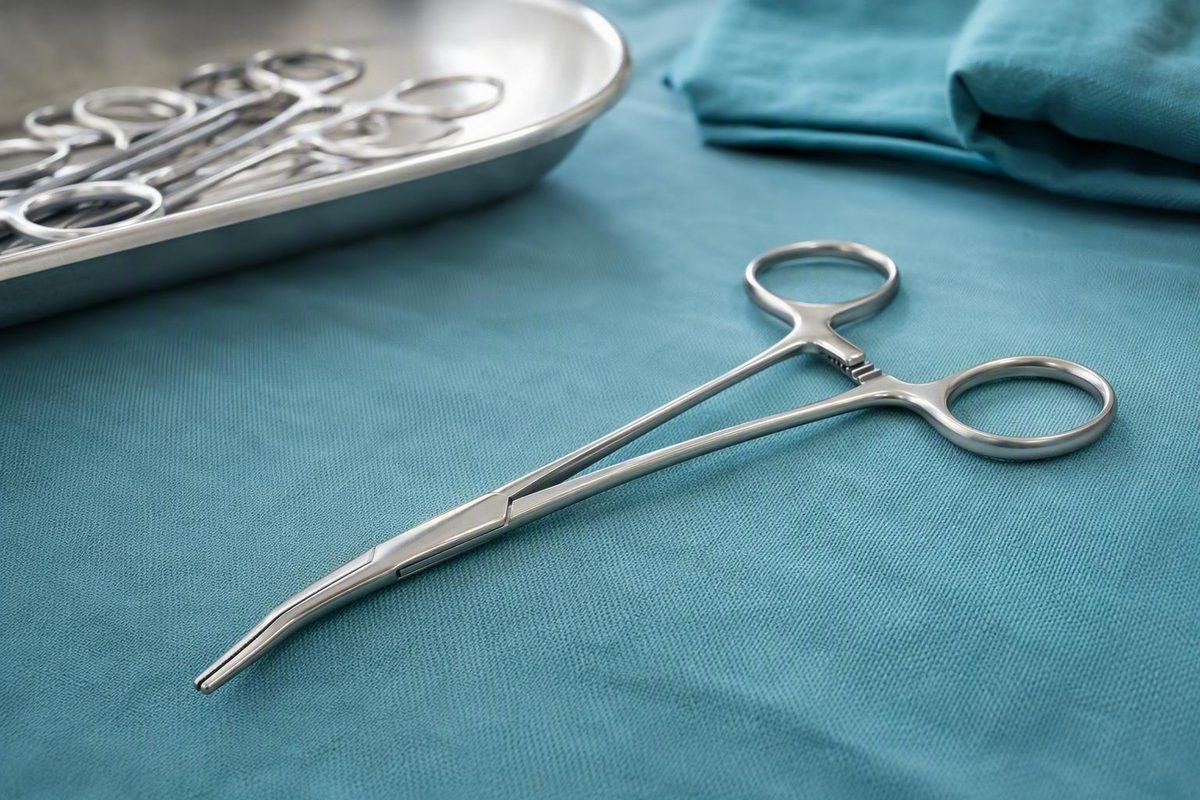
Recognize it by its side-biting vascular purpose, angled end, elongated shanks, handle and locking mechanism, not by its name or length alone.
What is a Satinsky clamp?
A Satinsky clamp is a curved or angled, locking vascular clamp that manufacturers and instrument vendors characteristically associate with tangential, side-biting, or partial occlusion of a large blood vessel. Instead of necessarily crossing the vessel’s full diameter, the working end is shaped to isolate a segment along one side. The vena cava is the vessel most consistently associated with the pattern, while the aorta is another commonly named large vessel.GerMedUSA describes the Satinsky pattern and partial-occlusion concept
Catalog terminology varies. The same general family may be called a:
- Satinsky clamp
- Satinsky vascular clamp
- Satinsky vascular forceps
- Satinsky vena cava clamp
- Tangential-occlusion clamp
- Side-biting clamp
- Satinsky-DeBakey clamp, when the model has DeBakey-pattern jaws
Conceptually, partial occlusion means that the jaws capture a side segment of the vessel wall rather than compressing the vessel from edge to edge. Part of the lumen may remain outside the jaws, making continued flow through the unclamped portion possible.
Continued flow is a design objective, not a guaranteed result. The degree of occlusion depends on the exact clamp, its position, vessel anatomy and characteristics, jaw geometry, and closure pressure. The available catalog evidence does not establish that every Satinsky clamp preserves flow under every condition.
Partial occlusion is the characteristic function associated with the family, but the name does not prove that a particular model is limited to partial occlusion. Some sellers describe individual Satinsky-DeBakey models as suitable for either partial or total occlusion. That capability must be verified for the exact product rather than generalized across the family.
The word atraumatic also appears frequently in catalogs. Here, it should be read as a manufacturer-used design category or intent, generally referring to jaw shape, surface pattern, or distributed compression. It does not mean that vessel-wall injury is impossible, and it does not establish comparative safety without independent clinical evidence.
Evidence scope: This is a catalog-based identification overview. The supplied evidence consists primarily of manufacturer product pages, seller listings, and commercial instrument guides. Those sources can document names, dimensions, materials, and seller-described functions, but they are not substitutes for independent clinical guidance or current product instructions.
Consistent with Medical Forceps’ stated role as an educational instrument-room reference, this article supports identification and terminology. It does not teach operative placement, determine indications for an individual patient, or replace professional training, clinical judgment, product-specific instructions, or facility policy.
How side-biting partial occlusion works
The easiest way to understand a Satinsky clamp is to compare its side-biting geometry with a clamp that spans the vessel.
A. SIDE-BITING OR PARTIAL OCCLUSION

                    Angled working end
                         ______
/ \
Vessel wall =========/========\================
Lumen        --------| isolated |------ open ----
Vessel wall =========\________/================

                  Side segment enclosed
                  Remaining lumen outside jaws


B. COMPLETE CROSS-CLAMPING

                         Clamp
                         │  │
Vessel wall  ============│==│===================
Lumen        ------------│XX│-------------------
Vessel wall  ============│==│===================

                    Vessel diameter spanned
In the side-biting concept, the angled working end encloses only part of the vessel’s circumference. The remaining lumen is not necessarily captured by the jaws. By contrast, a full cross-clamp spans the vessel and is associated with occlusion across its diameter.
The isolated side segment may provide a localized, relatively bloodless area for work involving vessel repair, an anastomosis, or graft suturing while another part of the lumen remains unclamped. A manufacturer’s guide describes the Satinsky’s multi-angled or C-shaped jaw as isolating a localized segment while permitting flow through the portion outside the jaws.Rosh Tech illustrates the partial-occlusion concept and contrasts it with total occlusion
The curve makes this tangential relationship possible, but there is no single universal Satinsky curve. Catalog descriptions include:
- Angled
- Double-angled
- U-shaped
- J-shaped
- Shallow S-shaped
- C-shaped
- Generally curved
These terms may reflect genuine model differences, viewing orientation, or inconsistent catalog vocabulary. For identification, the important feature is not resemblance to one particular letter. It is a pronounced working-end geometry associated with approaching and enclosing a side segment.
Most conventional open Satinsky clamps also have a stepped ratchet near the finger rings. Successive positions provide graduated locking settings intended to regulate closure or compression. A ratchet is not a pressure scale: the supplied product information does not provide validated pressure values or safe vessel-specific limits for individual positions.
The geometry and ratchet are intended to support controlled vascular clamping, but design intent must be separated from demonstrated outcome. These features do not establish that:
- Blood flow will always be preserved.
- A given ratchet position is safe for a particular vessel.
- Vessel-wall injury cannot occur.
- Every Satinsky model can provide both partial and complete occlusion.
- One jaw pattern produces better clinical outcomes than another.
Those questions require model-specific documentation, professional judgment, and evidence beyond general catalog descriptions.
Identifying features and instrument anatomy
A conventional open Satinsky clamp has a recognizable silhouette: prominent angled or curved jaws, elongated shanks, a joint, finger-ring handles, and a locking ratchet. At a glance, it resembles a long ring-handled clamp whose working end bends markedly away from the handles’ main axis.
                 CONCEPTUAL SATINSKY ANATOMY

        Angled jaws and jaw surface
                    _________
/ /////// \
/___________\
\
\____________________
Long shanks \
                                                [Joint]
\____ ( ) Finger ring
                                                    ||||
                                                  Ratchet
                                                   ____ ( )  Finger ring
The pronounced angle, curve, and depth of the working end are generally stronger identification clues than overall length alone. Adult, pediatric, and laparoscopic instruments can all carry the Satinsky name even though their dimensions and handle forms differ substantially.
Jaws and working surfaces
Two principal jaw-surface descriptions recur in the supplied catalogs:
- DeBakey-pattern serrations or teeth. Catalogs may describe these as fine longitudinal or interlocking vascular serrations.
- Cross-serrations or cross-hatching. Fine lines intersect to form a cross-patterned surface.
These are model-dependent alternatives. The available evidence does not demonstrate that either pattern is clinically safer, gentler, or superior. In this context, DeBakey describes the jaw pattern; it does not convert the instrument into every other forceps or clamp that also bears the DeBakey name.
Working ends also vary in length, depth, and curvature. Those dimensions describe different aspects of the jaw and should be recorded separately. They cannot safely be inferred from broad labels such as small, medium, or large.
Shanks, joint, handles, and ratchet
Long or slim shanks are cataloged as a means of reaching deep or confined areas while keeping the handles away from the working end. One Satinsky anastomosis-clamp listing combines elongated slim shanks, double-angled cross-serrated jaws, ring handles, a box joint, and a ratchet lock.SURTEX documents these features for its Satinsky anastomosis clamp
The joint allows the jaws to respond to movement of the handles. On a standard open clamp, finger rings provide a scissor-like grip, while the ratchet retains a selected locking position.
The presence, configuration, and condition of the ratchet should therefore be documented independently rather than assumed from the Satinsky name.
Recognition checklist
When examining an instrument or catalog image, check:
- Overall profile: Is there a prominent angled or side-biting working end?
- Jaw geometry: Is the end curved, single-angled, double-angled, or described with a letter-shaped profile?
- Jaw depth: Is the side-biting opening relatively shallow or deep?
- Jaw surface: Does documentation identify DeBakey-pattern serrations, cross-serrations, or another surface?
- Overall length: Is it an adult open, pediatric, or long-shaft model?
- Jaw dimensions: Are length, depth, width, or opening spread stated separately?
- Shanks: Are they straight, curved, slim, standard length, or extended?
- Joint: Is a box joint or another construction documented?
- Handle form: Ring-handled, spring-style, or axial?
- Ratchet: Is one present, and what configuration is documented?
- Markings: Are the manufacturer, model, catalog number, or traceability details legible?
- Approach: Is the model intended for open or laparoscopic use?
- Documentation match: Does the physical instrument correspond to the current catalog entry?
The family name alone does not establish exact dimensions, material, supply sterility, degree of occlusion, or validated use. Physical resemblance is a starting point, not final identification.
High-level uses and associated vessels
At a high level, the Satinsky pattern is associated with vascular control when a localized segment of a major vessel must be isolated. Its side-biting profile may create a working area for anastomosis, graft suturing, or vessel repair without necessarily enclosing the full lumen.
The vena cava and aorta are the vessels most consistently named in the supplied product and vendor material. Other catalogs associate Satinsky patterns with cardiovascular, thoracic, bypass, reconstructive, aortic, hepatic, renal, and laparoscopic settings. These broad categories provide context; they do not establish universal indications for every model.
Vendor-authored examples include partial aortic occlusion during construction of a proximal coronary bypass anastomosis, side-biting occlusion in valve-related work, and partial occlusion during aortic repair or graft placement.SURTEX presents these as example uses in cardiovascular surgery They should be read as commercial descriptions of context, not as instructions for carrying out those procedures.
Catalog classification can also help distinguish models. Aspen places its medium Satinsky vena cava clamp in cardiovascular and thoracic surgery and classifies the anatomy as vascular. Integra categorizes its long-shaft, axial-handled MicroFrance models as laparoscopic instruments rather than conventional open ring-handled clamps.
These classifications show why a family name cannot replace a model number. An open vena cava clamp and a long-shaft laparoscopic Satinsky may share a side-biting concept while differing substantially in access, dimensions, handle mechanism, and product documentation.
Clinical application depends on the selected model, vessel anatomy, operative access, desired degree of occlusion, and professional judgment. A procedure list on a commercial page does not by itself establish approved indications, compatibility with a particular anatomy, or suitability for an individual patient.
Satinsky, Satinsky-DeBakey, bulldog, and full cross-clamps
Several identification fields are easily conflated:
- Named instrument family: Satinsky, bulldog, or another clamp pattern.
- Jaw-surface pattern: DeBakey serrations, cross-serrations, or another documented surface.
- Occlusion concept: Partial side-biting, temporary local occlusion, or complete cross-clamping.
- Handle and locking form: Ring handles with a ratchet, a spring body, or an axial laparoscopic handle.
These fields should be recorded separately.
A Satinsky-DeBakey clamp is generally cataloged as a Satinsky-pattern instrument fitted with DeBakey-pattern jaws. “DeBakey” may describe a serration pattern as well as appearing in the names of other vascular instruments. It does not erase the Satinsky clamp’s angled profile or automatically establish whether the exact model is intended for partial, complete, or both forms of occlusion.
One vendor distinguishes a standard Satinsky tangential-occlusion clamp, described for partial clamping of large vessels or the aorta, from a DeBakey-Satinsky bulldog clamp, described for temporary occlusion of smaller vessels.The vendor comparison separates standard tangential clamps from smaller bulldog patterns This is useful catalog terminology, not a universal classification rule.
| Pattern | Characteristic occlusion concept | Typical scale | Handle or locking form | Identification caution |
|---|---|---|---|---|
| Standard open Satinsky | Tangential or side-biting partial occlusion of a large vessel | Long open instrument | Finger rings with ratchet | Confirm jaw dimensions, surface, and intended degree of occlusion |
| Satinsky-DeBakey | Satinsky geometry with DeBakey-pattern jaw surfaces | Often comparable to an adult open Satinsky, though variants exist | Commonly ring-handled and ratcheted | “DeBakey” may describe the jaws rather than a separate occlusion concept |
| DeBakey-Satinsky bulldog | Vendor-described temporary local occlusion of smaller vessels | Smaller than a standard open Satinsky | Vendor comparisons associate bulldogs with a spring-style body | Do not confuse a spring body with a standard Satinsky ratchet |
| Full cross-clamp | Spans the vessel rather than isolating only a side segment | Varies by vessel and pattern | Pattern-specific | Complete cross-clamping is a functional distinction, not proof that one pattern is preferable |
| Laparoscopic Satinsky | Side-biting concept delivered through a long-shaft approach | Substantially longer shaft | Axial handle and narrow tube | Record overall, working, and jaw lengths separately |
Side-biting and complete cross-clamping address different mechanical relationships between the working end and the vessel. That distinction does not establish that one instrument is universally better.
Some commercial listings further complicate classification by describing particular Satinsky-DeBakey clamps as suitable for partial or total occlusion.GerMedUSA makes that claim for its specific Satinsky-DeBakey product The capability should not be inferred solely from the family name, jaw pattern, or resemblance to another clamp.
Sizes, jaw patterns, materials, and representative models
Satinsky denotes a family of patterns, not one standardized instrument with a universal length, curve, jaw surface, material, or handle. The table below normalizes selected catalog fields while preserving omissions and questionable source data.
| Manufacturer or seller | Model or part number | Overall length | Working and jaw dimensions | Jaw pattern | Material | Reuse and supply condition | Approach |
|---|---|---|---|---|---|---|---|
| Teleflex Pilling | 354000; 354002; 354004; 354010 | 354000: 10¼ in / 26.0 cm; 354002: 10 in / 25.5 cm; 354004: 9⅞ in / 25.0 cm; 354010: 10¼ in / 26.0 cm | Respective jaw lengths: 50, 40, 30, and 50 mm | First three: DeBakey; 354010: cross-serrated | Stainless steel | Not stated in captured listing | Open, ring-handled |
| Ambler Surgical | 18-783 | 9⅛ in | Angled jaws, 2.5 cm long | Catalog calls the jaws “atraumatic”; surface pattern not stated | Titanium | Reusable; supplied non-sterile | Open, ring-handled |
| Aspen Surgical | 55-6050 | 10 in / 254 mm | Not stated | Not stated | Not stated | Reusable; supply sterility not stated; latex-free | Open; medium vena cava model |
| SurgiPro | SPCT-007 | 6½ in / 16.5 cm | Internal jaw dimensions: 32 × 7 mm | Not stated | Seller lists stainless steel | Reuse and supply sterility not stated | Pediatric open model |
| Artisan Medical | SAT-300-P and adult SAT-300 series | SAT-300-P: 6¼ in / 15.9 cm; adult examples: 9¼–10¼ in | Adult entries list multiple jaw dimensions; SAT-300 reports a 9.0 cm jaw depth, which appears anomalous and requires verification | Cross-serrated and DeBakey-pattern variants | Not stated | Not stated | Open adult and pediatric models |
| Integra MicroFrance | CEVA101 | 447 mm | Nominal working length 260 mm; separately listed working length 257 mm; jaw/tip length 87 mm; source-reported width 77 mm, requiring verification | Not stated | Stainless steel | Reusable | Laparoscopic; axial handle; curved 6.0 mm tube |
| Integra MicroFrance | CEVA103 | 443 mm | Nominal working length 240 mm; separately listed working length 242 mm; jaw/tip length 67 mm; source-reported width 58 mm, requiring verification | Not stated | Stainless steel | Reusable | Laparoscopic; axial handle; curved 6.0 mm tube |
Teleflex’s listed Pilling configurations demonstrate that one manufacturer offers multiple overall and jaw lengths, three DeBakey-jaw sizes, and a cross-serrated alternative. Its page also describes a dull, non-glare stainless-steel finish and stepped ratchets.
Ambler’s model shows that stainless steel is not universal: its catalog identifies a reusable titanium clamp with angled jaws, supplied non-sterile. Aspen’s listing adds another documentation lesson—it states length, reusable status, specialty classification, vascular anatomy, and latex-free status but does not provide material or jaw design in the captured page.
The pediatric listings illustrate a substantially shorter open-clamp range. SurgiPro reports both overall length and internal jaw dimensions, while Artisan lists a pediatric cross-serrated model alongside adult cross-serrated and DeBakey-pattern variants.
The Artisan and MicroFrance entries also demonstrate why catalog data should not be silently normalized. Artisan’s reported 9.0 cm jaw depth is markedly different from neighboring entries. For MicroFrance, nominal and separately tabulated working lengths differ slightly, while the reported jaw-width values appear unusual relative to the stated 6.0 mm tubes. These values should be preserved as source-reported and marked for verification, not corrected by assumption.
A broad catalog pattern is visible:
- Many open adult examples fall around 9 to 10.5 inches overall.
- The supplied pediatric examples are around 6.25 to 6.5 inches.
- Laparoscopic models have substantially longer shafts and require separate working-length documentation.
- Stainless steel predominates in the reviewed listings, but titanium is also represented.
- Both DeBakey-pattern and cross-serrated jaws appear in adult catalogs.
Every specification remains model-specific and should be checked against current manufacturer documentation. Prices, discounts, stock claims, shipping terms, and return conditions are excluded because they are volatile and do not establish instrument identity.
A practical identification and documentation framework
Students, sterile-processing personnel, and instrument-room technicians should identify a Satinsky clamp through observable and documented fields rather than deciding that it merely “looks about right.”
1. Start with markings
Check the instrument for:
- Manufacturer or brand
- Catalog or part number
- Size marking
- Material marking, if present
- Lot, device, or other traceability identifiers where applicable
Search current manufacturer documentation using the catalog number before relying on a generic tray name. A physical model marking is generally more discriminating than a label that says only “Satinsky.”
2. Record dimensions separately
Distinguish among:
- Overall instrument length
- Working length
- Jaw or tip length
- Jaw depth
- Jaw width
- Opening spread, if documented
- Tube diameter for a laparoscopic model
Do not combine these into one “size” field. Overall length is particularly limited for long-shaft instruments because much of the measurement may represent the access tube rather than the working jaw.
Labels such as small, medium, large, adult, and pediatric cannot replace measurements. Named sizes vary among catalogs, and models with the same overall length may have different jaw geometry.
3. Describe the working end
Use neutral visual terms:
- Curved or angled
- Single- or double-angled
- Shallow or deep side-biting profile
- J-, S-, U-, or C-shaped when that term appears in the catalog
- Jaw length and depth
Do not force every Satinsky into one letter-shaped category. Prefer the manufacturer’s terminology, then add objective measurements.
4. Identify the jaw surface
Under adequate lighting or magnification, compare what is visible with the product record:
- DeBakey-pattern jaws: catalogs may describe a fine longitudinal or interlocking vascular-serration arrangement.
- Cross-serrated jaws: fine lines cross in more than one direction to create a cross-patterned surface.
Record both the observed appearance and the documented description. If they disagree, mark the identification for verification rather than selecting the expected answer. Do not attach unsupported claims about relative safety or clinical performance to either pattern.
5. Record handle and locking form
Specify whether the clamp is:
- Ring-handled and ratcheted
- Spring-style, as cataloged for a bulldog pattern
- Axial-handled for laparoscopic access
- Intended for an open or minimally invasive approach
If a ratchet is present, document its configuration and condition without assigning pressure values to its positions.
6. Capture material and lifecycle fields
Where documentation states them, record:
- Stainless steel or titanium
- Reusable or single-use
- Sterile or non-sterile when supplied
- Open or laparoscopic approach
- Current instructions-for-use reference
Do not infer titanium from color or low weight alone. Likewise, “sterilizable” does not by itself establish reusable status, validated processing cycles, or sterility on delivery.
7. Apply a data-quality rule
Never silently correct an implausible specification. Preserve the source-reported value, label it “verification required,” and consult current manufacturer documentation.
Apply this rule when:
- Named and tabulated working lengths differ.
- Jaw width appears incompatible with tube diameter.
- A jaw-depth value is far outside neighboring entries.
- Imperial and metric values do not agree.
- The product image does not match the stated configuration.
8. Verify procurement fields independently
For procurement or master-instrument records, confirm:
- Exact product identity
- Intended use
- Validated degree of occlusion
- Current instructions for use
- Supply condition
- Material
- Reuse status
- Product and lot traceability
- Exact jaw dimensions and surface
- Compatible approach and tray assignment
- Applicable facility requirements
Physical resemblance is not sufficient to establish identity, validated use, compatibility, or interchangeability.
Reprocessing, inspection, and evidence limits
Many cataloged Satinsky examples are reusable, but reuse status must be confirmed for the exact product. Reusable status is not guaranteed by the family name.
Reusable also does not mean sterile when supplied. Ambler explicitly identifies its titanium model as reusable and non-sterile, while other captured listings omit supply sterility. Those fields therefore belong in separate documentation columns.
For any reusable clamp, follow the exact product’s current instructions for use and the facility’s validated policies for cleaning, inspection, lubrication where directed, packaging, sterilization, storage, and release for use. Aspen’s product page, for example, links to instructions for use for vascular clamps.Aspen provides a product-family IFU link with its Satinsky listing
A universal steam cycle or generic commercial reprocessing sequence should not be applied to every Satinsky clamp. Requirements may differ by model, material, construction, packaging system, sterilizer, and validated facility process.
Without reviewed model-specific instructions, it is safer to treat the following only as possible documentation or inspection topics, not as universal acceptance criteria:
- Jaw alignment and jaw-surface condition
- Complete opening and closing
- Hinge or box-joint movement
- Ratchet engagement and release
- Corrosion, pitting, or staining
- Bending or deformation
- Residual soil and cleanliness
- Legibility of markings
- Integrity of axial handles, tubes, or other model-specific components
The supplied catalog evidence does not establish:
- Safe clamping pressure
- Pressure produced at each ratchet position
- Vessel-specific closure limits
- Universal contraindications
- Complication rates
- Standardized retirement criteria
- One validated sterilization cycle for every model
Promotional language also requires restraint. Terms such as atraumatic, no trauma, superior control, and reduced complications appear in commercial descriptions, but the supplied sources do not provide independent clinical evidence demonstrating those outcomes. Such terms should be treated as design or marketing language, not guaranteed performance.
Frequently asked questions
Does a Satinsky clamp completely stop blood flow?
Not necessarily. The characteristic Satinsky concept is partial or side-biting occlusion: the jaws isolate a side segment while another part of the lumen may remain outside the clamp. Continued flow may therefore be possible, but it is not guaranteed.
Some sellers describe particular Satinsky-DeBakey models as capable of partial or total occlusion. The intended degree of occlusion must be checked for the exact model rather than inferred from the family name.
What is the difference between a Satinsky clamp and a Satinsky-DeBakey clamp?
A Satinsky-DeBakey clamp is generally cataloged as a Satinsky-pattern clamp fitted with DeBakey-pattern jaw serrations. Satinsky identifies the instrument family and characteristic angled, side-biting form; DeBakey may identify the jaw-surface pattern.
Jaw pattern, named family, handle form, and intended occlusion are separate identification fields.
Are all Satinsky clamps the same size and jaw shape?
No. Catalogs include adult open, pediatric, and much longer laparoscopic variants. Jaw descriptions include curved, angled, double-angled, and U-, J-, S-, or C-shaped forms.
Jaw length, depth, surface, shank profile, ratchet, material, and handle configuration also vary. Record actual specifications and the catalog number instead of relying on labels such as small, medium, or adult.
Are Satinsky clamps reusable and sterile when supplied?
Many cataloged Satinsky clamps are reusable, but reuse status is model-specific. Sterility on delivery is a separate field: a reusable model may be supplied non-sterile.
Check the exact product’s current documentation for supply condition and validated processing requirements. Do not assume that reusable means sterile or that one sterilization process applies to every Satinsky clamp.
What should be checked when identifying a Satinsky clamp?
Check the instrument marking and catalog number first. Then document:
- Overall and working lengths
- Jaw length, depth, and other stated dimensions
- Working-end angle or curvature
- Jaw-surface pattern
- Shank profile
- Joint construction
- Ring, spring, or axial handle
- Ratchet configuration
- Material
- Open or laparoscopic approach
- Reuse status and supply sterility when documented
Finally, compare the physical instrument with current manufacturer information. The Satinsky name and general appearance alone do not establish exact identity, intended use, or interchangeability.
The most reliable way to recognize a Satinsky clamp is to combine its characteristic side-biting vascular purpose with its angled working end, elongated shanks, handle form, and locking mechanism—not to rely on the name or overall length alone. Satinsky denotes a variable family that includes adult and pediatric sizes, DeBakey-pattern and cross-serrated jaws, stainless-steel and titanium instruments, and open and laparoscopic configurations.
Identification should end with verification of markings and current model-specific documentation. Treat “atraumatic” performance language as design intent rather than a guaranteed outcome. Clinical selection and reprocessing decisions belong to trained professionals working under current instructions for use, facility policy, and the site’s stated educational-use terms.