
DeBakey Clamp Types and Specifications
Reliable identification starts with subtype, exact SKU, dimensions, jaw and shank geometry, material, sterility, reuse status and documentation.
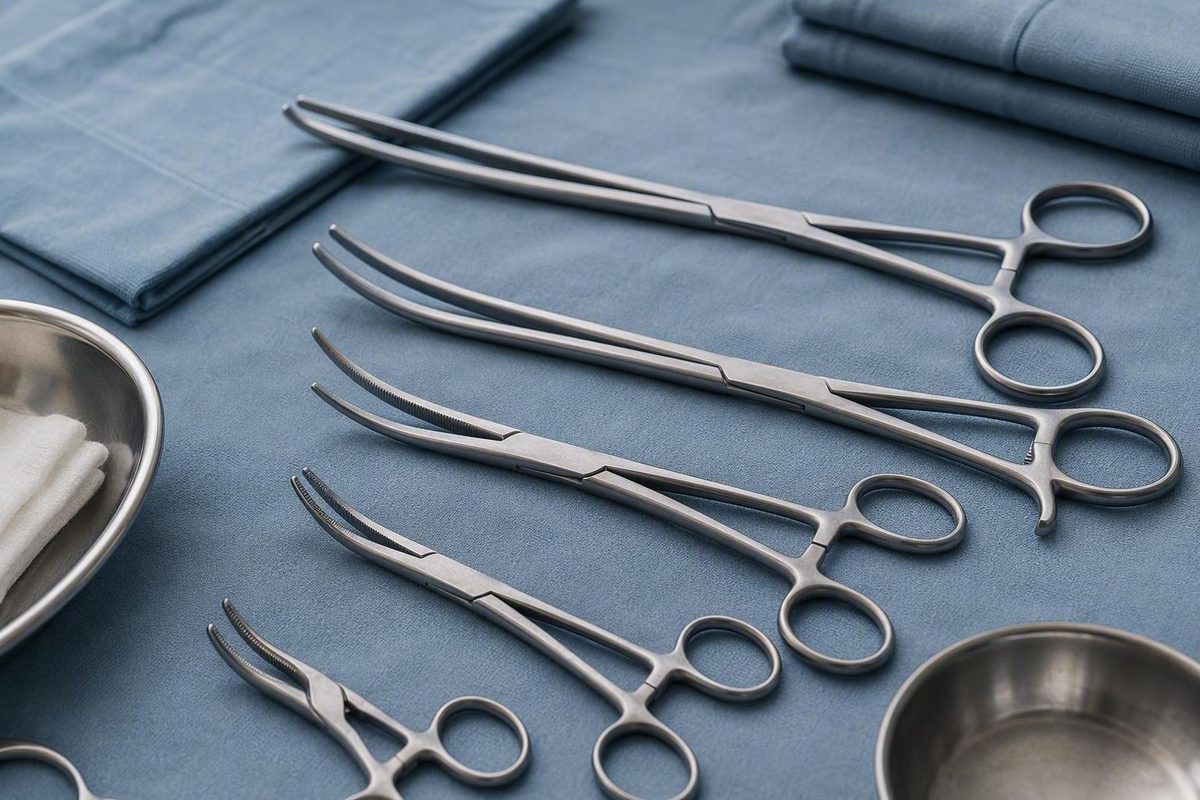
That distinction matters in the instrument room and during procurement. “DeBakey clamp” may refer to a compact peripheral model, a long aortic-aneurysm clamp, a straight titanium instrument, an angled multipurpose clamp, a bulldog pattern, or a Satinsky-DeBakey configuration. A photograph or family name cannot establish which model is being described.
Reliable identification therefore begins with the subtype, manufacturer, exact SKU, written dimensions, jaw and shank geometry, material, mechanism, supply sterility, reuse classification, package quantity, and current manufacturer documentation.
This is an educational identification and purchasing reference. It does not provide clinical selection, placement, occlusion, or reprocessing instructions and is not a substitute for professional training, facility policy, qualified professional judgment, or the exact manufacturer’s current instructions for use.
What a DeBakey clamp is—and what the name does not tell you
A DeBakey vascular clamp is generally described as a clamping or occluding instrument used for temporary control of blood flow. One instrument reference describes an adjustable, ratcheted peripheral vascular clamp available with straight, curved, or angled jaws, but that description should not be applied automatically to every DeBakey-named model.CSTSetup’s DeBakey vascular clamp reference
A commonly documented ring-handled form has:
- Two opposed jaws
- Shanks connecting the jaws to the handles
- A joint or box-lock region
- Ring handles
- On some models, a ratchet or another locking arrangement
Some exact-model product pages do not disclose the mechanism at all.
The critical point is that DeBakey is a design-family name, not a complete specification. The name alone does not establish:
- The intended vessel or procedure
- Whether an instrument is intended for complete, partial, or side-biting occlusion
- Overall, working, or jaw length
- Jaw width or pressure
- Straight, curved, angled, hooked, or S-shaped geometry
- Whether curvature is in the jaws, shanks, or both
- Serration or tooth pattern
- Handle and locking mechanism
- Stainless-steel or titanium construction
- Reusable or single-use classification
- Sterility when supplied
- Applicable processing requirements
- Package quantity
- Current regulatory or commercial availability
A family description can help classify an unidentified instrument, but it cannot replace an exact-model record. Even closely related products may have different dimensions, geometry, materials, or ordering terms.
A DeBakey vascular clamp must also be distinguished from DeBakey tissue forceps. If an inventory record says only “DeBakey,” first determine whether the item is a vascular clamp, tissue or thumb forceps, or another DeBakey-pattern instrument.
For educational and inventory records, “DeBakey clamp” is therefore the beginning of an identification—not the final answer. Medical Forceps describes itself as an educational instrument-room reference, states that it does not sell instruments, and says manufacturers do not pay for placement.About Medical Forceps
DeBakey clamp types: peripheral, aortic, bulldog, Satinsky-DeBakey, and other variants
Several materially different configurations are sold under the DeBakey name. These categories provide a useful terminology map, but they do not establish that two instruments are mechanically or clinically interchangeable.
Peripheral vascular clamps
Peripheral vascular models include relatively compact ring-handled instruments in different lengths and curves. Documented examples include:
- Ambler 17-482, an 8-inch model with curved shanks and curved jaws
- BOSS 65-6450, a 6-inch model with curved jaws
- BOSS 65-6425, listed as a related 8-inch S-shaped peripheral vascular model
The BOSS family listing binds the 6-inch curved-jaw description to SKU 65-6450 and identifies 65-6425 separately as an 8-inch S-shaped model.BOSS peripheral vascular clamp listing
These examples show why “peripheral DeBakey” remains incomplete as an inventory description. A 6-inch curved-jaw model and an 8-inch S-shaped model cannot be distinguished reliably by the family name alone.
Aortic and aortic-aneurysm clamps
Aortic and aortic-aneurysm configurations are represented by longer instruments with model-to-model differences in overall length, jaw length, width, and curvature.
GerVetUSA lists strongly curved and slightly curved variants from 9½ to 12¾ inches overall. The four slightly curved versions have listed jaw lengths from 7.5 to 12 cm. The seller classifies those variants as reusable, non-sterile stainless-steel instruments with a ratchet mechanism, but those specifications apply only to the listed products.GerVetUSA’s listed DeBakey variants
Integra’s Jarit aortic-aneurysm series provides a more granular example. Models 320-280 through 320-286 increase in overall length, working length, jaw length, and jaw width. Model 320-357 instead has both curved shanks and curved jaws and its own dimensional record.
DeBakey bulldog clamps
A commercial supplier article separately uses DeBakey bulldog clamp for a compact variant associated in that article with temporary small-vessel occlusion. That source does not establish a universal mechanism, dimension, indication, or model specification for every product sold under the bulldog name.
It is therefore safer to treat “DeBakey bulldog” as a supplier-used subgroup label requiring its own manufacturer, exact SKU, dimensions, geometry, mechanism, and documentation. It should not be assumed to be a miniature version of every ring-handled peripheral or aortic clamp.
Satinsky-DeBakey clamps
The term Satinsky-DeBakey appears in commercial listings for specialized vena-cava or angled configurations. SurgiPro SPAF-029, for example, is listed as a small 9¾-inch Satinsky-DeBakey vena-cava model.SurgiPro SPAF-029 listing
Commercial terminology is inconsistent. Some sellers describe Satinsky-DeBakey products by combining language associated with a Satinsky profile and DeBakey-style jaw features. That does not establish a universal taxonomy, and it does not prove that all Satinsky, DeBakey, and Satinsky-DeBakey products share the same geometry, mechanism, or intended use.
DeBakey-Derra variants
The DeBakey-Derra name appears as another supplier-used variant. One commercial article describes it as having curved hook jaws and associates it with anastomosis. That description is a terminology clue, not an authoritative indication for every product carrying the name.
Before recording or purchasing a DeBakey-Derra instrument, verify its exact product page or catalog entry rather than transferring a generic blog description into the model record.
Multipurpose angled clamps
Some DeBakey products are categorized as multipurpose angled clamps. Pilling 353694 is listed as a 9-inch instrument with a 70 mm DeBakey jaw and a No. 3, 90-degree configuration.
Wexler’s family links also show that DeBakey clamps may be offered in 15-degree and 45-degree angled forms, in addition to straight and curved configurations. Angle is a model-level specification, not a feature inherent to the DeBakey name.
Terminology caution
Pattern names such as peripheral, aortic, bulldog, Satinsky-DeBakey, DeBakey-Derra, and multipurpose help organize product families. They do not independently establish the clinical indication, target vessel, degree of occlusion, mechanism, or interchangeability of two instruments. Confirm the exact SKU and consult the current exact-model documentation before clinical selection or processing.
How to read the clamp’s geometry and measurements
Overall length
It is not the same as jaw length or working length.
An 8-inch clamp with relatively long jaws can differ substantially from another 8-inch clamp with shorter jaws and longer handles. Overall length alone is therefore insufficient for matching an instrument.
Working length
The exact reference convention should be confirmed in the manufacturer’s drawing or catalog.
Not every product page supplies working length. It should not be calculated by subtracting estimated handle dimensions from overall length.
Jaw or tip length
It is separate from overall and working length.
Ambler 17-482 illustrates the distinction: the instrument is listed as 8 inches overall, while its curved jaws are listed as 7.6 cm long. Those figures describe different parts of the instrument.
Jaw width
It may be listed as tip width, jaw width, or “width 1.”
The Jarit series demonstrates why width matters. Its listed tip or jaw widths range from 3 mm on model 320-280 to 5.6 mm on model 320-286. Two clamps can share the DeBakey name and a curved-jaw description while having visibly different jaw dimensions.
Jaw curvature and shank shape
The jaws and shanks are separate structures:
- Curved jaws means the clamping surfaces curve.
- Curved shanks means the sections between the joint or handles and the jaws curve.
- A model may have curved jaws without its shanks being described as curved.
- A model may have both curved jaws and curved shanks.
- “S-shaped” may describe a compound profile, but the location and direction of each curve require an exact drawing, image, or written specification.
Ambler 17-482 is listed with curved shanks and curved 7.6 cm jaws. Jarit 320-357 is another documented configuration with both curved shanks and curved jaws.
Jaw angle
An angled clamp should be identified with the numerical angle when the manufacturer provides one. Pilling 353694 is listed at 90 degrees, while Wexler links to 15-degree and 45-degree variants.
“Angled,” “acutely curved,” “strongly curved,” and “slightly curved” should not be treated as interchangeable descriptions. A numerical angle is also not necessarily comparable with a supplier’s qualitative curvature label unless the measuring method is stated.
Geometry language is descriptive, not comparative evidence
Listings use terms including:
- Straight
- Curved
- Acutely curved
- Strongly curved
- Slightly curved
- Angled
- S-shaped
- Hooked
These terms describe geometry. They do not by themselves prove that one configuration is safer, easier to handle, or clinically preferable.
Jaw pattern and serrations
“DeBakey jaw” does not guarantee one universal surface pattern. Integra lists 1 × 2 teeth for the cited Jarit models, while other sources use descriptions such as DeBakey serrations, fine-serrated, interlocking, or atraumatic jaws.Integra’s Jarit DeBakey catalog
A model-specific tooth pattern cannot be generalized to another manufacturer or SKU. Nor should two differently worded supplier descriptions be treated as equivalent without a detailed drawing or exact-model specification.
Neutral measurement map
A useful identification diagram should label the following fields without inventing dimensions:
        <--------------- overall length --------------->

   [ ring handles ]--[ joint ]--[ shanks ]--[ jaws/tips ]
<---->
jaw length
\
                                     shank curvature

   Working length: manufacturer-defined reference point to operating end
   Jaw width: measured transversely at the catalog-defined point
   Jaw angle: angle stated using the manufacturer's measuring convention
A complete diagram or catalog drawing may also identify:
- Overall length
- Working length
- Jaw length
- Jaw width
- Jaw angle
- Jaw curvature
- Shank curvature
- Joint or box-lock
- Handle
- Ratchet or other locking mechanism
When no manufacturer drawing is available, record a field as undisclosed rather than estimating it from a photograph.
Exact-model comparison: documented manufacturers, SKUs, and dimensions
The table below normalizes the available product information. Undisclosed means the exact product evidence did not state the field; it does not mean the feature is absent.
The five Jarit rows are drawn from the same Integra product catalog cited in the geometry section. Each Jarit row must still be treated as a separate exact-model record.
| Manufacturer or brand | Exact SKU | Subtype | Overall length | Working length | Jaw length | Jaw width | Geometry | Material | Supply sterility | Reuse status | Handle or mechanism | Missing or undisclosed information |
|---|---|---|---|---|---|---|---|---|---|---|---|---|
| Ambler Surgical | 17-482 | Peripheral vascular clamp | 8 in | Undisclosed | 7.6 cm | Undisclosed | Curved shanks; curved jaws | Stainless steel | Non-sterile | Reusable | Ring handle; lock undisclosed | Working length, jaw width, exact serration pattern, pressure data |
| Ambler Surgical | 17-462 | Small DeBakey clamp | 9⅝ in | Undisclosed | Undisclosed | Undisclosed | Acutely curved jaws | Stainless steel | Non-sterile | Reusable | Ring handle; lock undisclosed | Working and jaw dimensions, exact serration pattern, pressure data |
| Pilling/Teleflex | 353694 | Multipurpose angled clamp | 9 in / 23.0 cm | Undisclosed | 70 mm | Undisclosed | No. 3; 90-degree DeBakey jaw | Undisclosed | Undisclosed | Undisclosed | Undisclosed | Material, sterility, reuse classification, mechanism, jaw width |
| BOSS Instruments | 65-6450 | Peripheral vascular clamp | 6 in | Undisclosed | Undisclosed | Undisclosed | Curved jaws | Undisclosed | Undisclosed | Reusable | Undisclosed | Material, sterility, serration pattern, jaw dimensions, mechanism |
| SurgiPro | SPAF-029 | Small Satinsky-DeBakey vena-cava model | 9¾ in / 24.8 cm | Undisclosed | Undisclosed | Undisclosed | Specialized profile; exact angle undisclosed | Seller describes German stainless steel | Undisclosed | Undisclosed | Undisclosed | Mechanism, jaw pattern and dimensions, sterility, reuse and processing details |
| Wexler Surgical | AL2122.2 | Straight vascular clamp | 8.25 in / 21 cm | Undisclosed | Undisclosed | Undisclosed | Straight jaws; straight shanks | Titanium | Undisclosed | Undisclosed | Undisclosed; special order | Jaw dimensions, mechanism, sterility, reuse classification |
| Wexler Surgical | AL2122.1 | Stainless-steel counterpart to AL2122.2 | 8.25 in / 21 cm | Undisclosed | Undisclosed | Undisclosed | Straight configuration | Stainless steel | Undisclosed | Undisclosed | Undisclosed | Jaw dimensions, mechanism, sterility, reuse classification |
| Jarit | 320-280 | Aortic-aneurysm clamp | 262 mm / 10¼ in | 82 mm | 78 mm | 3 mm | Curved jaws; 1 × 2 teeth | Stainless steel | Undisclosed | Reusable | Undisclosed | Sterility, handle and locking mechanism, pressure data |
| Jarit | 320-282 | Aortic-aneurysm clamp | 274 mm / 10¾ in | 95.5 mm | 88 mm | 3.1 mm | Curved jaws; 1 × 2 teeth | Stainless steel | Undisclosed | Reusable | Undisclosed | Sterility, handle and locking mechanism, pressure data |
| Jarit | 320-284 | Aortic-aneurysm clamp | 311 mm / 12¼ in | 115 mm | 104 mm | 5.3 mm | Curved jaws; 1 × 2 teeth | Stainless steel | Undisclosed | Reusable | Undisclosed | Sterility, handle and locking mechanism, pressure data |
| Jarit | 320-286 | Aortic-aneurysm clamp | 328 mm / 13 in | 130 mm | 122 mm | 5.6 mm | Curved jaws; 1 × 2 teeth | Stainless steel | Undisclosed | Reusable | Undisclosed | Sterility, handle and locking mechanism, pressure data |
| Jarit | 320-357 | Aortic-aneurysm clamp | 271 mm / 10¾ in | Undisclosed | 55 mm | 3.5 mm | Curved shanks and curved jaws; 1 × 2 teeth | Stainless steel | Undisclosed | Reusable | Undisclosed | Working length, sterility, handle and locking mechanism, pressure data |
Read the table horizontally, one row at a time. Data from one row must not be used to fill a blank in another. For example:
- The reusable classification of BOSS 65-6450 does not prove its material or supply sterility.
- The non-sterile status of Ambler 17-482 does not establish the status of Pilling 353694.
- The Jarit 1 × 2 tooth specification does not describe Wexler AL2122.2.
- The titanium construction of Wexler AL2122.2 does not extend to stainless-steel AL2122.1.
- A mechanism shown in a family photograph is not documented unless the exact-SKU text or manufacturer drawing confirms it.
This unknown-field discipline is especially important when building instrument databases. A blank is not permission to copy a likely value from a related model.
Materials, reusability, and sterility status
Several exact DeBakey models are documented as reusable. These include Ambler 17-482 and 17-462, BOSS 65-6450, the listed GerVetUSA variants, and the cited Jarit models. That does not support the broader statement that every DeBakey clamp is reusable.
Likewise, selected models are expressly supplied non-sterile. Ambler identifies both cited models as non-sterile, and GerVetUSA gives that status for its listed variants. Product pages that do not state sterility must remain marked undisclosed.
Keep three concepts separate:
- Reusable is a product classification.
- Non-sterile describes the item’s condition when supplied.
- Processing instructions are model-specific directions and limitations that must be obtained from the applicable manufacturer documentation.
A reusable classification should not be treated as a generic cleaning, inspection, lubrication, packaging, or sterilization protocol. Before processing or placing an instrument into service, obtain the current exact-model instructions and apply the relevant facility requirements through qualified personnel.
Material also varies by model. Stainless steel is documented for the cited Ambler, GerVetUSA, and Jarit instruments. Wexler AL2122.2 is listed as titanium, while AL2122.1 is identified as its stainless-steel counterpart.
The available evidence does not establish a clinical, durability, weight-in-use, or handling advantage for titanium over stainless steel. A material decision may also involve facility compatibility, manufacturer support, processing requirements, repair options, and procurement standards not supplied by a basic product page.
Apply the same unknown-status rule to every material and processing field:
- If material is absent, record material undisclosed.
- If sterility is absent, record supply sterility undisclosed.
- If reusable or single-use status is absent, record reuse classification undisclosed.
- If the current exact-model instructions are unavailable, flag the document for retrieval rather than substituting generic processing advice.
What ‘atraumatic’ and ‘DeBakey serrations’ do—and do not—prove
Commercial sources repeatedly use terms such as:
- Atraumatic
- Non-crushing
- Fine-serrated
- Interlocking
- Pressure-distributing
- Gentle
- Tissue-sparing
- Precise compression
These terms mix physical descriptions with claimed benefits.
A physical specification can often be checked against an exact-model record. Examples include a stated jaw length, jaw width, numerical angle, curvature, or tooth pattern. A claim that the same geometry reduces tissue injury, distributes pressure more evenly, or improves an outcome requires a different level of evidence.
An atraumatic label is best understood here as a design intention or commercial description. It does not prove that vessel-wall injury, compression damage, misapplication, or another adverse effect cannot occur. “Non-crushing” likewise does not establish zero deformation or injury under every condition.
A ResearchGate page reproducing a figure from a 2015 publication identifies a DeBakey clamp as one of seven investigated vascular-clamp designs. The displayed material says the research question concerned potentially unequal pressure distribution along clamp jaws, but it does not provide DeBakey-specific measurements, comparative findings, or clinical conclusions.Figure-page excerpt for the vascular-clamp investigation
The available excerpt therefore does not prove that:
- A DeBakey clamp distributed pressure unequally
- A DeBakey clamp caused aortic injury
- DeBakey jaws were safer or less safe than another design
- One clamp was clinically superior
- A specific geometry prevented vessel damage
The statements that pressure may be unequal and may contribute to injury describe the displayed research rationale, not a model-specific result. Any substantive discussion of findings would require review of the complete publication rather than reliance on a figure page and truncated abstract.
Repeated marketing language also does not become independent evidence through repetition. If several sellers call a jaw “atraumatic,” those pages may be repeating a conventional product description rather than reporting separate biomechanical or clinical evaluations.
A defensible comparative safety analysis would require complete studies, precise model identification, independent biomechanical evidence, authoritative clinical sources, and attention to variables not supplied by the commercial pages. Those questions are outside what these listings can establish.
Why the exact SKU and written specification matter more than the image
Product families may contain multiple lengths, jaw angles, materials, and curvatures under nearly identical names. This creates predictable identification errors.
Representative images may not show the selected item
Teleflex expressly labels the image for Pilling 353694 as representative and states that the actual product may vary. GerVetUSA warns that family images may not match the exact specifications of the selected variant. Wexler says its images may show similar rather than exact instruments.
A photograph can help generate questions, but it should not be used alone to confirm:
- Overall or jaw length
- Exact jaw angle
- Shank geometry
- Serration pattern
- Material
- Handle or locking mechanism
- Sterility
- Package quantity
- Exact SKU
The image may depict another size or variant, and perspective can obscure curvature, proportions, or surface details.
Family-level specifications can cross-contaminate records
A product page may display several overall lengths and angles in one selector. It is easy to select one SKU while accidentally copying the jaw measurement of another.
This risk is particularly high when:
- Several models share one page
- A title contains one length while a selector lists several
- The main photograph is reused across variants
- Inch and metric dimensions appear together
- Curved-jaw and curved-shank descriptions are not separated
- One family member is titanium and another is stainless steel
- A related-product link is mistaken for the selected product
- A family description uses “many” or “available with” rather than identifying a feature for every model
Exact-model verification sequence
Use the following sequence when identifying or ordering a DeBakey clamp:
- Manufacturer or brand
- Exact product name
- Exact SKU or catalog number
- Subtype—peripheral, aortic, bulldog, Satinsky-DeBakey, or another form
- Overall length
- Working length, if supplied
- Jaw length and width
- Jaw angle
- Jaw curvature
- Shank shape or curvature
- Serration or tooth pattern
- Material
- Handle and locking mechanism
- Reuse classification
- Supply sterility
- Package quantity
- Current exact-model instructions
- Image status—exact or representative
Flag missing information explicitly. Common missing-data fields include:
- Serration pattern
- Handle or mechanism
- Sterility
- Material
- Jaw pressure
- Processing documentation
- Image accuracy
- Package quantity
- Current lead time
The written exact-SKU specification is generally more useful than a visual assumption, but ambiguous or conflicting details still require confirmation with the manufacturer or authorized supplier. Instrument-room notes should record the manufacturer and SKU rather than using only “DeBakey clamp.”
Pre-purchase checklist: price, availability, packaging, returns, and documentation
A DeBakey clamp purchase should be treated as a specification-matching task rather than a search for the family name alone.
Instrument specification
Before ordering, verify:
- [ ] Required subtype
- [ ] Manufacturer and exact SKU
- [ ] Overall length
- [ ] Working length, if relevant and documented
- [ ] Jaw length and width
- [ ] Jaw angle and curvature
- [ ] Shank shape
- [ ] Jaw pattern or serration
- [ ] Material
- [ ] Handle and locking mechanism
- [ ] Reusable or single-use classification
- [ ] Sterility when supplied
- [ ] Package quantity
- [ ] Current manufacturer instructions
- [ ] Compatibility with facility requirements
- [ ] Repair, maintenance, and replacement support
- [ ] Whether the photograph is exact or representative
Price and availability
- Publicly displayed price
- Pricing visible only after account login
- Quote-request or special-order pricing
As accessed on August 14, 2026, Ambler displayed seller-specific prices of $379 for 17-482 and $588 for 17-462.Ambler’s 17-462 product and pricing page
SurgiPro displayed a seller price of $349.95 for SPAF-029. Its page also advertised shipping and return terms that were seller- and location-specific and subject to change.SurgiPro’s SPAF-029 product and pricing page
GerVetUSA displayed variant prices of approximately $303 to $325, while Teleflex required account sign-in for Pilling 353694 pricing and availability. Wexler offered AL2122.2 through a quote request and identified it as a special-order item.Teleflex’s Pilling 353694 ordering page
These are dated seller examples, not stable market prices. Price, stock, shipping, and lead time can change and may depend on account status, location, contract terms, or quantity.
Record:
- [ ] Access or quotation date
- [ ] Seller
- [ ] Exact SKU
- [ ] Unit price
- [ ] Currency
- [ ] Package quantity
- [ ] Contract or account conditions
- [ ] Stock status
- [ ] Estimated lead time
- [ ] Shipping terms
- [ ] Quote-expiration date
Packaging
Teleflex lists Pilling 353694 as one per each and warns that its product image is representative. That package statement should not be extended to other models.
Confirm whether a quoted amount is per instrument, package, or case. This is especially important when suppliers use similar terms such as “each,” “single,” and “one per package.” The purchase order should mirror the seller’s stated unit of measure.
Returns and processing
Ambler and SurgiPro state that sterilized instruments cannot be returned under the return terms shown in the supplied pages. Because return conditions can change, verify the current policy before an instrument enters processing.
Before processing a newly received instrument:
- [ ] Match its physical marking to the purchase order
- [ ] Confirm manufacturer and SKU
- [ ] Compare dimensions and geometry with the written specification
- [ ] Confirm the supplied quantity
- [ ] Review the current return window and exclusions
- [ ] Resolve discrepancies before sterilization or other irreversible processing
- [ ] Obtain the current exact-model instructions
This is a procurement safeguard, not a generic reprocessing protocol.
Warranties and guarantees
Warranty language is not standardized. GerVetUSA describes a five-year limited warranty for its stainless-steel instruments, subject to proper use and maintenance.GerVetUSA’s product and warranty terms
SurgiPro markets a lifetime guarantee. These statements should not be treated as equivalent without reviewing coverage, exclusions, proof-of-purchase requirements, maintenance conditions, repair procedures, and geographic limits.
Record the actual written terms rather than entering “warrantied” as a simple yes-or-no field.
Documentation hierarchy
Separate device identity from the documents and requirements that govern use or processing.
For identity verification, establish:
- Manufacturer or brand
- Exact product name
- Exact SKU or catalog number
- Exact-model written specifications
- Whether the available image is exact or representative
For use, processing, and serviceability, consult the sources that govern each issue within its proper scope:
- Current exact-model manufacturer instructions and technical documentation
- Applicable facility policies
- Requirements established by qualified professionals
- Exact-SKU commercial records for ordering details
- Family-level catalogs or seller descriptions as secondary identification aids
- Representative images or generic web descriptions only as preliminary clues
An identifier such as a manufacturer and SKU tells you which device must be researched. It does not replace the instructions, policies, or professional requirements governing what happens next.
Frequently asked questions
What is a DeBakey clamp used for?
A DeBakey clamp is generally described as a vascular clamping or occluding instrument used for temporary control of blood flow. One peripheral-instrument reference describes complete vascular occlusion, but that statement applies to the form described by that reference and should not be generalized across every DeBakey-named model.CSTSetup’s peripheral DeBakey clamp description
Documented product categories include peripheral, aortic, bulldog, vena-cava, and angled multipurpose configurations. The family name alone does not establish the target vessel, degree of occlusion, or suitability for a procedure. Those questions require exact-model documentation and qualified clinical judgment.
What is the difference between a DeBakey vascular clamp and a Satinsky-DeBakey clamp?
“DeBakey vascular clamp” is a broad family description. Satinsky-DeBakey is a commercial designation used for more specialized configurations, including the vena-cava model in the comparison table.
The distinction cannot be reduced to one universal feature because supplier terminology is inconsistent. One vendor article describes Satinsky-DeBakey as combining an angled Satinsky profile with DeBakey-style jaw features, but that commercial explanation does not establish a universal taxonomy.GerMedUSA’s vascular-clamp terminology article
Compare the exact profile, jaw angle, dimensions, mechanism, manufacturer, and SKU. Do not assume that Satinsky, DeBakey, and Satinsky-DeBakey clamps are interchangeable.
Are all DeBakey clamps reusable and supplied non-sterile?
No. Several exact models in the comparison table are documented as reusable, but that does not establish the classification of every DeBakey clamp. BOSS, for example, identifies 65-6450 as reusable while leaving material and sterility undisclosed on the supplied page.
Reusable status and supply sterility must be checked separately for each SKU. If either field is absent, mark it undisclosed. A reusable classification also does not substitute for current exact-model processing instructions.
Are DeBakey clamps available in both stainless steel and titanium?
Yes. The exact-model records show stainless-steel products from Ambler and Jarit, while Wexler lists AL2122.2 as titanium and AL2122.1 as its stainless-steel counterpart.
That confirms material variety within the family. It does not establish that titanium is clinically safer, more durable, or preferable to stainless steel. Material comparisons should be based on exact product documentation and applicable facility requirements.
Do atraumatic DeBakey jaws guarantee that a vessel will not be injured?
No. “Atraumatic” is a design intention or commercial description, not a guarantee that injury cannot occur. Jaw geometry, dimensions, and a documented tooth pattern are physical specifications; claims about reduced trauma or improved outcomes require appropriate independent evidence.
The available 2015 figure-page excerpt does not provide DeBakey-specific pressure measurements or clinical conclusions. It therefore cannot support a claim that the design either causes or prevents vessel injury.
Conclusion
The most useful answer to “Which DeBakey clamp is this?” is not simply “a DeBakey.” A reliable record identifies the subtype, manufacturer, exact SKU, overall and jaw dimensions, jaw and shank geometry, material, mechanism, reuse classification, supply sterility, package quantity, and current documentation.
Treat representative photographs and “atraumatic” performance language cautiously. Preserve undisclosed fields as unknown rather than borrowing values from related products. Clinical selection and processing decisions belong with qualified professionals, applicable facility policy, and the exact manufacturer’s current instructions.