
Identify and Compare Desmarres Retractors
The conventional pattern is hand-held for eyelid retention; "Size 1" can mean 12 or 13 mm. Compare exact dimensions, SKU, sterility and reuse status.
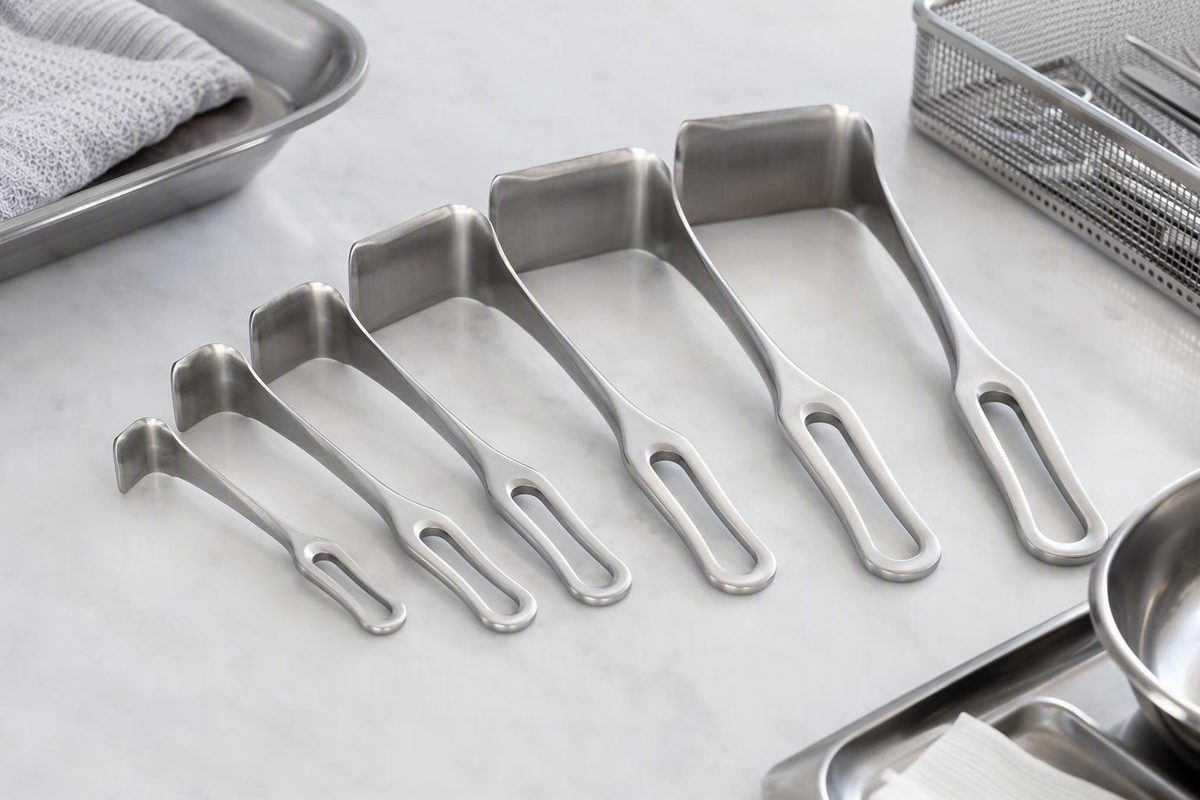
The most useful identifiers are blade width, overall length, blade geometry, handle configuration, material, exact model number, insulation label, reuse status, supplied sterility, packaging, and availability of model-specific instructions.
That distinction matters because two instruments labeled “Size 1” may have different blade widths, while instruments with the same width may differ in length, sterility, insulation, handle style, or authorized reuse. Catalogs can document those attributes, but they do not establish which blade is appropriate for an individual patient or procedure. Nor do they prove claims about visibility, tissue protection, comfort, control, or clinical superiority.
This reference normalizes specifications reported by manufacturers, sellers, retailers, and a commercial product directory. Catalog pages were reviewed on August 15, 2026. Because listings and documentation can change, current specifications should be confirmed with the manufacturer or supplier before purchase or use.
What a Desmarres retractor is
A Desmarres retractor is a hand-held retractor commonly cataloged for retaining an eyelid during an ophthalmic examination or procedure. The more specific term Desmarres lid retractor reflects this dominant documented use. Commercial directories may also place related models in broader surgical categories, but category placement alone should not be treated as a validated indication for every instrument in the category.MedicalExpo’s Desmarres product directory
Unlike a self-retaining retractor, a conventional hand-held Desmarres pattern does not remain in position independently. The operator or an assistant must continue holding and controlling it. This is both a workflow distinction and an identification point: a curved lid blade does not make an instrument self-retaining.
The recurring components are:
- Handle: the section held by the operator.
- Shaft: the slender section connecting the handle to the blade.
- Blade or tip: the curved working end used to retain the lid.
Catalog descriptions use terms such as curved, rounded, blunt, smooth, solid, and saddle-style for the working end. These are physical descriptions. They do not prove that an instrument is “atraumatic,” prevents injury, or is suitable for a particular patient or procedure. Catalog geometry alone cannot establish clinical safety.
The same restraint applies to terms such as “precise,” “comfortable,” “optimal,” or “tissue protecting.” Unless supported by suitable comparative evidence, those phrases should be treated as promotional claims rather than verified performance characteristics.
This article is an identification and procurement reference. It does not provide procedural instruction, patient-specific sizing advice, medical advice, or a substitute for professional clinical and instrument-processing training. Medical Forceps likewise describes its material as educational reference rather than clinical instruction in its Terms and Conditions.
How to recognize the pattern
Documented working-end descriptions include:
- A curved blade with a rounded, blunt tip
- A smooth working edge
- A solid blade
- A saddle-style blade
- A curved, smooth, blunt blade
- An insulated blade
- A vendor-labeled non-conductive version
- An insulated, double-ended configuration
These features vary by model.
Handle construction also varies. Catalogs document square textured, flat, flat serrated, and serrated handles. These details can help distinguish exact models, but no one handle style is a universal defining feature. A flat handle does not by itself identify a Desmarres retractor, and not every Desmarres retractor has a flat handle.
Overall length is a useful secondary identifier. An overall length of 140 mm or 5.5 inches recurs across many reusable catalog models. Documented exceptions include a 130 mm Blink model, a 132 mm Moria listing, a 160 mm Fuhrmann listing, and another directory-listed instrument measuring 6.25 inches.MedicalExpo’s listed Desmarres dimensions
A separate Sklar retailer listing illustrates another 6.25-inch configuration: model 65-1841c is described as a reusable, non-sterile stainless-steel instrument with a 12 mm curved saddle-style blade, serrated handle, smooth working edge, and one blunt blade.Sklar 65-1841c retailer specifications Those details identify that particular listing; they should not be generalized to all Desmarres retractors.
Length is therefore useful for confirming identity, not for proving equivalence. Two instruments with the same blade width may have different overall lengths, handle proportions, blade depths, curvatures, finishes, or intended supply configurations.
A note on spelling
The names Desmarres, DesMarres, DeMarres, and Demarres all appear in the reviewed source material. The evidence does not show that these spelling and capitalization differences represent separate instrument patterns.
When searching inventory records, archived purchase orders, or supplier databases, try the spelling variants. Final identification should still depend on measurable specifications and the exact model or SKU rather than spelling alone.
Blade widths and the problem with size numbers
The reviewed product families document blade widths from approximately 9 mm through 18 mm. The range varies by source:
- Black & Black: 9, 11, 13, and 15 mm.Black & Black insulated DesMarres family
- Marina: 10, 12, 14, and 16 mm.Marina standard and non-conductive variants
- Padgett: 10, 12, and 14 mm.Padgett Desmarres ordering information
- WPI: 11, 13, and 15 mm.WPI Desmarres lid retractor specifications
- gSource: 12, 13, 15, and 17 mm.gSource Desmarres lid retractor family
- Miltex: 12, 14, 16, and 18 mm.Miltex Desmarres ordering information
This is a catalog range, not a clinical sizing framework. It does not establish how a clinician should select a blade for an individual patient, examination, or operation.
The central comparison problem is that seller- and manufacturer-reported size numbers are not standardized. The reviewed listings use the following systems:
| Reporting source | Size sequence | Corresponding widths |
|---|---|---|
| WPI | Sizes 0, 1, and 2 | 11, 13, and 15 mm |
| gSource | Sizes 1, 2, 3, and 4 | 12, 13, 15, and 17 mm |
| Padgett | Sizes 0, 1, and 2 | 10, 12, and 14 mm |
| Miltex | Sizes 1, 2, 3, and 4 | 12, 14, 16, and 18 mm |
A request for a “Size 1 Desmarres” is consequently ambiguous:
| Source or brand | Documented “Size 1” width |
|---|---|
| WPI | 13 mm |
| gSource | 12 mm |
| Padgett | 12 mm |
| Miltex | 12 mm |
Even when two sources assign the same width to the same number, that does not establish equivalence in blade depth, curvature, overall length, material, finish, insulation, handle style, sterility, documentation, or authorized reuse.
A more useful inventory description is:
Desmarres lid retractor, 12 mm blade width, 140 mm overall length, flat handle, reusable, supplied non-sterile, model 5247E.
This records the measured dimension and traceable item number rather than relying on “Size 1.” If blade depth is disclosed, record it separately from width. Do not assume a dimension described merely as “blade size” necessarily represents width without checking the listing.
The Miltex catalog also requires a data-quality warning. It reports model 18-110 as 12 mm and model 18-112 as 14 mm, while describing both as having a 1/2-inch blade. The 16 mm and 18 mm variants are listed as 5/8 inch and 3/4 inch, respectively. The unusual duplicate 1/2-inch conversion should be preserved as a source discrepancy rather than silently corrected in a purchasing or inventory record.
When millimeter and inch descriptions conflict or appear internally unusual:
- Retain the original reported values.
- Record which source supplied each value.
- Ask the manufacturer or supplier which dimension controls.
- Obtain written clarification before treating the models as equivalent.
- Update the local record without erasing the original discrepancy.
Standard, insulated, and non-conductive versions
Ordinary catalog configurations should be separated from products specifically labeled insulated or non-conductive. Those labels may be important for procurement, but the reviewed listings do not establish that they describe identical materials, construction, testing, inspection methods, or performance limits.
Black & Black lists an insulated 14 cm family in 9, 11, 13, and 15 mm widths. The seller associates the family with electrosurgical instruments and transconjunctival blepharoplasty and also mentions hand and nasal retraction. These are seller-described associations, not independent evidence that every width is suitable for every electrosurgical system, setting, or procedure.
The same listing does not disclose the insulation material, electrical test standard, condition limits, or width-specific SKUs in the supplied text. It also presents an unexplained difference between the displayed family identifier and the label visible in the product image. That conflict should be resolved with the supplier before ordering.
Padgett illustrates why an exact SKU is more dependable than width or size number. Its reusable, stainless-steel, 140 mm family includes:
- P4315: 10 mm, Size 0, non-insulated
- P4315IN: 10 mm, Size 0, insulated
- P4316IN: 12 mm, Size 1, insulated
- P4317IN: 14 mm, Size 2, insulated
P4315 and P4315IN have the same reported width and size label but different insulation status. The suffix is therefore part of the product identity and should appear in the purchase order, receiving record, and local inventory description.
Marina uses a different naming approach. It lists paired standard and vendor-labeled non-conductive products in 10, 12, 14, and 16 mm widths, all 14 cm long. The non-conductive variants add “NC” to the corresponding base SKU: 110-050NC, 110-052NC, 110-054NC, and 110-056NC.
The Marina listing does not define “non-conductive,” identify the material system, or provide performance limits in the reviewed text. The label should therefore be recorded exactly as reported, without translating it into “insulated” or treating it as proof of electrosurgical compatibility.
Ambler item 5248EC is another documented insulated configuration. The seller lists it as a 14 mm, Size 2, 5.5-inch model with an insulated blade and flat handle. It is described as reusable stainless steel and supplied non-sterile.
An “insulated” label and a “non-conductive” label should not be assumed to express the same technical property. For any intended electrosurgical context, qualified personnel should obtain and review model-specific documentation addressing:
- The exact SKU and variant
- The manufacturer’s description of the insulating or non-conductive system
- Any stated compatible equipment, modes, settings, and accessories
- Required inspection procedures and rejection criteria
- Cleaning and sterilization restrictions
- Applicable instructions for use
- Relevant institutional requirements
A variant name alone does not establish compatibility with a particular electrosurgical device, mode, setting, accessory, or procedure.
Reusable, single-use, sterile, and autoclavable are different attributes
There is no category-wide answer to whether a Desmarres retractor is reusable, disposable, sterile, non-sterile, or suitable for steam sterilization. Each attribute must be checked independently for the exact item.
Ambler items 5247E and 5248EC are reported as reusable stainless-steel instruments supplied non-sterile. Padgett also lists its reviewed Desmarres models as reusable stainless steel. By contrast, Blink item 90-9013 is listed as a sterile, single-use, 14 mm by 130 mm retractor supplied in boxes of 10.Blink 90-9013 single-use listing
These terms answer different questions:
| Attribute | Question it answers |
|---|---|
| Reusable | Does the product labeling permit more than one use when the applicable instructions are followed? |
| Single-use | Is the product labeled for one use rather than reprocessing and reuse? |
| Supplied sterile | Is the product labeled sterile in its unopened, intact package? |
| Supplied non-sterile | Is processing required before clinical use under the applicable instructions and institutional requirements? |
| Autoclavable | Does the manufacturer state that the product can undergo a specified steam-sterilization process? |
The distinctions are important:
- Reusable does not mean supplied sterile.
- Autoclavable does not mean sterile on delivery.
- Supplied sterile does not necessarily mean reusable.
- Stainless steel does not establish a valid cleaning or sterilization process.
- A reusable label does not supply the missing reprocessing parameters.
WPI states that its 14 cm stainless-steel family is suitable for autoclaving, but the reviewed product page does not provide validated cycle parameters. That statement should not be converted into a generic time, temperature, packaging, pressure, or drying recommendation.
For reusable instruments, obtain the exact manufacturer’s current instructions covering cleaning, inspection, packaging, sterilization, drying, storage, and permitted reuse. Do not substitute a cycle copied from another brand, another SKU, or a visually similar instrument.
A practical receiving check should confirm:
- The packaging is intact and matches the expected package type.
- Sterile or non-sterile status is clearly identified.
- The product is labeled single-use or reusable.
- The exact model, suffix, and item number match the purchase order.
- The expected width and overall length match the received item.
- Applicable instructions are available to personnel responsible for processing or use.
- Any model-specific inspection requirements can be followed.
- Package quantity matches the order, especially for products sold by the box.
If required labeling or instructions are missing, the uncertainty should be resolved before the instrument enters workflow. Appearance, price, material, or packaging style should not be used to infer reuse or sterility status.
Normalized model and specification comparison
The table below normalizes documented listings around measurable and procurement-relevant attributes. Catalog pages were reviewed on August 15, 2026.
Unknown means the reviewed page did not disclose the attribute. It does not mean the manufacturer has never documented it elsewhere. “None stated” means the listing did not identify an insulation feature; it is not proof that no specialized variant exists.
| Reporting source / brand | Model or SKU | Blade width | Size label | Overall length | Blade or handle description | Material | Insulation label | Reuse status | Supplied sterility | Packaging | Documentation status |
|---|---|---|---|---|---|---|---|---|---|---|---|
| WPI | WP108200 | 11 mm | Size 0 | 14 cm | Curved, rounded, blunt blade; square textured handle | Stainless steel | None stated | Not expressly stated | Unknown | Unknown | Page states autoclave suitability but provides no cycle parameters |
| WPI | WP108220 | 13 mm | Size 1 | 14 cm | Same reported family configuration | Stainless steel | None stated | Not expressly stated | Unknown | Unknown | Model and width documented on family page |
| WPI | WP108230 | 15 mm | Size 2 | 14 cm | Same reported family configuration | Stainless steel | None stated | Not expressly stated | Unknown | Unknown | Model and width documented on family page |
| Black & Black | Displayed family identifier differs from image label | 9, 11, 13, or 15 mm | Not stated | 14 cm | Detailed geometry not disclosed in supplied text | Unknown | Insulated | Reprocessing instructions linked; reuse status not explicit | Unknown | Unknown | Identifier conflict unresolved; width-specific SKUs not disclosed |
| Ambler | 5247E | 12 mm | Size 1 | 5.5 in | Flat handle | Stainless steel | No insulation stated | Reusable | Non-sterile | Unknown | Product page links cleaning and sterilization information |
| Ambler | 5248EC | 14 mm | Size 2 | 5.5 in | Insulated blade; flat handle | Stainless steel | Insulated | Reusable | Non-sterile | Unknown | Product page links cleaning and sterilization information |
| gSource | gS 34.4580 | 12 mm | Size 1 | 5.5 in | Hand-held lid retractor; detailed geometry not stated | German surgical stainless steel | None stated | Unknown | Unknown | Unknown | Seller provides competitor cross-references; equivalence is not independently established |
| gSource | gS 34.4600 | 13 mm | Size 2 | 5.5 in | Same family description | German surgical stainless steel | None stated | Unknown | Unknown | Unknown | Model, width, size, and length documented |
| gSource | gS 34.4620 | 15 mm | Size 3 | 5.5 in | Same family description | German surgical stainless steel | None stated | Unknown | Unknown | Unknown | Model, width, size, and length documented |
| gSource | gS 34.4640 | 17 mm | Size 4 | 5.5 in | Same family description | German surgical stainless steel | None stated | Unknown | Unknown | Unknown | Model, width, size, and length documented |
| Marina | 110-050 / 110-050NC | 10 mm | Not stated | 14 cm | Blade and handle details not disclosed | Unknown | Standard / non-conductive | Unknown | Unknown | Unknown | NC property is labeled but not defined in the listing |
| Marina | 110-052 / 110-052NC | 12 mm | Not stated | 14 cm | Pictured NC family member; further geometry undisclosed | Unknown | Standard / non-conductive | Unknown | Unknown | Unknown | Base and NC SKUs documented |
| Marina | 110-054 / 110-054NC | 14 mm | Not stated | 14 cm | Blade and handle details not disclosed | Unknown | Standard / non-conductive | Unknown | Unknown | Unknown | Base and NC SKUs documented |
| Marina | 110-056 / 110-056NC | 16 mm | Not stated | 14 cm | Blade and handle details not disclosed | Unknown | Standard / non-conductive | Unknown | Unknown | Unknown | Base and NC SKUs documented |
| Blink | 90-9013 | 14 mm | Not stated | 130 mm | Detailed blade and handle configuration unknown | Unknown | None stated | Single-use | Sterile | Box of 10 | Dimensions, use status, sterility, and quantity documented |
| Padgett | P4315 | 10 mm | Size 0 | 140 mm | Curved; satin finish | Stainless steel | Non-insulated | Reusable | Unknown | Unknown | Manufacturer product page and IFU entry shown |
| Padgett | P4315IN | 10 mm | Size 0 | 140 mm | Curved; satin finish | Stainless steel | Insulated | Reusable | Unknown | Unknown | Insulated counterpart to P4315; suffix must be verified |
| Padgett | P4316IN | 12 mm | Size 1 | 140 mm | Curved; satin finish | Stainless steel | Insulated | Reusable | Unknown | Unknown | Dimensions and reuse status documented |
| Padgett | P4317IN | 14 mm | Size 2 | 140 mm | Curved; satin finish | Stainless steel | Insulated | Reusable | Unknown | Unknown | Dimensions and reuse status documented |
| Miltex | 18-110 | 12 mm | Size 1 | 140 mm | Blade and handle details unknown | Unknown | Unknown | Unknown | Unknown | Unknown | Catalog also says 1/2 in; no product documents found on page |
| Miltex | 18-112 | 14 mm | Size 2 | 140 mm | Blade and handle details unknown | Unknown | Unknown | Unknown | Unknown | Unknown | Catalog also says 1/2 in, creating an unusual duplicate conversion |
| Miltex | 18-114 | 16 mm | Size 3 | 140 mm | Blade and handle details unknown | Unknown | Unknown | Unknown | Unknown | Unknown | Catalog says 5/8 in; no product documents found on page |
| Miltex | 18-116 | 18 mm | Size 4 | 140 mm | Blade and handle details unknown | Unknown | Unknown | Unknown | Unknown | Unknown | Catalog says 3/4 in; no product documents found on page |
Several practical conclusions follow.
First, a branded size number is not a portable measurement. WPI Size 1 is reported as 13 mm, while gSource, Padgett, and Miltex list Size 1 as 12 mm.
Second, products that share a width can differ in consequential supply attributes. The 14 mm Blink model is listed as sterile and single-use, while Ambler’s 14 mm 5248EC is listed as reusable, insulated, and supplied non-sterile. Width alone cannot distinguish them.
Third, a suffix may be as important as the base model. P4315 and P4315IN share the same reported width, size, length, material, shape, and reuse status, but differ in insulation labeling.
Fourth, missing information should remain unknown. Material should not be inferred from appearance, reuse from price, sterility from packaging style, or electrosurgical compatibility from coating color.
Finally, this is not a product ranking. The reviewed pages do not provide independent comparative evidence for exposure, ergonomics, durability, tissue effects, complication rates, service life, or clinical outcomes.
Documented applications—and the limits of the evidence
The most consistently documented application is eyelid retraction during ophthalmic examinations or procedures. Catalogs also associate particular products with oculoplastics, lid surgery, blepharoplasty, and plastic or reconstructive surgery. These classifications may help locate products, but they do not independently prove efficacy or establish a universal indication for every Desmarres model.
One bounded clinical example comes from the University of Iowa. In a recorded internal suture browpexy performed with upper blepharoplasty, the transcript describes placement of a Desmarres retractor after exposure of the superior orbital rim and during preperiosteal dissection with a Freer periosteal elevator.University of Iowa internal suture browpexy transcript
That demonstration documents one workflow. It does not identify the retractor’s dimensions or model, establish universal positioning, provide a blade-selection rule, or prove that the same technique applies to other procedures.
A Sklar retailer listing says its particular 12 mm saddle-style model is intended primarily to retain the upper eyelid and eyelashes and may also retract the lower lid. That statement is model-specific and retailer-reported. It should not be generalized to all Desmarres retractors.
Broader catalog placements require still more caution. Commercial pages place some Desmarres products in nasal, hand, dermal, oral, dental, orthopedic, spine, or veterinary categories. Such placement may reflect seller descriptions, merchandising structure, or website filters rather than a validated category-wide indication.
The available evidence does not independently compare:
- Quality or extent of exposure
- Tissue pressure
- Tissue trauma
- Operator ergonomics or fatigue
- Insulation performance
- Durability or service life
- Complication rates
- Patient outcomes
- Performance against self-retaining lid retractors
- Clinical superiority among brands, widths, or blade geometries
Promotional phrases about improved visibility, precise control, reduced trauma, comfort, limited fatigue, or optimal exposure should therefore remain classified as marketing claims unless supported by suitable comparative evidence.
Pre-purchase and identification checklist
Use a structured specification check rather than ordering from the generic name “Desmarres retractor.”
-
Record the actual blade width in millimeters. Do not rely on Size 0, 1, 2, 3, or 4 without the corresponding measured width. If inch and millimeter values conflict, request written clarification.
-
Confirm the overall length. Although 140 mm or 5.5 inches is common in the reviewed listings, documented models vary. Length can distinguish products that otherwise appear similar.
-
Describe the working end. Record curvature, blade depth when disclosed, solid or other construction, saddle-style form, and working-edge description. Do not convert “blunt” or “smooth” into an unsupported safety claim.
-
Check whether the instrument is single- or double-ended. A double-ended product should not automatically be substituted for a conventional single-ended model.
-
Identify the handle configuration. Note whether it is flat, square textured, serrated, flat serrated, or another documented pattern. Handle style can support identification but does not prove ergonomic superiority.
-
Verify the material. Many reviewed reusable models specify stainless steel, but not every listing discloses material. Record unknown rather than inferring it from appearance.
-
Distinguish standard, insulated, and non-conductive variants. Include the exact suffix or variant code. For any intended electrosurgical context, obtain model-specific technical, compatibility, inspection, use, and reprocessing documentation.
-
Separate reuse from sterility. Confirm whether the product is reusable or single-use and, independently, whether it is supplied sterile or non-sterile.
-
Obtain applicable reprocessing instructions. For reusable products, verify that the current model-specific instructions are available before purchase or use. Do not assume that “autoclavable” authorizes a facility’s preferred cycle.
-
Confirm package quantity. A single-use product may be quoted by the box rather than by the individual instrument. Compare total quantities and packaging units, not just the displayed product name.
-
Match every identifier. Compare the written product name, SKU, suffix, blade width, overall length, image, quotation, and purchase order. Ask the supplier to resolve conflicting identifiers before ordering.
-
Treat cross-references as leads, not proof. A seller’s “compare to” or “equivalent to” field can identify another product to investigate. It does not establish dimensional, material, technical, clinical, or regulatory equivalence.
-
Keep commercial terms dated and seller-specific. Price, stock, shipping, warranty, return terms, and availability may vary by region, variant, package, and date. Do not copy them into a permanent technical specification as though they were fixed product characteristics.
-
Separate specifications from promotion. Width, length, model number, material, sterility, and reuse status are documentable attributes. Statements about reduced trauma, improved visibility, greater comfort, better control, less fatigue, or superior outcomes require separate evidence.
-
Confirm documentation at receiving. Before the instrument enters workflow, verify packaging integrity, exact item number, variant suffix, sterile status, reuse label, package quantity, applicable instructions, and any model-specific inspection requirements.
The final identification record should contain, at minimum:
- Actual blade width
- Overall length
- Blade geometry and depth, when disclosed
- Handle configuration
- Single- or double-ended construction
- Exact model or SKU
- Material
- Insulation or non-conductive label
- Reuse status
- Supplied sterility
- Package quantity
- Availability and revision status of applicable instructions
Medical Forceps states that it is an educational instrument reference, does not sell instruments, and does not accept manufacturer-paid placement.About Medical Forceps Clinical selection, electrosurgical compatibility, handling, and reprocessing decisions remain matters for qualified personnel using current model-specific documentation and institutional requirements.
What is a Desmarres retractor used for?
It is primarily cataloged as a hand-held instrument for retaining an eyelid during ophthalmic examinations or procedures. Particular sellers also associate specific models with oculoplastics, lid surgery, blepharoplasty, and plastic or reconstructive surgery.
Because the conventional pattern is hand-held rather than self-retaining, an operator or assistant must continue controlling it. Catalog placement does not establish that every model is validated for broader nasal, hand, dermal, orthopedic, dental, spine, or veterinary applications.
What blade widths do Desmarres retractors come in?
The reviewed listings document widths from approximately 9 mm to 18 mm. Individual product families cover narrower ranges, including 9–15 mm, 10–16 mm, 11–15 mm, 12–17 mm, and 12–18 mm.
Compare the measured width in millimeters rather than the branded size number. “Size 1” can mean 12 mm or 13 mm depending on the reporting source. Width is an identification specification, not a patient- or procedure-specific sizing recommendation.
Is a Desmarres retractor reusable or disposable?
Both configurations appear in the reviewed catalogs. Multiple stainless-steel models are listed as reusable, while Blink item 90-9013 is listed as sterile and single-use.
Reuse status must be verified for the exact SKU. Appearance, material, price, or the generic name “Desmarres retractor” cannot determine whether reuse is authorized.
What is the difference between insulated and non-conductive Desmarres retractors?
They are different vendor labels and should not automatically be treated as interchangeable technical terms. Some listings use insulated, while Marina identifies certain variants as non-conductive. The reviewed pages do not consistently disclose materials, testing standards, inspection methods, or performance limits.
Neither label alone establishes compatibility with a particular electrosurgical device, mode, setting, accessory, or procedure. Verify the exact SKU and obtain the applicable technical, inspection, use, and reprocessing documentation.
Is a reusable Desmarres retractor supplied sterile?
Not necessarily. Ambler’s reusable 5247E and 5248EC models are specifically listed as supplied non-sterile. Reusable, supplied sterile, supplied non-sterile, and autoclavable are separate attributes.
Check the exact model label, package, and applicable instructions at receiving. Where a reusable product is supplied non-sterile, processing decisions should follow its current model-specific documentation and institutional requirements.
The practical conclusion is straightforward: identify and procure a Desmarres retractor by its measured blade width, overall length, blade and handle configuration, exact SKU, material, insulation label, reuse status, supplied sterility, packaging, and applicable instructions. Catalogs are useful for documenting dimensions and variants, but they do not provide procedure-specific sizing rules, safety guarantees, or evidence-based product rankings. Conflicting identifiers should be resolved with the supplier before ordering, while clinical selection, electrosurgical compatibility, and reprocessing remain the responsibility of qualified personnel using validated model-specific information.