
Doyen Forceps With Model-Specific Features
Final identification rests on the exact manufacturer and SKU, curvature, dimensions, jaw pattern, lock, sterility, reuse status and documentation.
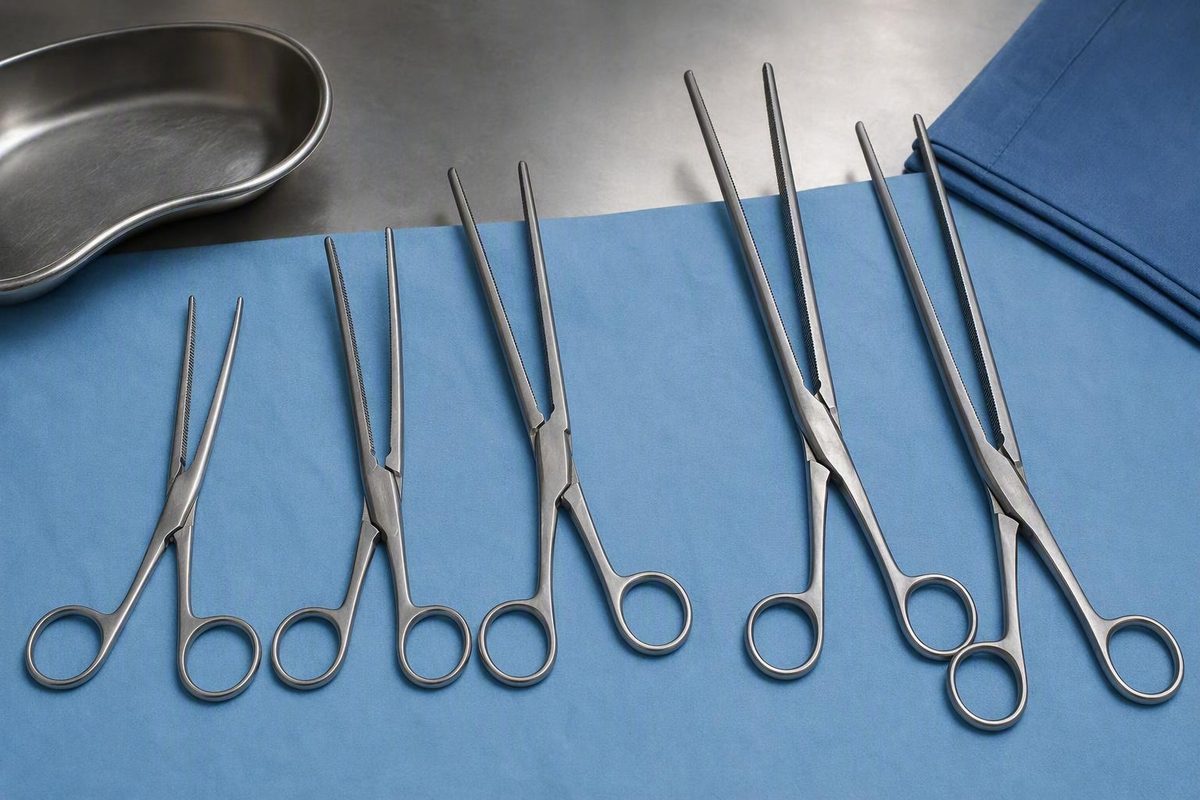
Doyen forceps are recognizable as a family of long-jawed intestinal clamps, but the name does not define one universal instrument. Reliable identification therefore depends on the exact manufacturer and SKU—not merely on a familiar silhouette or the word Doyen.
The same caution applies to descriptions such as atraumatic and non-crushing. These are useful catalog labels for distinguishing product designs, but they are not proof that an instrument cannot injure tissue. Students, technicians, educators, and purchasers should separate listed specifications from vendor-stated applications and unsupported performance claims.
What are Doyen forceps?
Doyen forceps are generally classified as intestinal or gastrointestinal clamps. Commercial listings associate them with temporarily grasping, isolating, manipulating, enclosing, or occluding bowel and other hollow organs. Ambler Surgical, for example, describes the pattern as a clamp for occluding the intestine or another hollow organ and catalogs straight and curved versions with different jaw descriptions in its Doyen forceps range.
That broad classification is more reliable than treating every Doyen forceps as a standardized design. The recurring concept is a relatively long-jawed clamp associated with handling or temporarily isolating intestinal structures. The precise intended application must come from the documentation for the individual model.
These pages can establish what a vendor calls an instrument, which variants it offers, and which specifications it publishes. They do not by themselves establish comparative clinical performance, safe closure force, an appropriate ratchet position, or a permissible duration of occlusion.
Accordingly, this is an identification and specification reference, not step-by-step guidance on:
- where to place a clamp;
- how much force to apply;
- which ratchet position to engage;
- how long to leave an instrument closed;
- which tissue can tolerate a particular degree of compression; or
- when a specific pattern is clinically indicated.
Doyen forceps also should not be presented primarily as hemostats or recommended for vessel clamping on the strength of the evidence summarized here. The relevant product pages predominantly identify them as intestinal clamps. A broader use mentioned by one seller cannot safely be transferred to every model, market, or procedure.
Instrument selection and use belong to appropriately trained professionals following applicable clinical protocols, institutional policy, and the exact manufacturer’s current documentation. Medical Forceps describes its material as educational rather than clinical instruction, explains its editorial position about Medical Forceps and its independence, and states that its content does not replace professional training in its educational-use notice.
How to identify a Doyen intestinal forceps
The most useful starting point is the instrument’s overall profile. Listed Doyen intestinal forceps commonly combine:
- elongated jaws;
- a serrated or otherwise patterned gripping surface;
- extended members between the jaws and handles; and
- finger-ring handles.
Some detailed listings also specify a ratchet near the rings. A ratchet should not be assumed to be universal. Confirm its presence and design for the exact SKU because abbreviated descriptions may omit the locking mechanism, and a catalog image may represent an entire product family rather than the selected variant.
A visual identification sequence
When examining a physical instrument or a clear catalog image, trace it systematically from tip to handle:
- Jaws: Look for the elongated jaw profile associated with an intestinal clamp. Determine whether the selected model is straight or curved.
- Gripping surface: Inspect the direction and form of the serrations. Catalogs may describe them as longitudinal, diagonal, standard serrated, fenestrated, or by another manufacturer-specific term.
- Jaw openings: Determine whether the working surfaces are solid or fenestrated. Do not infer fenestration from the word atraumatic.
- Members behind the jaws: Follow the working end toward the joint and handles. Record the construction visible on the actual instrument without assuming that every Doyen pattern uses identical geometry.
- Joint area: Examine the joint’s visible construction and condition. Treat a box-lock description as model-specific unless it appears in the documentation for that SKU.
- Finger rings: Ring handles recur throughout the documented examples and help distinguish these clamps from tweezer-like thumb forceps.
- Ratchet, where present: Look between the finger rings for interlocking teeth. Record a ratchet only when it is documented or clearly confirmed on the exact instrument.
- Identification marks: Record any manufacturer name, catalog number, or other marking that is actually present. Do not assume that every model carries the same type of mark.
For teaching purposes, the profile can be understood as a feature map: jaws and serrations at the working end, extended members leading to the joint, and finger rings at the handle end, with a ratchet only where the model includes one. Straight and curved examples should be compared side by side, but neither should be presented as the universal Doyen configuration.
What appearance cannot establish
A long-jawed, ring-handled clamp may resemble a cataloged Doyen pattern, but appearance alone cannot establish:
- whether it was supplied sterile;
- whether it is reusable;
- whether a sterilization method has been validated for it;
- the grade or origin of its metal;
- whether it is intended for human or veterinary use;
- its regulatory status;
- its approved application;
- its jaw-closing force; or
- whether its manufacturer labels it atraumatic.
Even a visible Doyen name is not a substitute for model-specific records. If manufacturer and catalog markings are incomplete, identification should remain provisional until the instrument can be matched to authoritative documentation.
The name also appears on unrelated instruments. Doyen retractors, rib rasps, and scissors are not Doyen intestinal forceps. Catalog searches may place all of them in the same result set, so classification must be based on instrument type and physical form rather than the eponym alone.
Jaw patterns and the meaning of “atraumatic”
Doyen jaw construction varies substantially among listings. Documented descriptions include:
- longitudinal or lengthwise serrations;
- diagonal serrations;
- standard serrated jaws;
- fenestrated jaws; and
- jaws labeled atraumatic or non-crushing.
These terms are not interchangeable. A longitudinally serrated jaw has grooves described as running primarily along its length. A diagonal pattern crosses the jaw at an angle. A fenestrated jaw includes an opening or window in its working area. A description such as “standard serrated” provides less detail and may require a drawing, a model-specific image, or a fuller specification.
The Doyen designation also does not guarantee that different manufacturers use the same serration depth, spacing, jaw width, flexibility, surface finish, or closure geometry.
Documented examples
Miltex V916-160 and V916-162 are documented examples of straight and curved patterns with longitudinal serrations. The Baby Doyen BDIF family, by contrast, is described as a light pattern with diagonal serrations and finger-ring handles.
Another family illustrates a documentation problem purchasers should recognize. GerVetUSA’s general description refers to fine longitudinal or lengthwise serrations, while its variant descriptions refer to diagonal serrations. The discrepancy cannot be resolved by choosing whichever wording appears more typical. The appropriate record is “conflicting” until the seller or manufacturer confirms the specification for the exact SKU.
“Atraumatic” is not a guarantee
In a catalog, atraumatic is best treated as a design category or marketing label. It may indicate that a manufacturer intends the jaw geometry to handle delicate structures differently from another pattern. It does not demonstrate that the instrument eliminates trauma, crushing, ischemia, leakage, or other adverse tissue effects.
Similarly, non-crushing should not be interpreted literally as a guarantee of risk-free compression. The cited commercial pages do not independently quantify closure pressure, tissue deformation, safe ratchet engagement, or comparative injury outcomes. A jaw label therefore cannot determine safe force, ratchet position, or duration.
For example, American Medicals lists straight and curved Doyen forceps with fenestrated jaws, ring handles, and a ratchet. Its claims about minimizing tissue trauma remain vendor statements rather than independent clinical evidence on the commercial product page.
For identification records, separate these fields:
- Jaw geometry: solid, fenestrated, or unspecified.
- Serration direction: longitudinal, diagonal, otherwise described, or unspecified.
- Catalog label: standard, atraumatic, non-crushing, or other wording.
- Performance evidence: independently supported, vendor-stated only, absent, or unresolved.
This preserves useful product terminology without converting it into an unsupported safety conclusion.
Straight, curved, and Baby Doyen patterns
Straight and curved configurations recur across multiple Doyen catalogs. Both forms appear among standard-length instruments and smaller Baby Doyen listings. The available commercial evidence does not establish either shape as universally superior.
Curvature should be treated as a model specification to be considered with the planned procedure, anatomy, access requirements, other instruments in the set, and the trained clinician’s judgment. A curved jaw changes the instrument’s geometry, but that observation does not establish when it should be placed, how it should be oriented, or whether it is preferable in a particular clinical situation.
Straight Doyen
A straight Doyen model has jaws cataloged without the bend specified for a curved variant. Documented examples include Miltex V916-160, Ambler 29-505, GerVetUSA G11-174, and the straight option in the BDIF Baby Doyen family.
“Straight” describes curvature only. It does not guarantee a particular serration pattern, jaw length, material grade, ratchet, sterility status, reuse status, or intended market.
Curved Doyen
A curved model has a defined bend in the working jaws. Documented examples include Miltex V916-162, Ambler 29-510, GerVetUSA G11-175, J0135C, and the curved option in the BDIF family.
As with straight instruments, curved is only one part of the specification. Two curved models may differ in arc, jaw dimensions, serrations, lock construction, material claims, sterility, and market documentation.
Baby Doyen
Baby Doyen should be understood cautiously as a shorter or lighter listed pattern rather than a universally standardized construction. The documented BDIF family is described as a light pattern and is available in straight and curved forms. Another manufacturer could use the same name for an instrument with different dimensions or jaw details.
The comparison is therefore relative:
| Configuration | Documented example | What the name communicates | What still requires verification |
|---|---|---|---|
| Standard straight | Straight standard-length catalog pattern | Straight jaw configuration | Serrations, jaw dimensions, lock, material, sterility, reuse status, and market |
| Standard curved | Curved standard-length catalog pattern | Curved jaw configuration | Degree of curve, serrations, jaw dimensions, lock, material, and documentation |
| Baby Doyen straight | Smaller straight listed pattern | A smaller or lighter straight configuration | Whether “baby” denotes the same construction across manufacturers |
| Baby Doyen curved | Smaller curved listed pattern | A smaller or lighter curved configuration | Curve, serrations, jaw profile, sterility, reuse status, and intended market |
A configuration name should never be used as shorthand for every other property. Baby, straight, and curved are classification clues, not complete specifications.
Doyen forceps sizes and measurement guide
The commercial pages reviewed here contain examples spanning approximately 13–23 cm, but that is a sample of listed products rather than proof of the complete market range. One catalog lists straight and curved variants at 13, 16, 18, 21, and 23 cm.1 Another seller lists 7-inch and 9-inch configurations, while the documented Baby Doyen family includes 6.5-inch straight and curved options.23
When comparing catalogs, normalize measurements into the same unit while retaining the manufacturer’s original value. Do not assume that paired metric and imperial values are exact equivalents; catalog measurements may be nominal or rounded.
| Nominal length | Approximate metric equivalent | Basis |
|---|---|---|
| 6.5 in | 16.5 cm | Rounded conversion of the listed Baby Doyen length3 |
| 7 in | 17.8 cm | Rounded conversion of the listed standard length2 |
| 9 in | 22.9 cm | Rounded conversion of the listed standard length2 |
A manufacturer may describe a nominal 9-inch instrument as 230 mm rather than the more precise mathematical conversion. That difference should be preserved as the manufacturer’s stated specification rather than silently “corrected.”
Overall length versus jaw length
Overall length and jaw length are separate fields. Overall length generally describes the complete instrument from the distal tip to the opposite end of the handles. Jaw length describes only the working jaw section, subject to the measurement convention used by the seller or manufacturer.
The curved J0135C illustrates the distinction: its listing gives a 9-inch overall length, 4-inch jaws, curved form, and stainless-steel construction.4 Recording only “9 inches” would omit an important comparison point and could be misread as a jaw measurement.
For procurement or tray documentation, use separate fields for:
- overall instrument length;
- jaw length;
- jaw width, if supplied;
- curvature;
- usable or working length, if the manufacturer defines it; and
- the original unit and any stated rounding convention.
Size alone does not establish intended use, jaw capacity, tissue safety, alignment, construction quality, or compatibility with a procedure.
If a seller provides only a nominal size, do not estimate jaw length from a photograph.
Model-by-model specification comparison
The table below keeps straight and curved models in separate rows wherever the catalog provides distinct identifiers. “Not stated” means that the cited page does not establish the field; it does not prove that the information is unavailable from another document.
Market descriptions are also kept separate. A human-surgical heading, veterinary category, or seller statement does not by itself establish regulatory authorization for a particular jurisdiction or application.
| Manufacturer or seller and exact model | Length | Form | Documented jaw or handle details | Other listed properties and market context | Documentation gaps or conflicts |
|---|---|---|---|---|---|
| Miltex V916-1605 | 9 in / 230 mm | Straight | Longitudinal serrations | Listed as made in Pakistan; cataloged under an intestinal specialty | Material, sterility, reuse status, detailed intended use, and supporting documents not established on the displayed page |
| Miltex V916-1625 | 9 in / 230 mm | Curved | Longitudinal serrations | Listed as made in Pakistan; cataloged under an intestinal specialty | Same principal gaps as V916-160 |
| Ambler 29-5056 | 9 in / about 22.9 cm | Straight | Serrated jaws; ring handle | Stainless steel; reusable; supplied non-sterile; listed as made in Germany | Precise serration direction, jaw length, detailed reprocessing instructions, and broader regulatory information not established on the cited page |
| Ambler 29-5107 | 9 in / about 22.9 cm | Curved | Serrated jaws; ring handle | Cataloged as a Doyen intestinal forceps | Material, supplied sterility, reuse status, jaw length, detailed serration pattern, intended market, and instructions for use not established by the cited category listing |
| GerVetUSA G11-1748 | 9 in / 22.86 cm | Straight | Long jaws; finger-ring handles; ratchet stated | Seller describes it as reusable, non-sterile, and made from German stainless steel; veterinary seller also states broader human and veterinary applications | Page conflicts between longitudinal and diagonal serrations; GerVetUSA and GerMedUSA branding is mixed; regulatory and market suitability require confirmation |
| GerVetUSA G11-1758 | 9 in / 22.86 cm | Curved | Long jaws; finger-ring handles; ratchet stated | Seller describes it as reusable, non-sterile, and made from German stainless steel; veterinary seller also states broader human and veterinary applications | Same serration conflict, mixed branding, and market-context concerns as G11-174 |
| Baby Doyen BDIF — straight option9 | 6.5 in / about 16.5 cm | Straight | Light pattern; diagonal serrations; finger-ring handles | Family-level SKU rather than a clearly stated final variant SKU | Page header says human surgical use while a category identifies veterinary intestinal instruments; supplied sterility and detailed reprocessing status are not established |
| Baby Doyen BDIF — curved option9 | 6.5 in / about 16.5 cm | Curved | Light pattern; diagonal serrations; finger-ring handles | Same family-level listing | Same intended-market inconsistency; exact orderable identifier, supplied sterility, and detailed reprocessing information are not established |
| J0135C10 | 9 in / about 22.9 cm overall; 4 in / about 10.2 cm jaws | Curved | Detailed serration pattern not stated | Stainless steel; listed by a veterinary-supply seller | Intended procedure, supplied sterility, reuse status, origin, lock design, regulatory information, and instructions for use not established |
Several practical lessons follow from the comparison.
First, a product family is not a substitute for a model record. Miltex assigns different codes to its straight and curved variants. A purchasing file that records only “Miltex Doyen” loses the distinction required to reorder the same configuration.
Second, dimensions should not be merged. J0135C is the example here for which both overall length and jaw length are stated. The overall measurement must not be entered as the jaw length.
Third, apparently specific catalog language can still be internally inconsistent. GerVetUSA uses both longitudinal and diagonal serration descriptions for the same product family. Until that discrepancy is resolved for the selected model, the serration field should remain marked as conflicting.
Fourth, family-level SKUs require special care. BDIF identifies a family containing straight and curved options, but the cited listing does not clearly provide a final orderable identifier for each variation. The exact selected variant should be confirmed before ordering.
Finally, prices do not belong in a durable identification table unless they are dated and attributed as commercial snapshots. Price, stock, shipping, warranties, and returns can change, and none of them establishes alignment, durability, tissue effect, or overall quality.
Sterility, reuse, and documentation limits
There is no evidence here for treating all Doyen forceps as sterile, non-sterile, reusable, disposable, autoclavable, or compatible with one reprocessing method. The product listings provide uneven information.
Ambler 29-505 is specifically listed as a reusable stainless-steel instrument supplied non-sterile.6 That specification applies to 29-505 and should not be copied into the record for 29-510 or another manufacturer’s model without confirmation.
GerVetUSA describes G11-174 and G11-175 as reusable and non-sterile and states that its instruments can withstand repeated autoclaving.8 This remains a seller-attributed statement about that listed family. It is not a universal rule for Doyen forceps and does not establish a validated cycle for another model.
Other cited pages omit some or all of the following:
- supplied sterility;
- reuse or service-life limits;
- cleaning instructions;
- lubrication requirements;
- sterilization method and cycle;
- inspection criteria;
- packaging requirements;
- storage conditions;
- retirement criteria;
- regulatory information; and
- a downloadable instructions-for-use document.
“Stainless steel” does not fill these documentation gaps. It identifies a material category but does not, on the evidence available here, establish a cleaning process, sterilization cycle, detergent, lubricant, packaging system, drying method, or service-life limit.
What to do when reprocessing information is missing
Before adding an instrument to a reusable workflow, obtain the exact manufacturer’s current instructions and reconcile them with the facility’s established requirements. Relevant documentation may need to address:
- point-of-use handling;
- cleaning and rinsing;
- access to joints and ratchets;
- inspection;
- lubrication, where permitted;
- packaging;
- sterilization;
- drying and storage;
- functional testing; and
- repair or retirement.
This article does not provide a generalized cleaning cycle, sterilization temperature, exposure time, lubricant recommendation, or inspection standard. The cited product pages do not establish one method that can be applied across all Doyen models.
If model-specific instructions cannot be obtained, record that absence as a documentation gap and use the facility’s established procurement, sterile-processing, infection-prevention, or regulatory escalation process. Silence in a catalog should not be converted into an assumption that another product’s instructions apply.
The same limitation applies to instruments already in inventory. Visual resemblance to a documented reusable model does not establish that an unmarked instrument has the same material, assembly, or manufacturer-supported reprocessing requirements.
A practical identification and procurement checklist
Use the following checklist before labeling an instrument, adding it to a count sheet, comparing quotations, or placing an order.
Identity and traceability
- [ ] Record the manufacturer, not only the retailer.
- [ ] Record the exact SKU or catalog number.
- [ ] Distinguish a product-family SKU from a final orderable variant.
- [ ] Capture markings from the physical instrument where present.
- [ ] Confirm that the catalog image represents the selected SKU.
- [ ] Record the document revision or access date.
Physical configuration
- [ ] Is the instrument straight or curved?
- [ ] What overall length is listed?
- [ ] Is the measurement nominal, exact, or rounded?
- [ ] Is jaw length documented separately?
- [ ] Are jaw width and curvature dimensions supplied?
- [ ] Are the jaws solid or fenestrated?
- [ ] Are serrations longitudinal, diagonal, otherwise patterned, or unspecified?
- [ ] Does the description merely say “serrated”?
- [ ] Are finger-ring handles documented?
- [ ] Is a ratchet present and specified?
- [ ] What joint construction is documented for the exact model?
Supply, market, and lifecycle status
- [ ] What material is stated?
- [ ] Is a material grade supplied?
- [ ] Is the instrument supplied sterile or non-sterile?
- [ ] Is it reusable, single-use, or unstated?
- [ ] Are model-specific reprocessing instructions available?
- [ ] Are inspection, maintenance, repair, and retirement criteria available?
- [ ] Is the documented market human, veterinary, both as vendor-stated, or unresolved?
- [ ] Is the market description consistent across the page, category, packaging, and manufacturer documentation?
Documentation and purchasing
- [ ] Obtain the current manufacturer documentation for the exact model.
- [ ] Confirm applicable regulatory or institutional records.
- [ ] Check compatibility with the facility’s validated workflow.
- [ ] Review warranty terms without treating warranty length as proof of quality.
- [ ] Treat price, stock, delivery, shipping, and returns as changeable commercial details.
- [ ] Resolve catalog conflicts before ordering rather than guessing.
- [ ] Preserve correspondence used to clarify a disputed specification.
How to handle conflicting information
Catalog conflicts are themselves relevant procurement information. Flag the record when:
- the headline and variant description name different serrations;
- the image appears curved but the selected SKU is straight;
- a human-surgery heading conflicts with a veterinary category;
- the seller name and product trademark differ;
- metric and imperial dimensions do not reasonably correspond;
- a family image is used for several variants;
- the page describes a ratchet that is absent from the selected model’s documentation; or
- retailer copy differs from current manufacturer documentation.
Prefer model-specific manufacturer documentation over generic category copy. If a discrepancy remains unresolved, label the field “unresolved” rather than substituting an assumption.
What does not prove quality
Price, country of origin, “German steel” wording, and economy, mid-tier, premium, or professional labels do not independently establish:
- jaw alignment;
- closure consistency;
- resistance to corrosion;
- durability;
- serration quality;
- ratchet reliability;
- validated reusability;
- clinical suitability; or
- tissue safety.
Those characteristics require appropriate specifications, documentation, inspection, testing, and—where clinical performance is claimed—relevant supporting evidence. Country of origin is a traceability field, not a performance measurement, while commercial tier and price can reflect factors unrelated to instrument performance.
Evidence legend for reading Doyen listings
Use a simple evidence legend in teaching or procurement files:
- Listed specification: A concrete field confirmed as appearing on the cited page, such as SKU, nominal length, curvature, serration description, or supplied sterility. This does not mean the field was independently validated.
- Vendor-stated application: A use described by a seller or manufacturer but not independently established by the listing.
- Unresolved conflict: Two parts of the available documentation disagree or map ambiguously to a variant.
- Unsupported performance claim: Language such as prevents crushing, eliminates trauma, or guarantees secure handling without suitable independent evidence.
Frequently asked questions about Doyen forceps
What are Doyen forceps used for?
Commercial listings generally classify Doyen forceps as intestinal clamps and associate them with temporarily grasping, isolating, manipulating, enclosing, or occluding bowel and other hollow organs.7 These descriptions identify the product category; they do not provide safe placement, closure-force, ratchet, or duration instructions.
Model selection and use must remain with trained professionals working under applicable protocols and the exact manufacturer’s documentation. The commercial evidence summarized here does not support presenting Doyen forceps primarily as hemostats or recommending them for vessel clamping.
Are all Doyen forceps atraumatic or non-crushing?
No. Catalogs list standard-serrated, longitudinally serrated, diagonally serrated, fenestrated, and atraumatic-labeled versions. The Doyen name does not guarantee one jaw design.
Moreover, atraumatic and non-crushing are product or marketing terms, not proof that a clamp cannot injure tissue. They do not establish a safe closure force, ratchet position, or occlusion duration.
What is the difference between straight and curved Doyen forceps?
The immediate difference is jaw geometry: one configuration is straight, while the other incorporates a curve. Both forms occur in standard and smaller listed patterns.
Curvature is one specification to consider alongside the procedure, anatomy, access requirements, and trained clinician’s judgment. The cited product listings do not establish either shape as universally superior. Straight and curved instruments may also differ in jaw dimensions, serrations, lock, material, sterility, reuse status, and intended market.
What is a Baby Doyen forceps?
Baby Doyen generally denotes a shorter or lighter cataloged pattern rather than a universally standardized instrument. The documented BDIF family includes straight and curved 6.5-inch options described as a light pattern with diagonal serrations and finger-ring handles.9
Another manufacturer’s Baby Doyen may not share all those characteristics. Confirm the exact SKU, overall and jaw dimensions, curvature, serrations, lock, sterility, reuse status, and intended market.
Are Doyen forceps supplied sterile and reusable?
It depends on the exact model. Ambler 29-505 is listed as reusable and supplied non-sterile, while GerVetUSA gives the same status for G11-174 and G11-175.68 Several other cited listings omit one or both fields.
Do not assume that every Doyen forceps is reusable, supplied non-sterile, or supported for autoclaving. Stainless-steel construction does not by itself provide model-specific reprocessing instructions.
How to compare Doyen forceps reliably
Doyen forceps are recognizable as a family of elongated, ring-handled intestinal clamps, but the name does not define one universal instrument. Final identification should rest on the exact manufacturer and SKU, curvature, overall and jaw dimensions, jaw pattern, locking mechanism, supplied sterility, reuse status, intended market, and available manufacturer documentation.
Treat atraumatic and non-crushing as catalog terminology unless suitable evidence supports a specific performance claim. Selection, clinical use, and reprocessing remain the responsibility of trained professionals working under applicable protocols and model-specific documentation.
Finally, keep the category boundary clear: Doyen retractors, Doyen rib rasps, and Doyen scissors are separate instruments and should not be included in a Doyen intestinal forceps comparison merely because they share the same name.