
Sterilizing Medical Equipment: Choosing a Compatible Method
Compare steam, hydrogen peroxide, ethylene oxide, dry heat and liquid chemical methods by device compatibility, lumen limits and storage needs.
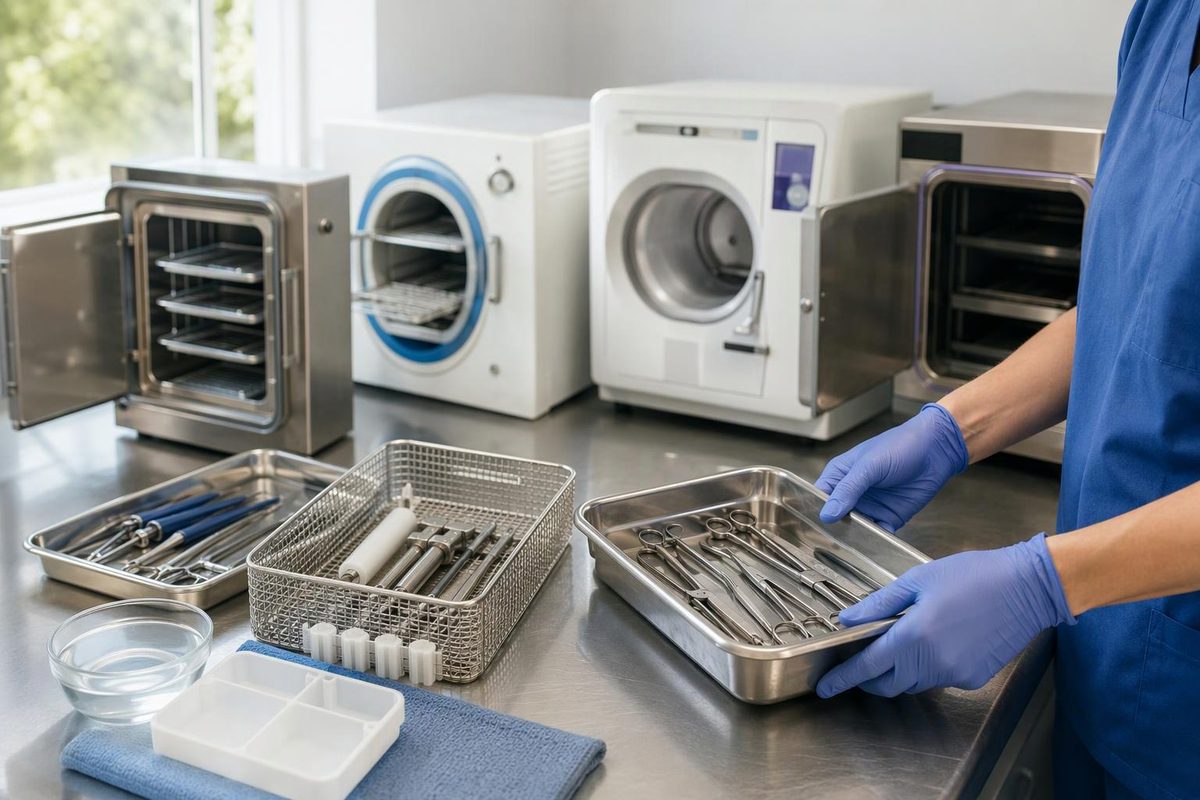
Steam is preferred for critical reusable instruments that tolerate heat, moisture and pressure. Heat- or moisture-sensitive equipment needs a compatible alternative—not simply a cooler cycle. The choice must match the exact device, sterilizer and packaging instructions. CDC method-selection recommendations
This guide compares methods and the documentation needed to select between them, drawing on US CDC and FDA guidance. It is an educational reference, not a processing protocol or substitute for sterile-processing training.
Does the equipment need sterilization?
Sterilization destroys or eliminates all forms of microbial life, including bacterial spores. Cleaning removes soil; disinfection is a different process and does not provide the same endpoint. Thorough cleaning is essential before either sterilization or high-level disinfection. CDC definitions
The equipment’s intended patient contact determines the required processing level:
| Equipment category | Intended contact | Required processing level |
|---|---|---|
| Critical | Normally sterile tissue or the vascular system; also devices through which sterile body fluid flows | Sterilization before each patient use |
| Semicritical | Mucous membranes or nonintact skin | At least high-level disinfection |
| Noncritical | Intact skin, such as a blood-pressure cuff | Low-level disinfection |
These are the categories used in US CDC recommendations. “Medical equipment” therefore does not mean everything belongs in a sterilizer. Check the device’s intended use and instructions for use (IFU), rather than assigning a process from its name alone.
Compare the main sterilization methods
The table identifies candidate methods, not permission to process a particular instrument.
| Method | Where it may fit | Main selection constraint |
|---|---|---|
| Steam under pressure—autoclaving | Critical instruments that tolerate heat, steam, pressure and moisture | Device, sterilizer and wrap or container instructions must specify compatible cycle conditions. CDC |
| Hydrogen peroxide vapor or gas plasma | Compatible heat- or moisture-sensitive devices; gas-plasma examples include some plastics and electrical devices | Verify the exact system and cycle. Lumen length and diameter affect effectiveness; “low temperature” does not establish compatibility. FDA methods overview, CDC gas-plasma guidance |
| Ethylene oxide—EtO | Compatible heat- or moisture-sensitive equipment; manufacturers also use it for certain polymers and devices with hard-to-reach areas | Required aeration must be completed before patient use. Residual chemical levels and occupational exposure require control. CDC, FDA |
| Dry heat | Heat-tolerant materials that moist heat may damage or cannot penetrate, such as certain powders and oils | High temperatures exclude many materials, and heat penetration is slow. It is not a gentler substitute for steam. CDC dry-heat guidance |
| Liquid chemical sterilization, including peracetic-acid immersion systems | Heat-sensitive, immersible critical devices incompatible with thermal and gas/vapor/plasma methods | FDA says it does not convey the same sterility assurance as thermal or gas/vapor/plasma sterilization. Devices cannot be wrapped during treatment, and rinsing and subsequent handling limit assurance and storage. FDA liquid-chemical guidance |
For peracetic-acid immersion specifically, CDC says processed critical items must be used immediately rather than stored. A liquid chemical’s high-level-disinfection exposure is also not interchangeable with its sterilization exposure. CDC recommendations, CDC definitions
Radiation belongs to a different setting. Gamma and electron-beam processes are used for large-scale medical-product sterilization, not as routine instrument-room reprocessing options. CDC radiation guidance
For steam-cycle details and forceps preparation, see autoclave sterilization of surgical instruments.
What to verify for the exact device
Before choosing a method, assemble the relevant IFUs and answer these questions:
- Is it reusable? Establish reuse status first. A successful sterilizer cycle does not itself authorize reprocessing a single-use device; US single-use-device reprocessing is subject to FDA regulation. CDC reuse guidance
- Is the complete device compatible? Check the permitted method and preparation requirements for the exact manufacturer and model—not merely the visible metal body or forceps pattern name.
- Can the sterilant reach every surface? Narrow lumens challenge all low-temperature technologies. Check applicable channel dimensions, connectors and preparation instructions. CDC method-selection guidance
- Is the packaging compatible? The instrument, sterilizer and wrap or container requirements must work together. Decide whether the item needs protected storage or immediate use; liquid immersion cannot provide the same packaged-storage pathway. CDC packaging recommendations, FDA liquid-chemical limitations
- Do the instructions agree? CDC recommends resolving conflicting device and sterilizer instructions with both manufacturers. Do not invent a compromise cycle. CDC quality-control recommendations
Method selection comes before cycle scheduling: required preparation, cooling or EtO aeration still applies even when an instrument is urgently needed. Cleaning and inspection also remain prerequisites; damaged equipment that cannot be properly processed needs repair or removal from service, not a stronger sterilization method. CDC cleaning and sterilization recommendations